The collection of news and articles on Muslim women and sports around the world. I decided to create the blog after I started doing research on the subject and recognized the lacuna of a central repository of collected materials about Muslim women's involvement in physical activities. -Sertaç Sehlikoglu


LAURA WALDEN / Sports Features Communications
TAMPA/NEW YORK, Sept 22: IOC Executive Board member Nawal El Moutawakel was speaking out at the UN Millennium Development Goals Summit being held in New York to support of education for women.
The Olympian is also a United Nations Children’s Fund (UNICEF) Goodwill Ambassador and has dealt with many of her own trying experiences growing up in the ‘60’s and ‘70’s in Morocco. El Moutawakel is also the first Muslim woman to win an Olympic gold medal on the 400 meter hurdles and has even served her country as Minister of Sports.
Speaking to the UN News center today she said: “I personally lived these difficulties… access to education, women’s empowerment, environmental protection, improvement in health. I had experiences in all these fields linked to my personal life, to that of my country.”
“An educated woman is an educated family and an educated country since women represent more than half the population in most countries today. When women have no access to education all other (MDG) efforts are doomed to fail.
“Access to primary education is vital since it has a run-on impact on all other MDGs, it even determines the success and survival of some, like women’s empowerment.”
UN Secretary-General Ban Ki-moon held a roundtable discussion with other IOC Members Prince Albert of Monaco and Hungarian President Pal Schmitt to discuss the important value of sport working closely with the UN to strive to attain the MDG goals for 2015.

AbstractThis article examines the impetus for, and process of, engaging Muslim women in community sport. The research focuses on how and why a community sport organization, located in a large Australian city, embraced cultural change and developed a more inclusive community sport environment through social capital facilitation. The operation of the three types of social capital (bonding, bridging and linking) is considered alongside social capital attributes (networks, trust, reciprocity, volunteering and community building). The theoretical framework employed is derived from Lin's framework of social capital. The research findings are analysed through an examination of the stages of investment, development, mobilization and reproduction of social capital. This research illustrates the potential for the development of trust, cooperation and community networks, leading to cultural awareness, and changes to the cultural profile and practices of community sport organizations. |

| Month | Male | Country | Female | Country |
| June | Teddy Tamgho | FRA | Anita Wlodarczyk | POL |
| May | Andreas Thorkildsen | NOR | Jessica Ennis | GBR |
| April | Gerd Kanter | EST | Liliya Shobukhova | RUS |
| March | Teddy Tamgho | FRA | Jessica Ennis | GBR |
| February | David Gillick | IRL | Elvan Abeylegesse | TUR |
| January | Ivan Ukhov | RUS | Jessica Ennis | GBR |


Montreal's only soccer league that accepts hijab-wearing teens wrapped up its season this past weekend.
The Muslim Youth Soccer League was created when players were barred from FIFA-sanctioned tournaments because the sport's governing body ruled that hijabs posed an injury risk to players.
Raghad Abu-Thuraia was one player who found herself excluded after the ruling.
"They're like 'maybe because pins could fall off,' and I was like 'I can tuck this in I'm wearing like two pieces,' and they're like 'I'm sorry," said Raghad.
When his sister could no longer play for Pierrefonds, Musab Nabil Abu-Thuraia created the MYSL.
"We started with 50 players and right now we have 250 players ages five and up," said Abu-Thuraia.
He says that over the past two years, the league has helped unite Montreal's Muslim community.
"Keep our differences aside, bring our cultures, learn about each other and unite as one community as Muslim-Canadians," said Abu-Thuraia.
Players like Basma Salame say as a way of meeting other Muslims, the league is very effective.
"I met new people from here and you don't know how many Muslims there are until you join a community that brings them all together," Salame said.
"It was all about having fun."
However the league is inclusive, and open to all players, Muslim or not.
Jessica Avalos plays in the league, and says there is nowhere else she'd rather play.
"No one's telling you you're not allowed to do something," said Avalos. "I really like it, it's free, open."


Eda Karatas of Turkey reacts during the Youth Olympics Games Girls' Preliminaries Group A soccer match between Turkey and Iran on Thursday, Aug. 12, 2010, in Singapore. (AP Photo/Wong Maye-E)
By MICHAEL CASEY (AP) –
SINGAPORE — When Jihan El Midany leads the Egyptian delegation into Saturday's opening ceremony of the inaugural Youth Olympics, it will be a historic moment for her country.
The 18-year-old pentathlete will become the first woman from Egypt to serve as a flag bearer at an Olympic event. And if she wins a medal as expected in the competition that includes swimming, shooting, fencing and running, she would be the first woman from her country to do so at an Olympic event.
El Midany said she hopes her prominent role will inspire girls across the Muslim world to take up sports.
"I'm hoping I can be a good role model," El Midany said Friday as she walked through the athletes' village. "I want to prove that the veil does not have to prevent girls from doing anything."
The Youth Olympics, which runs through Aug. 26, features about 3,600 competitors aged 14 to 18 from 204 countries competing in the same 26 sports on the current Summer Olympics program.
El Midany's success comes at a time when girls across the Muslim world are making historic progress in sports, starting soccer leagues and competing in boxing and wrestling. That would have been unheard of just a few years ago.
For the first time, Qatar is sending girls to an Olympic competition. And Iranians agreed to send a girls soccer team after reaching a compromise that allows them to wear hats rather than the banned head scarves.
Yet many girls still face insurmountable hurdles, from conservative societies that frown on sports to families that would rather keep their daughters at home. El Midan almost abandoned the pentathlon this year after the sports governing body required athletes to wear swimsuits that exposed the neck, shoulder and legs. It's less modest than the suit she wore that covered the entire body.
El Midany said she was "disappointed" by the ruling, but got the blessing of her family and sporting authorities to compete in Singapore. She admits feeling "uncomfortable" in the new suit, but knows the swimming event doesn't last long.
Sharif A. El-Erain, the vice president of the Egyptian Federation of Modern Pentathlon, acknowledges it is much harder to recruit girls than boys. He's hoping El Midany's success will bring the federation more attention, more money and more female athletes.
"For me, that is a dream," he said of an Egyptian woman winning a medal. "We came so close in the last Olympics, so if we can make it here, it would be great. It will get us more recognition."
At the 2008 Beijing Olympics, Aya Medany finished eighth in the pentathlon.
While El Midany was talking of making history, most athletes had their sights on more modest goals — winning medals, reaching personal bests and making friends. Many athletes spent Friday training and mingling with teammates at the sprawling village housed at a local university.
Some critics have derided the new event as little more than a summer camp with little support from local Singaporeans. But there was no indication that the athletes were taking the event lightly.
"This is the closest thing to the Olympics. It's the junior Olympics," said American Amber Bryant-Brock, a 16-year-old 400-meter hurdler. "This is big. I'm anxious and I'm ready to compete. It's scary because it's anybody's race."
Simone Meyer, a 17-year-old South African discus thrower, called the competition a "road to 2012," referring to the London Olympics. She's the top discus thrower in her country's age group.
"It will be a great experience," she said. "It's an opportunity of a lifetime. You will learn so much."
For Armando Moss of the Bahamas, competing in the first Youth Olympics will be satisfaction enough. The 18-year-old swimmer said he hopes to finish in the top eight in two events.
"This is the biggest meet of my life," Moss said. "I'm taking it seriously. It's an honor to be in the first Youth Olympics. My name will go down in history for being part of it."
Source: The Associated Press


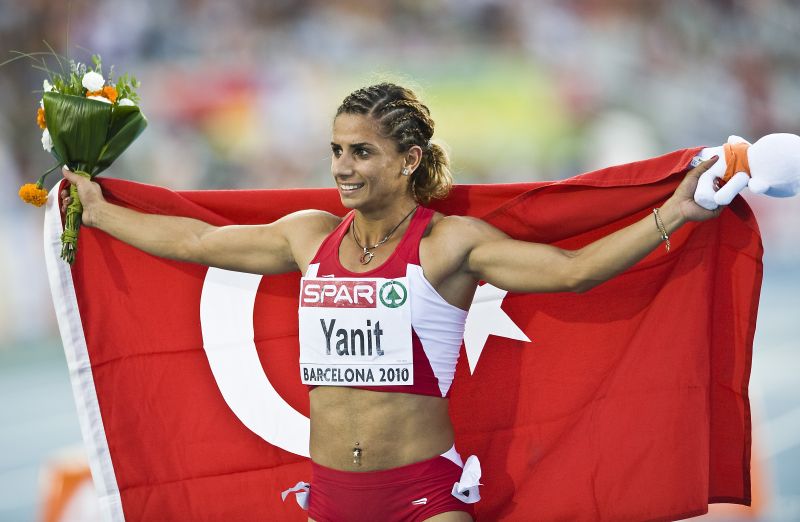
BARCELONA - Turkish athlete Elvan Abeylegesse won women's 10,000m at the European Athletics Championships at Barcelona's Olympic stadium.
Abeylegesse, Turkey's first world record holder, --at 5,000m in Bergen in 2004-- clinched Turkey's first gold medal at the championship on Wednesday.
Turkish athlete finished the race in 31 minutes 10.23 seconds, 12 seconds ahead of Russia's Inga Abitova. Portuguese runner Jessica Augusto finished in third place.
"I am now very happy to win the gold medal in 10,000m. I was a little bit afraid just before the race because of strong rivals and the wind. I have won silver in all previous races but today I won the gold," Elvan told the A.A after the race.
She also said that she had a minor injury in her foot and that she has not yet decided whether or not she would run 5,000m women's final.
Meanwhile, another Turkish athlete, Meryem Erdogan, came fifth in the race with her 31 minutes 44.86 seconds run
Source: http://www.aa.com.tr/index.php?option=com_haber&popup=hayrinti&haber_id=282386

ByLinus FernandesIt was a heady day in 2003, when Sania Mirza burst onto the stream of Indian sport consciousness, an awareness that if India were to ever have a world beater in an individual sport, it would not be a hirsute male, but a member of the weaker, fairer sex.
Sania Mirza erupted onto the scene like a long dormant volcano, heralding the birth of a new breed of Indian athletes, who not only excelled at their sport but were media savvy and clever enough to carve an image, a niche for themselves, in games other than cricket.
She was smart, she was intelligent, she was articulate, she was pretty, she was sexy, she was photogenic and she had attitude with a capital A. She carried off the anachronism of a nose ring with aplomb and style.
To top it all , she owned a killer forehand—the one that drew comparisons with her idol Steffi Graf —that was almost impossible to return when she dispatched the tennis ball with all the power and strength at her disposal. The forehand was flat and it was skiddy.
Sania Mirza had arrived on the stage of world tennis and Indian tennis would never be the same again. Or so we hoped.
Bouquets and Brickbats
We stood by her, we rooted for her, and we put up with all her shenanigans. We gathered around our television sets to cheer her every shot, her every return, her every serve.
She was the face of a modern India, a cosmopolitan India and most of all, she was a Muslim, a brave heart standing for progress contrasted against the conservatism and insularity of a minority community. She presented a brave new India; she had balls and she had gumption.
We craved learning what her T-shirts read; her sassy T-shirts hit the headlines as often as her brushes with the religious fanatics who chastised her for donning un-Islamic attire—mini-skirt and sleeveless vest—and being chummy with doubles partner Peer from the I of Israel. The evil I!
Some of her more interesting T-shirts needled "Well-behaved women rarely make history ," "I'm cute? No shit.," "Don't stand in my way," and "You can either agree with me, or be wrong."
This young tennis star, swimming in potential, was lapped up not just by the Indian media but by the international press as well. She appeared on the cover of Time magazine and was listed by the New Statesman as one among 10 youngsters who could change the world.
She happens to be the most searched Indian sportsperson on Google India ahead of Sachin Tendulkar, her appeal truly transcending notional, national boundaries.
She was hurt most when she was misquoted as endorsing pre-marital sex; a source of consternation for her in-the-know admirers as she came from a conservative Muslim background. Her choice of partners bears this out as she was first engaged to her cousin Sohrab Mirza but wed Shoaib Malik , a Pakistani cricketer . She has, of course, been linked to other sports stars and celebrities, the most notable being the dashing Yuvraj Singh, but then who believes the tabloids?
Tennis Career
Her singles career stats read 224-122 and she has one WTA title, the 2005 Hyderabad Open, and thirteen ITF titles in her singles kitty. She also enjoys playing doubles and has won eight WTA and four ITF tourneys. Her other sporting honors include a gold in mixed doubles, a silver in singles and a silver in team tennis all at the 2006 Doha Asian Games .
Her best singles performance in a Grand Slam has been a fourth round finish at the 2005 US Open.
The year 2007 was her finest one. She reached a career-high ranking of 27th. But over the years, her opponents have grown smarter; they wait and prey on her many errors. Her one-dimensional game was soon exposed; the mishits kept piling up as the rallies and matches grew longer.
Further, she was plagued by injuries, mostly to her wrist. Injuries that have dogged her more than any controversies.
She is not the fittest of players and she does seem to be carrying excess fat compared to the extremely fit and stronger players on the circuit. She is also just 5 ft. 8 inches, tall perhaps by Indian standards, but average compared to other players on the WTA tour. She, however, plays fearlessly and is not afraid to launch into her groundstrokes at the slightest opportunity.
Her finest hour, arguably, was the doubles championship she lifted at the Australian Open in 2009 in tandem with Mahesh Bhupathi. She is India’s foremost woman player ever and she cannot be blamed for not having an Indian tennis role model to emulate. She has blazed a path for Indian Eves and it is for them to take up the torch and surpass her, if they can.
A Second Coming?
Sania Mirza is not to be counted out yet. In her own words, she intends to give tennis a go for a couple of years following her recent marriage.
She has, just last week, had her best performance in recent times, reaching the final of the Aegon classic . That is not an achievement to be sneezed at, although the ITF and WTA tournaments are not on the same plane and Mirza was the top seed in the tournament. (Maria Sharapova too, on her recent return from injury, preferred to give the bigger tournaments a miss and participated in second-tier tournaments to regain her confidence and boost her points tally.)
Can Sania regain her lost glory? Can she arrest her slide?
Her current ranking is a dismal 142. Can she fulfill the promise she once displayed? Can she overcome her injuries and be the beacon for Indian women tennis players for some more years to come?
Or is she destined to follow the path of other Indian tennis players who have foregone any chances at personal glory and prefer their percentages in doubles? (If there is one thing I begrudge Leander and Mahesh, is that once they stumbled on the magic formula to lucre in doubles, it became an easy act to follow for the other tennis players from India.) Will Sania lose her way along the same route?
Only time will tell!
Source: http://bleacherreport.com/articles/425635-sania-mirza-whither-goest-thou