Showing posts with label Cycling. Show all posts

6/1/14

Iranian female junior cycling team wins first Asian medal


The Iranian female junior cycling team has created history in their country for winning
Bronze in 2014 Asian Cycling Championship in Astana, Kazakhstan on Monday, making their
mark in Asian cycling
This win has also marked the first Asian Championships medal by Iranian female
cyclists.
With this medal, Iran has received 6 medals, including 2 silvers and 4 bronze ones in the
2014 Asian Cycling Championships.
Photo taken from Josiah Ng’s Instagram: Follow him at @josiahcyclist
(http://instagram.com/josiahcyclist)
Source: http://www.baikbike.com/iranian-female-junior-cycling-team-wins-first-asian-medal/

3/14/14

Tour De Farm and BBQ: Join MADE’s first annual London to Oxford cycle ride

MADE in Europe is a Muslim youth-led organisation working to mobilise Muslim communities in the UK to live more ethically and sustainably. 

Join MADE for a 100km ride through the glorious Oxfordshire countryside to Willowbrook Farm ending with a delicious ethical BBQ of tayyib meat produced on the farm. Experience off­-the-grid sustainable living in action and explore Willowbrook Organic Farm, the UK’s first organic halal farm.

Get your friends and family to come along to spend the day on the farm and join you for the BBQ at the end of your journey. Everyone is welcome!

Please raise upwards of £100 for the cycle or just £12 for the farm visit and BBQ.   


Sarah Javaid
Executive Director


4/29/13

First Afghan Women's Cycling Team Sets Sights on Rio

There’s nothing like hopping on your bike for a sweat-drenching trek through the woods, cruise in the park, or ride around town—but would you risk your life for your two-wheeler? For women in Afghanistan, riding a bike is one step above committing a crime, but Shannon Galpin, founder of the nonprofit Mountain2Mountain and the 2013 National Geographic Adventurer of the Year, is hoping to change that.
When Galpin, a 38-year-old former Pilates instructor from Breckenridge, CO, learned about the war-torn country's first-ever national women's cycling team last fall, she immediately jumped at the chance to help out—after all, she became the first woman to mountain bike through the Afghan countryside in 2009.
So she’s helping supply the 45 young, budding road riders (they're all so new to cycling, they haven't even learned to clip in yet) with nutrition products, apparel, and gear, including 10 to 12 Liv/Giant road bikes this year. Galpin’s also making trips to Afghanistan to help local Coach Seddiq teach some skills to the 16- to 20-something-year-olds and to film “Afghan Cycles,” a 20-minute documentary about the women’s team directed by Sarah Menzies (check out their cool Kickstarter page).
Just hours before boarding a plane for her twelfth trip to Afghanistan, Galpin chatted with us about her mission and the girls’ chance to qualify for 2016 Olympics in Rio.
RELATED: Be inspired by eight women who shape the world.
SHAPE: What brought you to Afghanistan in the first place?
SHANNON GALPIN (SG): It's one of the worst places in the world to be a woman. I was unhappy with how I saw the conversation in Afghanistan developing between the Americans and Afghans, and I really wanted to change everyone's perception. At that point, I had worked around the world and I knew that I was really good at creating something from nothing, so I thought why don’t I? It was pretty much an overnight decision to launch Mountain2Mountain there six years ago.

SHAPE: Why biking?
SG: When I first started traveling to Afghanistan five years ago, there were no women biking. It wasn't even a thought. The bike came into play because I’m a mountain biker and it’s an incredibly beautiful country. I decided to push the gender barrier and ride a bike as a foreign woman to challenge the idea of what it is to be a woman. My actions ended up sparking conversations along the way. It was a great icebreaker, so I continued to ride every trip.

RELATED: The best advice 28 powerful women ever got can help give you the boost you need to start working toward your goals.
SHAPE: Did you have a hand in forming the national women's cycling team?
SG: No, and that’s the beauty of it—it’s fully Afghan-driven; it's not a Western project. I think they started about a year ago. My involvement is to look at what these women are doing and support them, as well as the men’s team. The stronger the men’s team is, the stronger the women’s team will be because they need the men’s team to help them break through. The women’s team is risking much more—this is a major taboo in their culture—but the men's team is paving the way for a brand new sport in a country that's all about soccer.

SHAPE: How has the Afghan community received the female cycling team so far?
SG: There’s no formal ban, but it's just that so few women ride. There’s too little encouragement and it’s culturally not acceptable: Riding a bike is essentially one step above the morality crimes that women are jailed for. It's worse than driving a car, which women have only just started to learn to do in Afghanistan. This is why we're planning to film these women in “Afghan Cycles.” We want to capture the back story of their motivation. They are literally risking their lives to ride a bike—something we take for granted. The women on this cycling team are willing to put themselves out there—on the frontlines—to start a movement. They will bear the weight of what is currently viewed as obscene, controversial, and offensive. These girls are trailblazers. They're braver than anyone I know. The least that we can do is support them.

SHAPE: How will going to the 2016 Olympics change things?
SG: If they go to the Olympics, it would be a very big thing in Afghanistan. There is such nationalistic pride for your athlete. Your whole country rallies behind you. It does not mean that it would suddenly become acceptable, but it's a starting point, for sure.

SHAPE: Think they have a real shot?
SG: It is a really short period of time to get ready, but there is a lot of support coming together right now from Mountain2Mountain, my connections in Colorado, and the International Olympic Committee. People from all over—including those who have worked with Olympians as well as Olympians themselves—are moved by these girls and starting to find ways to get more involved.

SHAPE: How can SHAPE readers help?
SG: We're trying to raise money (donate here!) to support the racing and traveling costs. But I understand that it may be a lot easier to collect gear than to raise donations. If you would like to donate cycling items—bikes (road and mountain), cleats/pedals combinations, shoes, indoor trainers, air pumps (standing and portable), rain jackets, sunglasses and helmets—please ship them to P.O. Box 7399, Breckenridge, CO 80424. That would be a huge help, thank you!

Photo credit: Claudia Lopez
Source: http://www.shape.com/blogs/shape-your-life/first-afghan-womens-cycling-team-sets-sights-rio

4/2/13

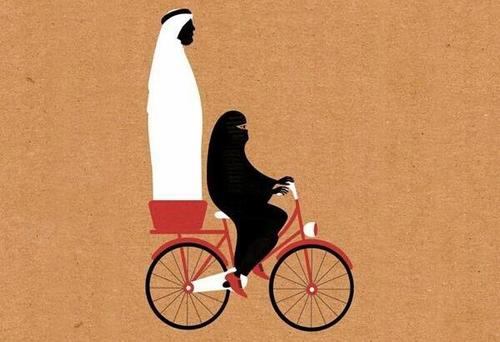
Saudi Arabia To Allow Women to Ride Bikes...for fun only.


BY: SHIREEN AHMED

Saudi Arabia has made more progress in women’s participation in athletics. This week they allowed Women’s Sports clubs despite previous concerns of girls exercising, potentially tearing their hymens.  

That Saudi women will be allowed to ride bicycles and motorbikes is fascinating and perhaps a sign of softening their conservative expectations of women’s behaviour and activity in public.

That female riders be modestly dressed and accompanied by a male relative is a requirement.
Could this be a step towards driving perhaps? Increased mobility and public exposure of women moving themselves, so to speak.
Furthermore, the bikes may only be used for entertainment purpose in park and not for, um, transportation. Yes, seriously.
I’m sure that getting from point A to point B for entertainment and pleasure only is exactly what the women riders are looking forward to.
Regardless of what triggered this new development in Saudi society, I look forward to seeing many women hit the road...for fun.
I wonder if helmets are a requirement...
Critical Mass anyone?


.

More on this story and the reactions from Saudi Arabia: http://stream.aljazeera.com/story/201304022007-0022651


9/2/11

An Invitation for Danish Muslim Sporty Women


Kære Stjerner og frivillige
Projekt Stjernerne fra Vollsmose er blevet en stor succes. I har gennemført et længerevarigt træningsprogram og har cyklet Fyn rundt på blot 5 dage. Vi ønsker nu at fremlægge resultaterne for samarbejdspartnerne, Stjernerne + jeres forældre og de frivillige.
I, og jeres familie er derfor inviteret til en fælles aftensmiddag fredag d.16.sept.11 kl. 16.30 i Kulturhuset i Vollsmose. Her kommer vi til at fremlægger projektets resultater og dele diplomer ud til jer.
Pga planlægning bedes i melde tilbage senest d. 05. sept. hvor mange i kommer.
mail til: safaa_abdol@hotmail.com eller ring på: 46 40 07 41
Vi ser frem til at se dig.
Photo: From Inaam Abou Khadra
_________________________________________________________
Programmet for dagen:
16.30 Velkomst. /v. Projektleder Safaa Abdol-Hamid
16.40 Åbningstale /v. Borgmester Anker Boye
16.50 Fremlæggelse af Max-test resultaterne. /v. Institut for idræt og biomekanik, Syddansk universitet Niels Christian
17.00 Derfor støtter Odense Kommune Stjernerne fra Vollsmose /v. Odense kommune, Cyklisternes By Elsebeth Gedde og Connie Juul
17.10 Den sociale udvikling og betydningen af dette i boligsociale områder. /v. beboerkonsulent Asmaa Abdol-Hamid
17.20 Videofilm
17.30 Diplomoverrækkelse til Stjernerne /v. Borgmester Anker Boye
18.05 Buffet
19.30 Farvel og tak

1/23/11

It’s Not “Lady-Like!” – Women’s Sport in Saudi


Written by Susie of Arabia from Mideast Post
An investigation is underway regarding a shocking and controversial sporting competition that was held recently in Jeddah. Shocking? Yes – because the event was for females (for shame!) and the event organizers failed to obtain prior approval from the Ministry of Education. Which begs the question: Are male sporting events subject to the same restrictions? Somehow I doubt it.
The illegal and contentious sporting event – thought to be the first of its kind in the Kingdom – was held on December 8th at Effat University and included competition in such “unlady-like” sports such as swimming, basketball, and badminton for some 200 young high school women representing six different Jeddah girls’ schools.
In the aftermath of the tournament, a member of the Board of Directors of one of the participating schools claims they had received more than 60 “anonymous” complaints about girls participating in sports.
All this commotion comes at the heels of another report out of Iran where a Muslim cleric condemned women’s sports and forbade Iranian females from participating in the Asian Games. He was quoted as saying that women’s sports are a product of the West’s “dirty” culture and should be shunned. I want to know, exactly what is “dirty” about women’s sports?
This was 2010, today it's 2011. It is common knowledge in this day and age that regular exercise promotes good health, weight control, and a sense of well-being. Yet for the girls and women of the kingdom, these facts don’t matter and aren’t considered important.
Last year I wrote about how the government cracked down on women’s gyms across Saudi Arabia, closing down countless women’s facilities if they were not properly licensed and if they were not affiliated with a hospital, while there are no such restrictions placed on men’s gyms. The closing of these facilities drove up membership costs and made it impossible for many Saudi women to be able to afford going to a gym. And it’s already hard enough for women to try to exercise in this country as it is. Women are forbidden from swimming (well they can, if they are fully covered), riding bicycles (too provocative as it reveals the female’s behind), or playing sports in public. Saudi Arabia has been long criticized for denying Saudi women from particpating in the Olympics and other sporting events.
Physical Education classes in girls’ schools are a very low priority. You won’t believe some of the ludicrous reasons given for why girls shouldn’t be allowed to participate in sports or exercise in school: The female hymen might break during exercise so the girl wouldn’t be considered a virgin anymore. “Good girls” would never disrobe outside their own home, not even to change into gym clothes at school. If girls did disrobe in front of other girls at school, they might get turned on and have nasty thoughts that they may want to act upon. I couldn’t make this stuff up if I tried!
All this craziness aside, women’s obesity is becoming a major health crisis here in Saudi Arabia, evident in the dramatic increases in diabetes, hypertension, depression, and other weight-related health issues. For the most part, women here lead a very sedentary lifestyle – many don’t even do any physical household chores because they have maids.
This antiquated mindset of restricting women from exercise and sports places Saudi Arabia way behind the times in promoting women’s health and well-being.

1/21/09

Qatar Launches Women’s Tour Event

PARIS, Jan 21, 2009 (AFP) - The Gulf state of Qatar will launch a women’s Tour event next month, bringing together 15 teams, including six national squads, and 90 riders.
The Ladies Tour of Qatar will run between February 8-10, following on from the Men’s Tour which runs from February 1-6.
Although 90 riders from 14 countries on five continents will gather for the three-stage race, there will be no local riders competing.
“A place for the women,” said Sheikh Khalid Bin Ali Abdulla al-Thani, head of the Qatari cycling federation.
“We hope to gradually develop women’s sport in Qatar,” Sheikh Khalid said, adding that the holding of the Tour event would be a “real boost” for women’s sport in the Muslim state.
Ladies Tour of Qatar teamsNuremberg (GER), Columbia (GER), Lotto (BEL), Giant (CHN), Flexpoint (NED), Leontien (NED), Selle Italia (ITA), Bigia (SUI), Cervelo (SUI); Australia, France, Italy, Japan, South Africa, United States
Source: http://www.bicycle.net/2009/qatar-launches-womens-tour-event

11/26/08

The No 1 Muslim Ladies' Cycling Club

Pull your brakes. Put your foot under. No, under. Set the pedal. Now release the brakes...” Most people remember learning to ride a bike. It is easier when you are 5 and not wearing a full hijab. It is also easier when small boys are not whizzing past on mini-BMXs laughing at you as their parents, on the way to Saturday morning shopping, stare and mutter under their breath.
The participants in Britain's only known Muslim women's cycling club are having their weekly lesson in a small park close to the East London mosque. “Most have never ridden,” says Erika Severina, their cycling instructor. “Some make excuses, such as saying their clothes aren't suitable, but we've found bikes to accommodate that. Others don't want to ride outside. But now we've got them in parks and on back roads.”
Learning to ride turns out to be one of the lesser hurdles the group faces. Women from other backgrounds and faiths have taken part, but most are religiously observant Muslims and wear full Islamic dress. The group was formed shortly before the July 7 bombings in 2005 - and in the aftermath it was not an easy time to take to the streets of London clad in a veil.
Even more off-putting is the significant disapproval the women face from their own community. “Women should not be riding bikes. They are stimulating themselves. If they want to stimulate themselves they should get a man,” says one Asian market trader on the pavement outside the Jagonari Women's Educational and Resource Centre in Whitechapel, where the cycling group is based.
Jagonari is Bengali for “Women wake up”, but most of the local men appear to believe that women have woken up far too much. A common sentiment - perhaps held by men generally - is that a woman in charge of a bicycle is a dangerous proposition. “They're bad enough in cars,” other men in the street agree.
Nurjahan Khatun, the director of the Jagonari Centre, and founder of the cycling project, points out that “there's nothing in the Koran to say that women shouldn't ride bikes”. Despite this, various postings on Muslim websites debate the point and the cultural barriers are strong.
The Jagonari Centre is in the heart of Bengali East London. A few miles away, the London 2012 Olympic site is under construction at Stratford, but comparatively few local girls and women from the Bengali community take part in sport. A 2006 report for Sport England found that only 19 per cent of Indian and Bengali women took part in any sport, compared with 31 per cent for women nationwide.
Alema, 19, is the co-ordinator of the cycling group. “It's always the boys and their bikes,” she says. Her father is an Indian chef and the family lives in Woodford, Essex. She has just started a BA in economics and politics at Goldsmiths University of London, in New Cross. “My parents never said ‘You can't have a bike'. I never asked them. I once rode my cousin's bike in Sheffield and I loved it. I rode for three hours non-stop, I didn't want to get off.”
Like many of the younger women in the group, Alema has a Westernised lifestyle and goes rock climbing and camping. But she also takes a more active interest in her religion than the older, more socially conservative, women who attend the Jagonari Centre. She wears the hijab scarf and the jilbab, a long black dress, and says that she became interested in Islam after 9/11. “I didn't know anything about Islam, but people started to say negative things about it, so I felt I had to find out the truth.”
She is considering wearing a face veil, and is not put off by her parents' concern that it will attract negative attention. “This life is full of thorns, the next life is Paradise. So if you want to wear a veil, it's going to be a struggle - but this life is supposed to be about struggle.”
Like other women in the group, however, she says that the best thing about riding a bike is “freedom”.
“You don't see many women out cycling, especially in the hijab,” says Rajana, who is in her twenties and likes to ride the biggest, raciest bike in the group. “I'm a bit of a rebel,” she says.
The other women learn on foldaway bikes with low crossbars to accommodate traditional garments. Various pins and clips are used to stop their long loose clothes getting caught in gears and spokes. Underneath many of the women are wearing fashionable shoes, or flipflops and have painted toenails. They look rather immaculate compared with the cycling instructor, who is wearing fingerless gloves, shorts and torn fishnet tights.
When the group started, the women rode large cumbersome Dutch bikes, turning tight circles in the tiny closed-off courtyard behind the centre. Now their confidence has grown and the women have already taken part in group rides in Hyde Park and past the Houses of Parliament.
“When I started the project it was because I had really wanted to learn to ride when I went to university at Cambridge, but I didn't have the nerve,” Khatun says. “I started the cycling group and expected young girls to come along, yet what's really surprised me was how many older women wanted to take part as well.”
With low levels of English, older Bengali women have traditionally been one of the hardest ethnic groups to reach. But these are the women who attend the Jagonari Centre to talk to their friends and take part in activities.
Naz is one such lady, whose commitment to cycling has been dedicated, despite slow progress. She struggles with her knees and finds it hard to work the pedals. At her weekly session the cycling instructor is holding her on with one hand while propelling her along a path with the other. Two other members of the group are watching.
“She is having problems with the circling,” says one. “It's the turning,” the other agrees.
“I'm just frightened I will veer off and hit someone,” Naz tells the instructor.
She appears to be making a beeline for an alarmed group of local drinkers, lounging on the grass.
“Do you know how not to hit someone?” the instructor asks the group.
After some thought one pipes up “Brakes?”
“My son has told me to get some stabilisers,” Naz says, both relieved and disappointed to have finished her lesson. She came to England from Pakistan as a young woman, but while her husband works in America she lives in East London with her grown-up son, who is an avid cyclist. “He loved riding his bike when he was a little boy. It would not have occurred to me to have a bike. But now he is supporting his old mum.”
Most of the women say that their husbands and sons are more bemused by their new hobby, rather than opposed to it - although the cycling group had one member who cycled in secret because she feared her father's disapproval.
Since the group began three years ago, it has seen dozens of women progress from wobbly beginnings to more confident riding, with a little independence thrown in. Khatun is proud that her project has borne unexpected fruit and encouraged the kind of “active citizenship” of which the Home Office would no doubt approve.
On a late Saturday morning session, the younger girls of the club meet and cycle along the backroads of East London to Mile End Park. There they fly up and down paths, rashly ignore instructions about braking and signalling - and cheer on impromptu races across the grass.
Naz is there too - casting an elder stateswoman's eye over proceedings and tutting occasionally, but generally enjoying the atmosphere. They may be the only Muslim women's cycling club in the country - and an excellent example of active citizenship and community engagement - but for that morning at least they look just like carefree girls.