Showing posts with label UAE. Show all posts

1/27/13

Arab Women Springing.... into Football Stadiums for Gulf Cup of Nations


BY: SHIREEN AHMED

Bahrain recently hosted the 21st Gulf Cup of Nations. A grand tournament involving eight teams from the Middle East.
The Emirati victors beat the talented Iraqi squad for a 2-1 win. They emerged glorious and jubilant. A nation of fans cheering wildly and supporting them.

Among those fans were, for the first time, women.
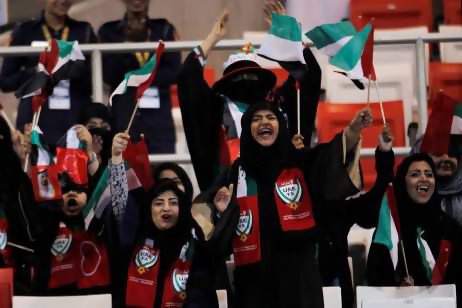

The semi-final match between the UAE team and Bahrain’s home team was one of the first
international matches to host women in a Gulf state.

For reasons cited as safety concerns, male chaperones required as well as years of tradition and inaccessibility, women have not gone to cheer football teams.

But times are changing and no more than in these conservative, Muslim countries.
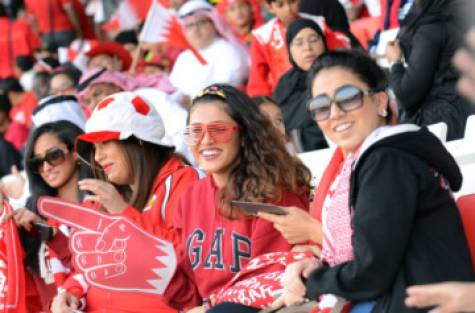
Women and girls are openly displaying their interest in and allegiance to their national teams.

In the final match between Iraq and UAE, 50 places were arranged on six different flights for women and their chaperones. This initiative was taken on by Nasreen Ali Darwish of the UAE Cycling Federation. She contacted the Emirati Football Association and reserved the places.
There was no hesitation on the part of the Football organization and the supporters flew to Bahrain with their fellow fans.

That women can share in the excitement, moment and joy of an important regional football tournament is unprecedented.

Currently, in the Middle East many stadiums are still considered to be a man’s domain.
In Iran, it is illegal, not just culturally and socially unacceptable, for women to attend football matches or even televised events in public.
This issue isn’t only about cultural inequality or traditional gender roles, it is about national pride: “Sport makes everyone connect as it is a mutual language for everyone," says Dr. Ahmad Alomosh, a Sociologist at University of Sharjah "A victory for a national team is bound to enhance national identity and unite people”.
Dr.Almosh also contends that publicly cheering sports teams represents a “natural progression of Emirati women’s role in society”.
In addition to the legions of female supporters in the Middle East, the are numerous critics of these supporters.
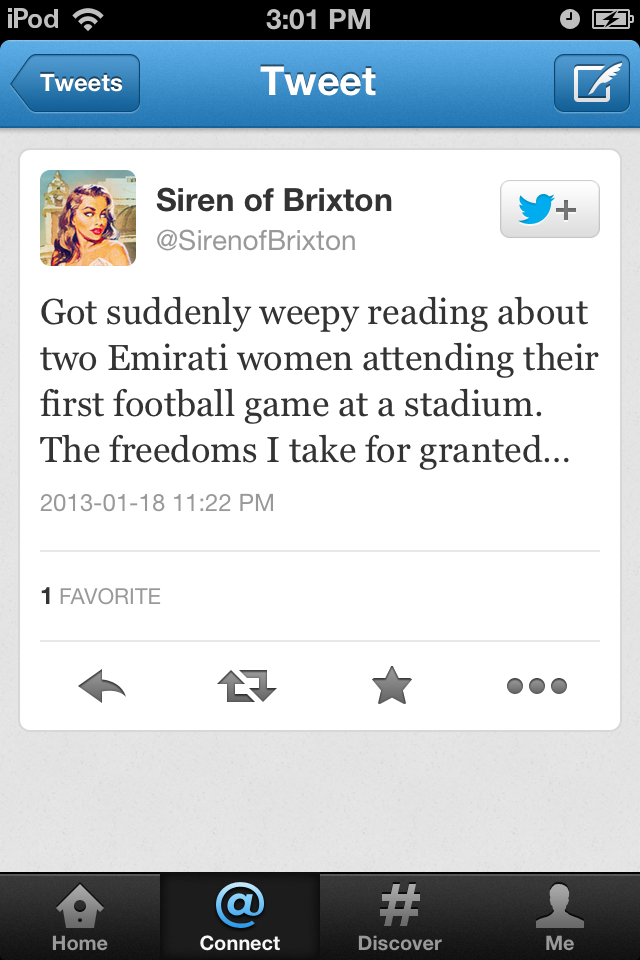
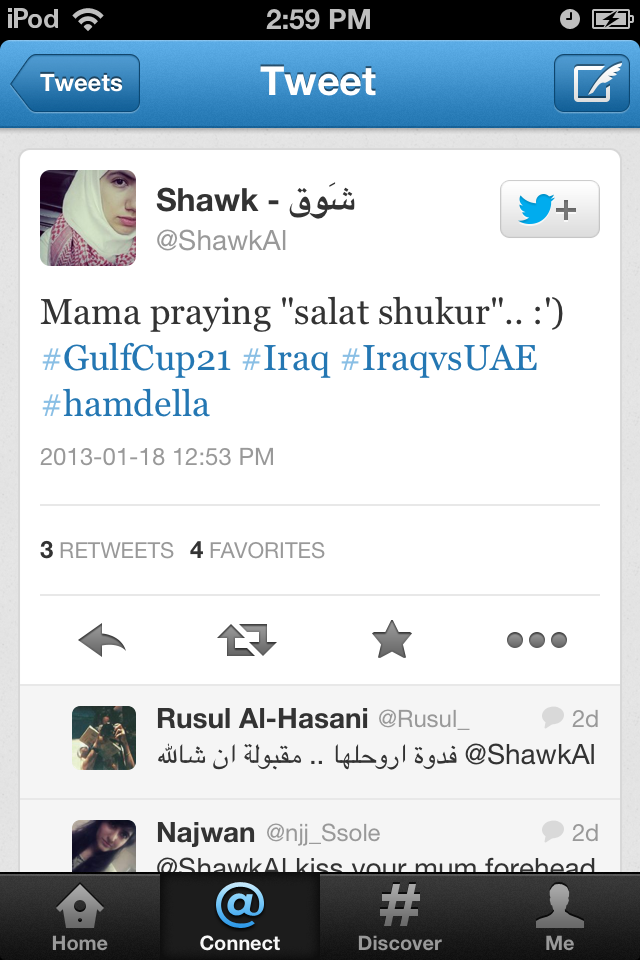
Twitter was ablaze with debate and discussion regarding the “bold” move of many women to travel outside of their country to support a team.

One twitter user stated: “It is sad to see the UAEFA encourages women to unveil and discard their decency under the flag of supportiveness”.
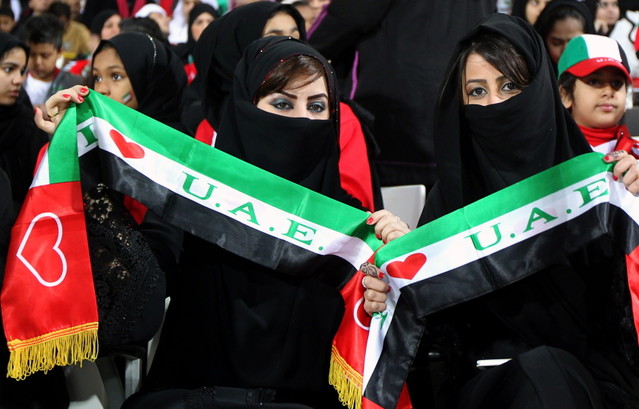

It should be noted that a lot of the women were dressed in long-sleeved t-shirts or long robes with some choosing to wear a headscarf (hijab). It is not required by law in Bahrain.

User @bomoath75 insisted that women at a match would “lose the spirit of modesty and chastity”.
As a footballer, a spirited fan and a woman,  I totally am unclear how chastity can be compromised by waving a flag in the stands.

Interestingly, women are also of this opinion. Twitter user @jumaira_ wrote that this idea was "foreign and alien to what we are used to and will distort the image of our country".

For some the option for women to stay and home and watch the matches is a valid one.
That these female supporters -gasp!- travel outside of the country to a neighouring one is unfathomable. Women engaging in loud cheering, whistling and clapping may be horrifying and what ultra-conservative folks think is the degradation of women’s expected responsible behaviour.
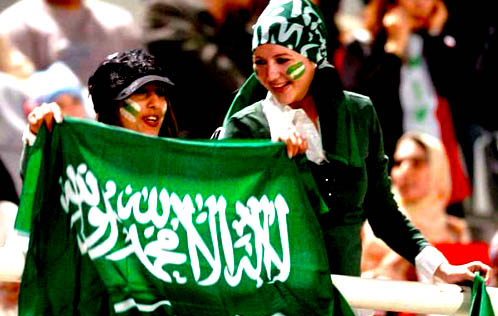

Or it could just be that there is a rise in interest in football among women where there may not have been previously. That girls are not just watching their brothers play but are healthy, active and confidently engaging in sport. That is is the most watched sport in the world and that stadiums are creating family spaces, clean washrooms and controlling amount of hooliganism that occurs is good for all involved.

A safe space for football is a critical one.

Almost one quarter of football matches in some parts of Europe are women. They have the resources and interest to participate in Fantasy Leagues, they attend matches and purchase kits and invest in heavily in team spirit.

Most are cognizant of that privilege - although it ought to be a right. The right to safety, hope and participation. It is widely known that women in some parts of the Middle East can not drive or travel without a male relative. But that they may not be welcome in stadiums to simply watch a game is unfathomable.


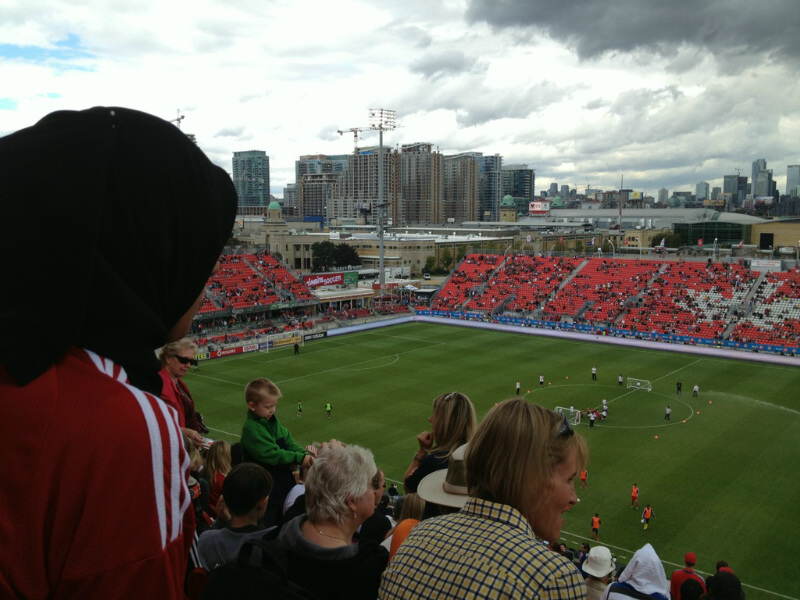
Most recently there had been a picture of a Muslim female fan in Bradford, England that went viral. This picture was important for many reasons. Firstly, it debunked the myth that women in hijab may not care for football. Second, it showed that there is a place for inclusion and ardent team loyalty from women regardless of race, religion.

This is an important parallel to the current issue in the Middle East. Women are making choices. They are working, earning, raising football lovers - both girls and boys- and to partake in football can only strengthen community bonds.

Not to mention that creating lines of sports apparel and merchandise catering to female fans in the Gulf states could be a very, very lucrative initiative. Would be very enticing for clubs to venture into this specialized area.

Women are ferocious and vocal supporters of football clubs. They have been for a long time in various ways. Some pray, some scream, some cheer and all are intense.


One of the most conservative Muslim countries, Saudi Arabia has begun construction of a new soccer arena in Jeddah that will be able to accommodate families, and female journalists and fans. Previously women were not permitted to attend due to a law barring men and women from mingling in public.

Football is the game of the world. It is not a novel idea that women of all ages and backgrounds would be interested in it. Even those from the Middle East.


Overall, the tone is of triumph, happiness. And women should partake in this joy.

There is a lot of work to be done to solidify systematic equality, safety and opportunity for girls and women in education, workplace and in community.

A football stadium is positive place to keep the momentum going. The road to empowerment of women is a long one; it even runs along the pitch.

I will for one be watching, and cheering and supporting the right to participate of these intrepid women just as I cheer at matches.


1/14/13

Middle East Football Association Campaign for women's right to play

By James M. Dorsey
Middle Eastern soccer associations have launched a campaign to put women’s soccer on par with men’s football in a region in which a woman’s right to play and pursue an athletic career remains controversial and at a time at which political Islam is on the rise.
The associations announced the campaign at the end of a two-day seminar in the Jordanian capital Amman organized by the West Asian Football Federation (WAFF) and the Asian Football Development Project (AFDP). Glaringly absent among the representatives of the 13 Middle Eastern WAFF members was Saudi Arabia where women’s soccer exists at best in a political and legal nether land as well as Yemen.
The campaign comes as women are demanding greater rights in a part of the world that has entered a period of dramatic political and social change. Popular revolts in the past two years have toppled the autocratic leaders of Tunisia, Egypt, Libya and Yemen, sparked a bloody civil war in Syria and prompted numerous other states to adopt policies designed to shield themselves against a wave of protest that is unlikely to leave any Middle Eastern nation untouched.
A statement at the end of the seminar chaired by FIFA Vice President and AFDP Chairman Prince Ali Bin Al Hussein defined “an athletic woman” as “an empowered woman who further empowers her community.” In a rebuttal of opposition to women’s soccer among some Islamists across the region and more conservative segments of Middle Eastern society the seminar stressed that women’s soccer did not demean cultural and traditional values.
In doing so, the associations backed by representatives of the United Nations, the Union of European Football Associations (UEFA), the Asian Football Confederation (AFC), and the English Football Association, put themselves at the forefront of efforts to secure equality and women’s rights. The seminar’s statement emphasized the right of women to play soccer irrespective of culture, religion and race; a women’s right to opt for soccer as a career rather than only as a sport; and soccer’s ability to promote gender equality and level the playing field on and off the pitch.
The statement called further for the appointment of women to the boards of WAFF member associations, establishment of a WAFF women’s committee, creation of Under-16 and Under-19 women competitions in the Middle East (West Asia) as well as the compulsory rotation of hosting of subsidized WAFF women competitions.
With Saudi Arabia unlikely to comply with the initiative, It was not immediately clear whether member associations who refused to participate would be sanctioned, and if so, how. The statement, however, singled out Saudi Arabia by explicitly stating that the kingdom would be included in women’s tournaments. The statement said it would kick start its campaign with a WAFF Girls Football Festival on International Women’s Day on March 8.
In campaigning for women’s rights, WAFF has its work cut out for it not only with regard to Saudi Arabia but also in relation to many of its members who did sign on to the focus on women. “Female athletes in the Middle East face pressures that include family, religion, politics, and culture,” said a recent study entitled ‘Muslim Female Athletes and the Hijab’ by Geoff Harkness, a sociologist at Northwestern University’s campus in Qatar, and one of his basketball playing students, Samira Islam.
Resistance to women’s sports is moreover not restricted to Muslims in the Middle East and North Africa. Palestine’s women soccer team includes 14 Christians and only four Muslims but a majority of the team has similar tales to tell about the obstacles they needed to overcome and the initial resistance they met from their families.
Human Rights Watch last year accused Saudi Arabia of kowtowing to assertions by the country's powerful conservative Muslim clerics that female sports constitute "steps of the devil" that will encourage immorality and reduce women's chances of meeting the requirements for marriage. The group’s charges contained in a report entitled “’Steps of the Devil’ came on the heels of the kingdom backtracking on a plan to build its first stadium especially designed to allow women who are currently barred from attending soccer matches because of the kingdom’s strict public gender segregation to watch games. The planned stadium was supposed to open in 2014.
Saudi Arabia, which does not have physical education for girls in schools and has hired consultants to draft its first ever five-year national sports plan but for men only, bowed to pressure last year to field for the first time ever women athletes at an international tournament, the London Olympics. It did so by fielding two expatriate Saudi females.
Women nonetheless play an important role in sporadic anti-government protests in Saudi Arabia, a country where discontent is simmering at the surface. Authorities earlier this month arrested 18 women in Buraida, a bulwark of Wahhabism, Saudi Arabia’s puritan interpretation of Islam, who were protesting the long-term detention of relatives without charges on suspicion of terrorism.
Women in Iran have the right to play provided their uniforms are compliant with Islamic precepts but like in Saudi Arabia are also barred from attending matches in all-men stadiums as spectators. Two women highlighted the issue during a World Cup qualifier last year when they smuggled themselves into the stadium dressed as men only to reveal themselves publicly after the match.
For their part, Kuwaiti Islamists denounced the Gulf University for Science and Technology’s organization of a soccer tournament for Gulf women teams. “Women playing football is unacceptable and contrary to human nature and good customs. The government has to step in and drop the tournament,” Kuwait’s Al Wasat newspaper quoted member of parliament Waleed al-Tabtabai as saying at the time.
Mr. Tabtabai was one of a number of deputies who earlier criticized the government and sports executives for allowing the Kuwaiti women’s national soccer team to take part in the Third West Asian Women Soccer Tournament in Abu Dhabi. The members of parliament charged that the women’s participation had been illegal and a waste of money. “Football is not meant for women, anyway,” Mr. Tabtabai said.
Prince Ali has however put conservatives on the defensive with his successful campaign last year to get FIFA to agree to observant Muslim soccer players wearing a headdress that complies with Islamic precepts as well as the world soccer body’s safety and security standards. The move set the stage for the WAFF campaign by taking away one major obstacle to women’s sports having the same status of the athletic endeavors of men.
James M. Dorsey is a senior fellow at the S. Rajaratnam School of International Studies, co-director of the University of Wuerzburg’s Institute for Fan Culture, and the author of The Turbulent World of Middle East Soccer blog

10/30/12

UAE defeat Palestine in AFC pre-qualifying game.


Bethlehem: AFC Women's Asian Cup 2014 qualification hopefuls Palestine went down to a 4-2 home defeat to the UAE in an international friendly at the Al Khader Stadium.
The UAE dominated the first-half and were 3-0 up after 34 minutes played, with Sara Muhammed adding to goals from Dalila Zarouqui (12th) and Iman Tarouda (16th).

The Palestinians rallied and went into the interval trailing by just one goal courtesy of a 37th minute Walaa Hussein effort and a Karol Sahejan strike one minute before the half-time whistle but their efforts turned out to be in vain as Tarouda scored her second and the UAE's fourth and final goal in the 62nd minute.

Palestine are in Group D of the 2014 AFC Women's Asian Cup qualifiers alongside Myanmar, Chinese Taipei and India with the match schedules to be announced soon.


Source: Women's Soccer United