Showing posts with label FIFA. Show all posts

3/10/13

Québec Soccer Federation Finally Allowing Hijab on Pitch


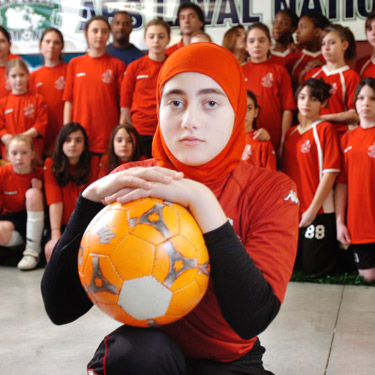
Finally, the Québec Soccer Federation has agreed to allow hijab on the soccer pitch. The ruling commission of International Football IFAB (International Football Association Board) had already agreed to reconsider the 2007 ban in July 2012. They further confirmed in November 2012 that they approved a prototype by Resport On by designer Ilham Sayyed from Montreal.

This is an important development for soccer in Canada and for Women and girls in Sport.
It cuts to the root of exclusion and discrimination on the pitch in .
Unlike Ontario, British Columbia, Nova Scotia and most other Canadian provinces with solid soccer traditions, Québec was one of the only provinces that waited for so long and for preliminary IFAB approval to allow players to wear headscarves.
Initially, the issue of hijab youth soccer was thrust into media attention when Azmahan Mansour of Ottawa was visiting Québec for a football tournament and was told to take off her hijab for safety reasons.
Mansour had never had issues playing with hijab in her home province of Ontario.
Her coach withdrew from the tournament in protest, as did four other teams.
Conversely, a spokesperson from Canadian Soccer Association (CSA) stated that "there is no official rule barring girls from wearing hijab". But each province has their own regulating body and is not required to defer to CSA.
(Asmahan Mansour 2007)

What ensued was FIFA declaring that the final say would be up to the officials as there was no specific law banning hijab specifically. QSF embraced this and advised Referees accordingly. Most of whom would not let players play in headgear.
In football, a referee's decision is final. It can not be appealed if it is made in clear judgement and the referee has strong precedent  to make the call.
In Mansour's case, the referee who barred her was Muslim (non hijab-wearing) causing more confusion for those trying to grasp the situation.
Following the heartbreak of the Iranian Women's team who were disqualified from qualifying matches for London 2012 Olympics as for playing wih hijab, In early 2012, Prince Ali Bin Hussein the FIFA vice-President representing Asia, presented a prototype hijab that would satisfy medical requirements of IFAB in order to allow women and girls in hijab to play safely.
This initiative was also supported by the Association of Professional Football Players (FIFPro). Read their statement: http://www.fifpro.org/news/news_details/1857
IFAB agreed to lift the ban and more consideration of the hijab pending approval by a medical team. A welcome and incredible event in the lives of so many women and girls footballers.
And the rest was history.
Except in Québec.
The French in  have been accused of xenophobia with regards to their policies and "values". Including allowing any type of religious headgear on the pitch, including sikh turbans as well as another highly ill-timed case of ejecting a 9 year-old player with  hijab just days after IFAB's initial decision to consider a Resport-On design.
Sadly the issue of  said “values” not only translated to exclusion for players but for referees as well. In 2011, a qualified referee was told she could not officiate because of her hijab in Québec.
A member of Parti Québecois (at the time the ruling party in Québec) publicly stated: "Religious freedom exists, but there are other values. For instance, multiculturalism is not a Québec value. It may be a Canadian one, but it is not a Québec one."
Similarly, across the Atlantic ocean, France seems to agree with it's descendants in Canada. Although IFAB lifted the hijab ban, the French Football Federation (FFF) also declared they would be upholding the hijab-ban for their players "in the name of universal and republican values".
That QSF has now relented and will allow girls and women in headscarves to participate is a huge victory considering the immense and heated debate over "reasonable accommodation" in the province.
Now that there is a solution to include women and girls into competitive and recreational levels of play in Québec, which has always carried a strong development program for children and youth, the result is inevitable: "More children will play".
That is a win for the players, clubs, officials and the beautiful game.  


originally published: http://footybedsheets.tumblr.com/post/45031122668/quebec-soccer-federation-finally-allowing-hijab-on

11/2/12

Unveiling Hijab on the Pitch- FIFA approves headscarf design.

Unveiling Hijab on the Pitch
BY:SHIREEN AHMED
This morning I woke up to find out that a design submitted by designer in Montreal Elham Sayed Javad was accepted by IFAB as an acceptable FIFA-approved model for a headscarf.
This means that we may soon be seeing hijabs on the pitch. It will open up the doors of competition and inclusion for thousands of potential footballers and extend opportunity for existing players.
I have been playing football for almost 30 years.This decision is a victory for me, my daughter and her daughters. 
It is also a victory for the sport.
Football is a game that unites countries in turmoil, strangers in fandom and creates development and cooperation between nations and communities that may not otherwise have a connection. 
Most important is signifies the importance of choice. If a woman wishes to wear hijab and still participate at a high level, she is not restricted from doing so.
The world is abuzz with many people philisophizing and making assumptions about women in hijab. There are questions to its’ relevance in this country, the impositions of the Eastern world and its’ representation of patriarchy and oppression. 
The core issue of hijab in football isn’t about religion. It’s about opportunity, right to wear and respect.
Whether a player wears a turban, is adorned with tattoos of the Holy Trinity or wears a Star of David is quite frankly irrelevant.
Their personal choice to believe in a faith and practice can not be a reason to eliminate them from play. Particularly now that there has been a hijab-designed to meet all safety criteria that IFAB requires.
My football uniform consists of my hijab as much as it does my jersey and my boots. I don’t use pins - just a stretchable cotton with another piece underneath, so my current club allowed me to play. 
I even bought a branded athletic shirt and stitched it to my liking as the material had wicking fabric suitable for intense matches.
For a very long time after I chose to wear hijab, I was excluded from playing in regular FIFA  and Canadian Soccer Association sanctioned-clubs. Most local clubs decided to avoid the issue and although they were independent, FIFA said “NO” so they could do the same. They cited various reasons; everything from players safety to non-permissibility of religious symbols to simply ‘we aren’t sure- so no’. Some clubs decided it was up to the referee to decide leaving players and teams quite frustrated without a firm answer.
Each provincial football body may have varying levels of deference to FIFA’s hijab ban which was strictly imposed in 2007 as a neck-safety precaution. Many argue Law 4 of FIFA it is about racism and xenophobia as opposed to safety.
Thankfully, I found a fantastic club in my area devoted to Youth Soccerand eventually I became the convener for the women’s division. There was all level of skill- ranging from varsity elite to beginner.
Because there were no restriction on type of hijab, many different women decided to join. They felt less judged and accepted. No concerns regarding eligibility due to hijab. 
For those who are much more competitive and looking for serious football, it may have been frustrating at times. A good run in an enjoyable environment but not the full organization and competition they may have craved. But the only option available. Not anymore thanks to ResportOn’s Pro Release design. It uses tiny magnets that can be released quickly, as opposed to velcro and uses dry fit materials. It has met all medical standards and criteria by IFAB.
The prototype of this headscarf was thoroughly researched, tested and re-tested. It is also affordable.
I had a few concerns regarding the initial IFAB approval. One of which was accessibility and price.
Had the scarf been designed by a large multinational company, then the product may have been too expensive for a young girl to purchase. That would had further isolated many girls from communities. Thus creating an atmosphere of privilege. 
Thus far ResportON hijabs are approx $60 CDN. Hopefully the price for the new design will not be much higher. For highly competitive Muslim athletes, that can be considered as necessary as their football boots and shin guards; a part of their kit. Not a clothing item that would have to be purchased too frequently- depending on the amount of play and product care. 
A large company may have tried to sell the hijab at a high-end price rendering the product which is suppose to include a minority football playing demographic, unattainable.
Another issue of concern would be whether now that a specific hijab is permitted on-field, 
would all Muslim players representing Muslim countries be required or expected to wear it?
Part of the philosophy of women in sport is choice, freedom and the health benefits of play.
Forcing a woman to wear a headscarf because it is permissible by FIFA rules, would go against the spirit of women playing football.
The importance of choice whether it be to play or to wear hijab are inextricably linked. 
The operative word being choice.
Now many more women around the world from varying parts will be able to represent their country in international play. The do not have to feel they have to choose between observing a part of their faith they feel is mandatory or choosing their passion for football.
There are Muslim women participating at International levels but until now, they were not permitted to play in FIFA sanctioned tournaments or games wearing a headscarf.
The result of that was equating hijab with an inability to advance to the highest level of women’s football in the world. 
When FIFA issues a formal statement and introduction of said hijab, smaller clubs, national and provincial Football Organizations should follow suit and adopt a policy that they disregarded or previously avoided delving into.
Hijab-wearing women could represent Iran, Canada, France, Germany, England, Turkey, China, Afghanistan and even the United States at high levels.
It will allow give way to younger girls and women being allowed to play in recreational and /or in semi-competitive leagues. It will open the idea to have women participate and join in whereby living fuller, healthier lifestyles and sharing interests.
The fact that will be far more women at trials for various clubs and communities is hugely important. Increases competition and awareness of equality within sport. 
The optics of a Muslim women competing is a powerful thing. This summer the London Olympics had many Muslim women represented as participants. In fact it was the first time every nation competing had females athletes- including Muslim countries that had previously not had female competitors.
Now many Muslim countries can compete with full squads in football to what has already become an incredibly exciting sport to watch. 
Canada is hosting the Women’s World Cup in 2015. It will be a time of excitement, welcome and more attention to the World’s game- particularly the Women’s game.  At that point FIFA would have fully allowed the participation of strong teams on which players wear hijab: Egypt, Iran, Yemen; rendering this a more inclusive, open and accessible sport.
I wait for a final statement from IFAB with some trepidation.
The implications of this are huge for women in the world today. Many footballers will not have to watch from the sidelines anymore.
To have Muslim women participate in the beautiful game, the world’s most popular sport, shall only heighten the majesty of the world of football which may now include all types of women- hijabi footballers included.

11/1/12

FIFA decides on Hijab Design

Football's world governing body FIFA met to decide the design of the official hijab for women.
The traditional Islamic headscarf was approved for use in July by the governing body, allowing women to wear a sport-specific headscarf. 
And there has been a competition on how the hijabs will look like.
This interview takes place before the decision with Montreal based fashion designer Elham Sayed Javad hopes  her design, one of the two studied  on soccer fields around the world, gets the approval.
Today she announced the good news with her fans that one of her designs receives approval.
Javad called her prototype's role in the decision the "biggest thing that I could have achieved".
Her soccer hijab uses a custom-made magnetic system that allows it to be opened and released instantly, if the headscarf is pulled from anywhere around the neck.
Al Jazeera's Daniel Lak reports from Montreal.

10/21/12

Play like a Girl in Iran... just don't watch like one.

BY: SHIREEN AHMED
The colourful world of football is composed of players, coaches, teams and most importantly fans. The loyalty and passion of global football fans is unparalleled. Their energy, support are motivating factors for the players and their presence at matches is an important indicator on the overall success of clubs.

Football fandom is so important and ingrained in society that there are organizations created to represent the right of supporters and fans to lower ticket prices, safe standing and protection of clubs.
The world is abuzz with excitement as the World Cup Brazil 2014 qualifying matches are underway. This past week one of the qualifying matches caught some attention. Iran played South Korea and won 1-0.
Iran is one of the tops teams in Group A of the Asian Football Confederation and are ranked 54 by FIFA’s ranking. Crowds in Tehran were almost at 80,000 at Azadi Stadium and elated that their team had defeated a team that is ranked much higher (South Korea 28).
Iranian nationals are passionate about football. Along with wrestling and volleyball it is the most popular sport. They flock to the matches and celebrate accordingly. They are allowed to rejoice in the jubilant atmosphere- unless they are Iranian women.
Women have been banned from watching live matches in public since the Iranian Revolution in 1979. They have been relegated to staying at home and supporting the teams in private.
Most recently Iranian women were not allowed to watch any Euro Cup 2012 matches that were screened publicly. This heightens a level of frustration among a large part of the population already struggling with image and regulations in Iran.
Despite the impermissibility, after the match there was a media release of two women dressing up as men in order to attend the Iran-Korea game with male relatives. They posted pictures and added a video of match highlights. This issue is of utmost importance as it clearly denotes that in order for women to partake in something that most cultures consider a gender neutral normal activity, they must be identifiable as men. In most other Muslim countries women are allowed and do attend attend matches in public. Often they may be harassed or leered at (another patriarchal societal ill) but they are not punishable by law.
When Iran beat Japan and qualified for the World Cup in 2006, many women defied policy and tried to enter the stadium forcefully clashing with police. The stadium was filled to capacity (100,000) and rejoiced in the win. Women danced in the streets and the strict Islamic Police were far more lenient during the celebrations.
One of the most ardent supporters of female supporters’ right to access public stadiums is President Mahmoud Ahmadinejad. In his first term in office in 2006 he tried unsuccessfully to change a law allowing women to attend stadium matches and watch football in public areas.
The reason given by the president seems to have been intended to placate hardliners. "The presence of women and families in public places promotes chastity," he said. As a football-adoring man, he has lobbied and been an outspoken voice for allowing women to watch matches since taking office.
Clerics have rebuffed his efforts and stated that “It was un-Islamic for a woman to look at a strange man’s leg- even if she doesn’t take pleasure from it”. Stadiums are said to be filled with rowdy fan using profanity and inappropriate language. The decision to ban women was explained as a “protection” for them.
Fierce debate ensued and finally Iran’s Supreme Leader Ayatollah Ali Khamenei ruled in favour of the clerics’ decision.
In many countries around the world a citizens’ patriotic connection is directly correlated to their unwavering support National Sports Teams. Politics and divisions may create cleavages in a society but one thing in common is unbridled passion for the home country team to succeed.
Ironically, women in Iran have won the fight to play football and represent their country wearing hijabs as part of their uniform. In Iran they are permitted to play games without men on-site on quality fields. They have hosted international matches in Tehran against other teams. Iranian Women’s national football team is very supported in Iran and has strong governmental support for development. A new Azadiye Stadium was to be completed in 20120 in Tehran to support the advancement of women’s soccer in Iran.
Iran lobbied strongly for FIFA to lift a hijab ban which prevented the women’s team  from qualifying for the London 2012 Olympics. They suited up in specially designed kits with modified hijabs caps without covering their necks. So, women in Iran are encouraged to play football but not to watch men play it.
More frustrating is that non_Iranian women are allowed to attend the matches at Azadi stadium. There were Korean female supporters at the match adding to the fury of Iranian women.  
Iranian women can enjoy the sport shrouded at home but can not translate their passion into attending a live match. For most football lovers this simple right would be unbearable- male or female. Recently, Tales of a Hijabi Footballer published a piece on the topic of fandom and hijab.
Enjoying the thrilling competition, savouring the moment with others and having access to a game is an interest and right that many women ought to have.  
There are movements and women’s organizations campaigning for rights to watch including the Asian Football Confederation.
“So far as the AFC is concerned, there should be no sex discrimination regarding the presence of men and women at stadiums,” AFC Director of National Team competition Shin Mangal was quoted as saying by the Shiite news agency Shafaqna.
Then there are those brave female fans who will go to any lengths to attend the matches despite the ban. These include dressing up as boys and men and sneaking into the matches undetected with risk of being arrested.
In 2006 a brilliant Iranian movie  “Offside” detailed the struggles of young, female football fans. It was the story of six young women who were detained as they tried to attend a victorious World Cup qualifying match in Azadi Stadium. It accurately portrayed their interest, knowledge and love for the sport was just as intense as that of the male officers guarding them.
The movie drew critical acclaim and Director Jafar Panahi stated that he was inspired by his own daughter to make the film. He hoped it would “push the limits in Iran and help women”.
The movie ends happily with the six young women escaping detention as the celebrations in Tehran reach a climax and the officers are too distracted.
“Shirin was a Canary” (2012) is a new film from Iran about a young woman who is so football-obsessed that she is expelled from school.
There is a cultural acceptance of women enjoying and playing football in Iran.
In sping 2012 there was much discussion that the ban to be lifted for the AFC U-16 championships being held in Tehran in September and October.  Unfortunately, there were no developments and Iranian women are still not permitted to attend games.
With some luck, continued pressure and a new decision by the conservative establishment, they will be able to appreciate and enjoy live matches as well.
“They think our minds will be poisoned if we go to football, that we will hear shouting that will offend us and will see the players' legs that will horrify us. They live in their cities, Qom and Mashhad and they never come out to see what life is like for us. We are a young people, we are modern, we don't need protecting. It's ridiculous. But they can't hide us away forever. We'll continue going to the matches whether they let us in or not. We're determined." -Noushin Najafi, Iranian footballer

9/18/12

Tasteless jokes about football video games to justify Violence Against Women

BY: SHIREEN AHMED

I'm not a much of a recreational gamer. I have never been interested in video games. I don't like simulating life when one can be OUT there actually living it. Why play NBA or NHL when one can go outside or to a gym and engage in real play? It's logical not to mention much better for one's health. I don't like gratuitous violence and don't appreciate kids "pretending" to kill people in popular games. Learning strategy, planning and hand-eye coordination is important but I find them anti-social and isolating.
That being said, I recognize I am from a different generation (remember board games?!?). 
Furthermore, there is much debate regarding how video games are beneficial for people to relieve tension, many advances in technological industry and how there may be other factors contributing to bad grades and depression in youth.
Any popular activity whether it be dancing, music, sport has the chance to become a video game. Within this industry there are also roles that women have. From what I have seen, the avatars for most video games that female players may choose are not diverse, offer little choice when selecting a "body-type" and are fairly stereotypical (white, large-chested yet thin woman).
In addition, most major sports games such as NBA, NHL, FIFA, do not have female player options. There are few games (aside from tennis and extreme beach volleyball) from amazon  that girls can choose to play and have their gender represented. Even sports gaming blogs have started to comment on this subject .
Furthermore, there is such a tremendous history of misogyny related to men's sport, gaming and in reporting and marketing in general. 
As an avid footballer and fan I was most disgusted to see the sexist tweets from from the official (yes, official) twitter account of EURO 2012 I watched the rather dull match between Portugal and Germany in early June 2012. 
(I immediately responded to the tweet expressing my disgust. My comment is below pic).
The first half was quite disappointing in play and result so the "journalist" decided to add some flavour to their commentary. Both offensive and absurd. Her outfit and appearance had absolutely nothing to do with the match, style of play or field on-goings (other than the Portugal scarf she was waving). That particular twitter account has since been deleted as the event is over. But to have an "official" twitter representative of a huge football event only including women in the coverage as sexualized objects is in such bad taste. The commentary and portrayal of her in the stands is cheap and sexist. I am sure there were many more fans there that day. But that this account chose to show this one as the only female to be seen during this match is telling of how much work the Sports Community must do to recognize and respect women as fans and players. 
Most recently there was tremendous criticism of the way that Women's Beach volleyball was photographed and represented during the London 2012 Olympic games. 
Although these two examples highlight clear examples of obvious biases in sports journalism, they do not go far enough to endorse violence and abuse of women.
Earlier this week, I saw a tweet from an account to which I follow (https://twitter.com/EverydaySexism). EverydaySexism tweets the experiences of women who must endure offensive comments, looks and situations that most of the community takes for granted and considers normal. When we read these pieces we are reminded how sexism is ingrained into the fabric of society.  
The request was to contact the account (https://twitter.com/Footy_Jokes) and ask that they apologize and remove the a tweet and disturbing image immediately. 

The picture was extremely graphic and upsetting. I have worked with abused women and their families and was horrified. This image reduces the effect of violence. It blatantly disregards so many factors regardiung the victim such as socio-economic struggles and emotional trauma. It portrays gamers as male-only, abusive, ranging barbarians who may ignore legal ramifications. It illustrates that a woman can not express her feelings about a relationship if it oversteps interferes with the latest, greatest gaming product. It perpetrates that a female partner in a relationship is not as worthy as the newest video game on the market.
Most horrifically, it shows that if she says something one may not agree with it is fine to bash her teeth out.
The https://twitter.com/Footy_Jokes account has over 195,000 followers on twitter many of whom are young men. It is not only condoning violence in the name of a video game but encouraging it. 
As depicted in the above illustration, there were many retweets of the image. One can assume that a retweeted image is an endorsement of the tweet, unless specifically stating otherwise. That almost 1000 people found this cartoon to be comical is mortifying at best. 
Since this post, the image has been removed from the account. It was not endorsed by the designers/ creators of the video game. They did not acknowledge or speak our against it. It is possible that it was removed before they were notified.  
Understandably there were millions of men and women who waited for the demo release of FIFA 2013 on Sept.11, 2012. To unofficially market the game through joking about violence against women is reckless and irresponsible particularly when this year has been such an exciting time for women's football. The London 2012 Olympics showed some spectacular athletes and level of play as did the more unknown South Asian Football Federation Women's Cup tournament. 
To reduce many accomplishments by relating's women's participation in football and fandom to such a disgusting image is disrespectful to millions of people- and the sport itself. 
It is very dangerous and setting a terrible precedent. Using a such a serious epidemic as Violence Against Women as the butt of jokes is not funny. 
Speaking up and out against Violence against Women is an important step. 
Letting media outlets and social media know that this will not be tolerated and mocked is necessary.
To educate and eradicate we must be sure that people understand that no sport, no match, no virtual reality, no fantasy league will ever justify hitting a woman. 


6/13/12

The Muslim Woman at Play: FIFA, the Olympics and the Veil


The hijab, the head-covering worn by some Muslim women, has been denounced and defended, legislated for and against. In past months a new front has opened in the battle over the veil: the role of the veil in sport. These debates will intensify as the London Olympics coincide with the Muslim Holy Month of Ramadan, and IOC officials continue to allow Saudi Arabia to participate in the Games, despite excluding Saudi female athletes from representing their country.
The push to allow veiled Muslim women to compete has long emanated from the Muslim world, despite its lack of egalitarianism towards all women in their societies. Muslim majority countries have diligently petitioned FIFA (football's international governing body) to allow Muslim women to wear the hijab while playing professional soccer. But just as FIFA strives to become more flexible in the interpretation of its laws, ultra-orthodox Wahabi Saudi Arabia, the cradle of Islam and the apical authority of Sunni Islam, has announced Saudi women will once again not represent their nation at the Olympics.
The veiled sportswoman elicits strong passions from both perspectives. Its high time objectification of Muslim women by Muslims ends -- Muslim women who are athletes should be seen and treated as the athletes they are rather than symbolic veiled icons of Islamist ideologies.
Despite medical and political misgivings, on March 3rd 2012 the IFAB (The International Football Association Board (IFAB), the body that determines the Laws of the Game of association football) sanctioned a Dutch designed 'velcro-opening' 'safe' headscarf for players and officials. At a recent meeting in May this prototype was found to be dangerous for active play and new research is invited. A final ruling by the FIFA Executive Committee is expected on July 5th this year but pressure is mounting for the legitimized right to be veiled while playing soccer.
Safety aside, to my mind a far greater principle is at stake here. Sport in general and soccer in particular has always prided itself on rising above religious and ethnic conflicts. Committed to its ability to bring the world together through sport, FIFA specifically has long banned players from wearing religious symbols on the field.
Why is the veil any different?
Permission to wear the veil is not a gain for religious tolerance, as some argue, but a loss of the egalitarian ideas that have long defined the world's favorite game. Noticeably, this concession fails to impact Saudi Arabia, the fulcrum of the worlds major Muslim sect-Sunni Islam and the progenitor of much Islamist ideology.
In favor of permitting Muslim women to wear the veil while playing competitive soccer, we must acknowledge (while it may seem retrograde to some) the veiled Muslim woman athlete actually strikes a blow for gender equality in her own society. If FIFA were to uphold ban on the veil during play, these women will be excluded from the sport unless they abandon veiling, a choice some Muslim women regard impossible to make. Certainly by allowing veiled Muslim women to play soccer, FIFA welcomes women into the sporting arena often when their countries of origin lack access to sport of any kind for its women, as Saudi Arabia's stark example illustrates.
Though many Westerners may see the veil as a symbol of oppression, advocates for veiling envision the veil as a paradoxical tool of liberation, literally permitting women to move in public spaces otherwise denied them by restrictive societies, cultural mores or conservative family values. These freedom afforded by a veil only became clear to me after I myself lived in Saudi Arabia, where legislated by law, once I was veiled I was free to move throughout Saudi society, without my veil I couldn't leave my compound -- I was literally brought to a standstill.
FIFA's relationship to the veil (and indeed much of competitive sport) has been short-lived but complex. Demands to allow veiling on the soccer pitch first emerged in 2007 when an 11-year-old Canadian Muslim Asmahan Mansour, was prevented from playing by the Quebec Soccer Federation after she refused to remove her headscarf. At the time FIFA supported the ruling issuing a formal ban on the head-coverings as religious, citing its bylaws forbidding players from displaying religious or political symbols of any kind.
By April 2010, FIFA had reiterated its position, announcing a planned ban of the hijab and other religious symbols during the 2012 Olympics. This ruling excluded the Iranian women's soccer team from competing. Because Iran mandates all women players to cover in full tracksuits, headscarves and neck warmers, the players were doubly disadvantaged -- even if they had chosen to play unveiled, their national authorities forbid them from representing Iran unveiled.
Responding to the protests of the Iranian soccer leadership at the exclusion of their players, FIFA relented, permitting a FIFA-approved 'cap' to be worn in place of the hijab. Compromise had begun.
Nonetheless in June 2011, defying the newly allowed cap, the Iran women's team appeared on pitch fully veiled immediately forfeiting an Olympic qualifier against Jordan.
Rather than deterring demands to wear the veil, this incident intensified the debate, which was quickly championed by Prince Ali Bin Al Hussein of Jordan (the half-brother of the ruling Monarch) and a FIFA Vice President of the Asian Soccer Federation.
As a practicing Muslim woman I wholly disagree. I believe there are strong arguments against permitting the veil on the pitch. First, its safety during play remains unclear. At the recent FIFA-Aspetar summit on Ramadan and Football in Doha, Qatar this winter -- the first symposium to examine the health impact of Ramadan on soccer -- scientist and physicians gathered to look at specific challenges facing the observant Muslim soccer player.
In this closed forum in which I was a participant, FIFA medical executives expressed serious health concerns. The head represents 25 percent of the body's surface area, imperative in cooling the extreme heat generated during intense exercise. A veil may impede this, particularly in hot climates or during extreme exertion. The veil poses a risk during a tackle, hyper-extending the neck, jeopardizing the cervical spine and other critical anatomic structures at the juncture of the head and neck, perhaps even threatening spinal cord injury if a player suddenly grabs her opponent's veil. Deaths have already been documented in other recreational settings at the time all thought to be 'unprecedented,' until they sadly transpired. FIFA Medical executives recommended careful study on these issues was urgently needed.
Nevertheless forces pushing for veiling on the pitch are growing. Football is the fastest growing sport in the Muslim world, a trend likely to continue. More critically, in 2022, the Wahabi State of Qatar will host the World Cup, the world's first Arab nation to do so, by which time (according to the Pew Research Center's Forum) a 1.9 billion or (24.6 percent of the projected global population) will be Muslim.
Whether or not they live in Muslim majority nations, more and more Muslim women will encounter new challenges when observe their religiosity while they follow their passion for sport.
Yet just at the moment football in the Muslim world is poised to explode, opportunist politicking threatens to confine the very women football can elevate. Worse Muslim royalty chooses to selectively advocate for the veiling of female sportswomen before advocating for the right for all Muslim women to play sports in the most fundamental non-competitive settings.
By demanding the veil as a vehicle into the soccer or the Olympics neo-orthodox Muslims place the onus on FIFA or the IOC instead of other stakeholders -- the Islamist proponents of mandatory veiling valued in ritualistic cultures defined by Wahabi sympathies. Those seeking a symbolic victory for Islamism create an additional barrier for women to enter the athletic arena -- 'You cannot represent our nation without a veil, and you cannot participate in a FIFA/IOC tournament unless first veiled.' This barrier is additive to all the social resistance already present towards Muslim women in sports
By accepting the veil as a 'cultural norm' for Muslim women (one more often enforced by social mores and legislation than by personal choice) rather than the incandescent religious symbol it truly is, FIFA has been capitulated into giving up precious apolitical ideals. And as we can see, Muslim majority countries feel confident in calling for such demands even as their fellow Muslim majority nations prohibit half of all Muslims -- women -- from any form of competition.
Permitting the hijab while playing soccer irreversibly compromises soccer's apolitical ideals and is a fundamental mistake. Until the arrival of the veil, no other space is as passionately defended to remain uncontaminated from sectarianism as football.
But FIFA is hardly to blame. Speaking as a Muslim woman, change should not be on the shoulders of FIFA but instead firmly planted upon the cultural expression of faith that puts these female athletes in this untenable position, one advocated and enforced solely by conservative men.
While I feel sympathy for female Muslim athletes who cannot play if they are not veiled, veiling is not an inviolable human right whereas the right to movement, including exercise and play very much is.
Whatever princes and potentates may claim, Islam speaks for itself. Islam does not encompass the concept of veiling in a piece of cloth, but rather a demeanor of modesty, demanded of both men and women. No specific item of clothing is described in the Quran pertaining to the veil. Nowhere does veiling appear in the five pillars central to Islamic belief. Veiling is a cultural value, not an Islamic one. Furthermore, during his lifetime the Prophet Mohammed advocated competitive play for both men and women, advising that such play should even be part of healthy, joyful marriage.
By coercing FIFA to yield their principles by falsely stating the veil is a cultural icon inseparable from the Muslim woman (including on the pitch) it is the neo-orthodox Islamists who have secured a colossal victory, one which signifies the encroaching public occupation of a constructed Muslim identity by Islamists. Their victory has brought an institution of extraordinary ideals into compromise. This victory comes at a price of one of the West's dearest ideals: egalitarianism and freedom from gender apartheid. Instead, in pursuit of well-intentioned but hapless tolerance we find ourselves pandering to Islamist ideals as we stand by powerless to intervene on behalf of the Saudi woman who seeks only to move and play as an athlete.
If we allow FIFA to abandon its profound tenet -- 'For the Game, For the World,' we will find we have blown the final whistle on the power of football to unite an increasingly divided world. The game will be well and truly over. And while our 'tolerance' for the veil may feel good, it influences not an iota the most oppressive manifestations of Islamist ideology. We have therefore cowered to little more than window-dressing in place of true engagement with Muslim women athletes. Sadly we deceive only ourselves as Muslim women, the objects of this struggle, bear passive and silent witness.
4/28/12

IOC, OCA seminar focuses on challenges in women's sports

MUSCAT (OMAN): The challenges that women athletes confront and possible solutions to them dominated the discussion during a two-day seminar on women's sports and media organised by the International Olympic Committee in collaboration with the Olympic Council of Asia. 

The Oman Olympic Committee played host as delegates from 45 countries, including India, deliberated on how to increase the participation of women in sports and administrative roles in their respective National Olympic Committees in the April 25-26 seminar. 

Among the presenters at the event were IOC Women and Sports Commission member Beng Choo Low from Malaysia and veteran Australian sports journalist Tracey Lee Holmes, who has covered six Olympics in a career spanning over two decades. 

The issues that dominated the discussion included the disparity in media coverage of women's sports viz-a-viz men's sports, the lack of training facilities for women athletes in participating countries and the issues surrounding the dress code of various sports when it comes to Muslim women in conservative societies. 

"The first thing the women need to do is stop complaining about being discriminated against because there is no point in that. We have to create our space, we should not expect men to create that for us. Don't wait for others to give opportunities, if you believe in something just do it yourself," said Low while addressing the delegates, only two of whom were men. 

"Women should not expect a place for themselves because of their gender, they should get there on the basis of their talent and capabilities. 

"What we can work on is to improve the pool of women coaches so that young girls even in conservative societies are exposed to sports without any restrictions," she said. 

During the seminar, OCA's Women and Sports Committee head Natalya Sipovich gave a status report on the progress made by women in terms of participation in Continental Games and in their respective National Olympic Committees. 

"I hope the NOCs seriously implement our recommendation of having 20 per cent reservation for capable women in administrative roles," she said. 

"We have to keep knocking at the door so that some day the window of opportunity opens up," she added. 

Another issue which was discussed vigorously was the dress code for Muslim women in sports, especially soccer and beach volleyball. 

FIFA's ban on women playing soccer with hijab was also a hot topic of discussion and the Sipovich said designs are now ready to ensure that Muslim women can play the sport with their heads covered without causing any safety concerns. 

"FIFA's hijab ban is because of the safety concerns because the way it is tied, a player might get injured if a rival lunges at her," explained Low. 

On the last day of the seminar, on April 26, the delegates pondered on an action plan to improve women's sports. The suggestions made at the seminar would be sent to the IOC for deliberation and implementation.
Source: The Times of India