Showing posts with label Hijab. Show all posts

1/12/16

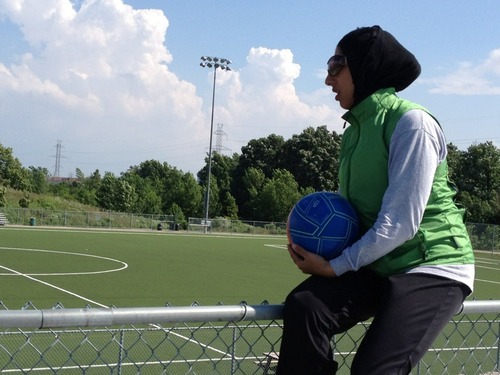
Hijabs and Hat-tricks: Muslim women lead the field


Growing up in Tallaght, Fadhila Hajji loved playing football with her brothers.
Kicking a ball around the yard during her teen years was the perfect way to relax after a long day at school. Unfortunately, the headscarf or hijab she wore as a Muslim teenager meant she was unable to play matches with other girls.
“It was very upsetting to me because I couldn’t express my passion for football,” says Hajji as she prepares for her weekly training in Phoenix Park on a grey, wet morning. “It was something I really enjoyed playing, something that I could use to blow steam off. Playing with everyone was just my happy time. I was really eager to join a team but couldn’t because of my headscarf.”
In March 2014, football’s world-governing body Fifa lifted the ban on head covers during matches. This meant female Muslim players would have the option to cover their heads when playing.
When Hajji’s brother Abdul-Rahman heard about Fifa’s decision to lift the ban on headscarves, he approached his sister with the idea of creating a Muslim women’s football team in Dublin. He was already an active member of Sports Against Racism Ireland (Sari).
Along with their friend, Abdul, the three young soccer enthusiasts contacted friends around Dublin encouraging them to get involved in their “Hijabs and Hat-tricks” project. Diverse City FC kicked off training in March 2014 and, two months later, they made their debut at the Fair Play Cup on World Refugee Day.

Weekly training

Mahdiyah Ayub from Coolock has joined Hajji for the Phoenix Park training despite the incessant rain. The girls stamp their feet as they catch up on the week’s gossip, waiting for the session to kick off.
Ayub was already a keen footballer player when Hajji called her in 2014 to join the new team. Before playing with Diverse City, she often removed her scarf for fear of sticking out on a pitch of non-Muslim players.
“It was more I was uncomfortable in my own skin,” says the 17 year old, catching her breath after warm-up laps. “Knowing you’re the only Muslim, you try and fit in more with the other girls, so I took my scarf off.”
The decision to join Diverse City has given her the confidence to play her favourite sport while wearing her hijab.
“Since I’ve joined this team, I’ve been wearing it to my school matches, to clubs and everything. The team gave me more confidence to go out there . . . to wear my scarf, to be proud of being a Muslim. To be proud of my scarf because it’s part of my identity.”
Wearing a scarf while playing sport is just like tying your hair back, says Ayub. “It’s also great because when it’s windy or raining you have an extra layer so your hair doesn’t get wet.”
Amina Moustafa, who is in first-year science at Trinity College, doesn’t wear a hijab, but has many friends who were afraid to join teams because of their headscarves. She and her twin sister, who also plays on the team, were lucky enough to grow up in a household where sports was always encouraged.
“My mam said when she was younger she was told not to play, that maybe it wasn’t for her. She didn’t want that for us so she encouraged us to keep going out.
“She loved the idea that there was a Muslim girls team and it was promoting diversity and interculturalism in Ireland. I’ve done so much sport over the years and this is the best team for bonding together. Normally, you just play the sport and go home, whereas I feel when we’re playing there’s more of a connection between the players.”
The girls are so enthusiastic about Diverse City they insisted on continuing training and playing matches during Ramadan – a period of the Islamic year when Muslims do not eat or drink anything between sunrise and sunset.
“It’s a good distraction from eating,” says Moustafa. “You don’t even think about it. We were just thinking about how amazing it was that we actually won a match when we didn’t have any energy.”
Azeez Yusuff, who coaches the team, says he was pleasantly surprised by how talented some players are. “All of them were good from day one when I first saw them – and now they’ve just totally developed which is absolutely amazing.”
“It’s great to see everyone mixing together because people say Muslim women just stay at home and stuff like that. Here you can see they’ve proven them wrong.”

Common sense

Former Republic of Ireland football manager Brian Kerr, who sits on the board of Sari and has followed the Hijabs and Hat-tricks project with great interest, says Fifa’s decision to allow women to wear hijabs while playing was “common sense”.
“Why should they have that restriction when in their culture they have to wear something to cover their hair?” he asks. Kerr believes Ireland’s decision to host the 2003 Special Olympics marked a turning point in attitudes.
“Why aren’t we inclusive in sport for everybody? As long as people give it the best they can and we can provide those opportunities, it can be vastly satisfying for players, coaches and volunteers.”
“A new population is coming into the country; a new diverse group with different religions and different cultural norms.”
Fadhila Hajji is proud to have played a leading role in making competitive football a reality for Irish Muslim women in their teens and early 20s. In December, she received a People of the Year Award for her work with Sari in fighting discrimination through sport.
“I feel proud. I feel like I have achieved something for the team, for myself and also for people around the world that feel inspired. I think it’s great that people from different backgrounds and ethnicities are getting together in one community and playing football.”
Hajji believes Muslim participation in sport sends out a positive message. “Islam is not portrayed very well at the moment. People seeing the Muslim people doing something good, that’s what we need right now.”

Source: http://www.irishtimes.com/sport/soccer/hijabs-and-hat-tricks-muslim-women-lead-the-field-1.2479670

3/5/14

I'm a Footballer Who Happens to Wear Hijab -- I Didn't Need FIFA to Tell Me That


By: Shireen Ahmed

Here is my reality.
I have been contacted many, many times since March 1 when FIFA announced that IFAB formally overturned their decision to ban headcoverings on the pitch. 
Family, friends and colleagues have sent me congratulatory notes and news reports. 
Since July 2012, I have blogged, written and expressed happiness, hope, gratitude and sometimes frustration with this process.
One more step towards the pitch! 
I was elated. 
Women from all qualifying nations will attend the Women’s World Cup 2015 in Canada. My country. There will be women from Asia, Africa and from Europe. There will be women in hijab, in pants and in shorts.
As it should be. I was thrilled initially.  
Now, I am exhausted.
I am drained from the process. I lost time away from the sport I have know and identified with since I was a very young child.
It was a part of my identity. It was a part of my routine. It was a part of my life.
I have written and opined about FIFA’s stance. I have shared pictures of radiating women who love the game and who defy cultural norms to enjoy it. Those connected and inspired by it.
Got this beautiful picture from Lela Ahmadzai’s website.   This particular image makes me incredibly happy. My mother always taught me I could “be anyone and play anything”.   I hope young women all over the world hear that message at some point in their lives.  It doesn’t have to be football. It can be something they love and something they crave. Women’s Advocacy, Sport, Environmentalism, Hobbies but something. So that they know, and the world understands, that everyone has a contribution to make.  Women need that chance. And that encouragement.   Lela has captured the resilience and passion of the women in Afghanistan and their love for the beautiful game.  Do check out her amazing work: http://www.ahmadzai.eu/en/allgemein-en/a-wmans-goal  I watch this short film a lot. It reminds me of my privilege. I am very aware of my ability to play safely and teach my daughter the same.   I have posted it and will continue to post it again. And again. And Again.
And those who risk their lives to play it.
What I did not say was how I suffered from sheer resentment and difficulty when I was not allowed to compete. 
I am allowing myself to say it now. 
I longed for the the thrill of the sprint, and the rush of the challenge.
And the goal. The beautiful goal.
I even craved the hit of the post or the uncontrolled shot that went wide. 
I missed it desperately.
But I chose to cover for personal reasons and told myself my connection to my Creator was stronger than my connection to football.
What I didn’t recognize was those two connections were not mutually exclusive. 
I understand the anger and frustration of women who were told “NO”.Who were told “NO” by an organization that is supposed to create opportunity and advocate for the Beautiful Game.
I started wearing hijab in 1997. I played my last season in the fall. I was told I had to either “take it off on the pitch” or “wait until I was ready to commit fully to the rules of the game”.
There was no specific law against (that would come in 2007) it but nothing allowing it either.
I walked away from the pitch.
My heart broke. But I quickly wiped my angry tears with my hijab. It provided me tight comfort and strength against this sporting injustice.
I played pick-up. I played at picnics. At family gatherings. I played at any opportunity. I played against my husband. I played with my children.
But I was used to playing in leagues, in matches with referees and full of politics and drama. 
I remember watching one of my heroes, Zinedine Zidane hoist the World Cup over his head in glory in 1998.
It was the first summer I did not play.
His victory as a Frenchman of Muslim-Algerian descent was bittersweet for me. He was of my faith. But he was playing.
I practice his roulette anyway. Just in case I might need it someday.
Life went on. I cheered, I watched and I fooled around with a ball. I did not play regularly. 
image
After what seemed like several lifetimes, I found a league that would accept me. 
I went back hesitant and I went back happily.
I tasted the joy in the sweat rolling down my face.
I loved it. I stayed for years and then I found the courage to venture out and challenge this.
I found a club that agreed.
And I remember what I always knew: I was a footballer who wore hijab.
Not a hijab-wearing woman who played football.
Fast forward to 2014 when Jerome Valcke announced: "It was decided that female players can cover their heads to play". 
Muslim women *could* always play.
Now they are *permitted*.
Semantics.
image
How can I laud FIFA for striking down a law that should have never been implemented in the first place?
How can I be grateful for someone allowing me to do what I should ahve always been allowed do?
Why was I made to choose?
How can you choose between your heart and soul?
Thank God my daughter won’t have to face that choice.
Someone pointed this out to me: “funny how the west tells us that hijab is oppressive yet they use it to oppress hijabis by banning them from playing sports”.
That isn’t funny. It is horrible. 
Last year, I was sidelined from football due to what turned out to be a full blowout of my ACL . Being ripped away from the game in this manner was painful. But it was of my volition. I was injured in a match, while in play. My choice.
Being ripped from the game because a lot of white, privileged men decided it was dangerous for me and the sport was torturous. Their choice.
And it was unfair.
So, today I am not “happy”. I am disappointed that I lost time and energy.
My joy is tapered with simple relief. 
In future, I will not let it ruin other childhoods and affect and exclude people.
Football is for all of us.
It should always have been.

Source: http://footybedsheets.tumblr.com/post/78519986470/my-thoughts-hijab-on-the-pitch

7/13/13

Spain's IOC member Marisol Casado says Turkey has removed women wearing headscarves in bid

Instanbul Olympic bid
The head of the Turkish bid, Ugur Erdener, speaks during the presentation of the Candidate Cities for the 2020 Olympic Games during the Association of National Olympic Committees meeting in Switzerland. Picture: AP Source: AP
A SPANISH IOC member questioned why Turkish bid leaders have failed to show images of women wearing headscarves in Istanbul's presentations for the 2020 Olympics.
While declining to answer questions about security in Turkey, Marisol Casado instead raised the issue of women who wear head coverings in the predominantly Muslim country.
Istanbul is competing against Madrid and Tokyo for the 2020 Games, which will be decided by the IOC on Sept. 7 in Buenos Aires, Argentina. The three cities made closed-door presentations to IOC members last week in Lausanne, Switzerland.
"There was one question that was never addressed, and that is the number of women who wear the veil," Ms Casado said at a news conference for Madrid's bid.
"There was never an image of a woman wearing a veil in any of their presentation videos."

Turkey, a country that sits on both the Asian and European continents, is governed by secular laws. It would be the first mainly Muslim country to host the Olympics if Istanbul wins in its fifth attempt.
"Anyone who visits Istanbul will be aware that around 30 per cent of women there tend to wear veils," Ms Casado said. "People who live in Arab nations are looking for something that will be more representative of their culture."
Ms Casado's remark was reminiscent of a faux pas made by Tokyo Governor Noiki Onose in April when he compared his city to Istanbul by saying that the Turkish city was underdeveloped and less equipped to host the games than Tokyo.
Mr Inose was also quoted as saying "the only thing (Muslim countries) share in common is Allah and they are fighting with each other, and they have classes."
The governor later apologised.
Under IOC bid rules, candidate cities are prohibited from criticizing rivals.
Ms Casado spoke as Spanish IOC members gave an assessment of how Madrid's bid was shaping up.
Juan Antonio Samaranch Jr., accompanied by Jose Perurena and Ms Casado, said Madrid's bid for the 2020 Olympics broke a long tradition of overspending to host the event.
"It's a new model," Mr Samaranch said. "The Madrid Games would be good for the Olympic movement" because it puts forward the idea that games can be organized without massive spending.
Mr Samaranch said it was now more important to "use our brains instead of the wallet." He said hosting the games would also help Spanish sports and the country's economy as a whole. He said that Madrid had "explained clearly that we want it and we need it."
Madrid has sought to present what it has labeled as a low-spend, responsible model, respectful of the 27 per cent unemployment rate that the economic crisis has caused.
Both Spanish Prime Minister Mariano Rajoy and Economy Minister Luis de Guindos have stated that the games posed no financial risk to Spain. Madrid has stressed that 80 per cent of its proposed venues are ready and it will only need $US1.9 billion ($2.1 billion) to complete and burnish its Olympic infrastructure.
"We have limited funds," Mr Samaranch said. "Our presentations have had to be very short and sometimes frustrating because of that."
Istanbul has defended its $US19.4 billion infrastructure budget while Tokyo boasts a reserve fund of $US4.5 billion to be used for the Olympics.
Source: http://www.heraldsun.com.au/sport/more-sports/spains-ioc-member-marisol-casado-says-turkey-has-removed-women-wearing-headscarves-in-bid/story-fnibbyyv-1226677414888 

5/28/13

Maldives Women’s Team Forfeit Basketball Tournament Over Headscarf Ban

BY: MINIVAN NEWS


Maldives women’s team forfeit basketball tournament over headscarf ban thumbnail

The Maldives’ women’s basketball team refused to play without their headscarves, forfeiting the International Basketball Federation’s (FIBA) first under 18 three-on-three tournament held in Bangkok, Thailand earlier this week.
“The girls were really upset, we are as well. We came prepared based on the uniform the team wore in the last two games,” Maldives Basketball Association (MBA) President Ahmed Hafiz told Minivan News today (May 27).
“According to FIBA, the head cannot be covered during play. We have to go with FIBA rules if we want to play,” Hafiz stated.
The Maldives’ women’s basketball team has been allowed to participate in past tournaments while wearing burugaathah (headscarves), however the decision to make an exception to the rules “depends on the officials”, according to Hafiz.
“Qatar held a tournament two weeks back and there were some complaints that the Qatar team was wearing headgear, so FIBA was forced to apply the rules,” Hafiz explained. “Maybe that is the reason this issue came up for the Maldives [in this tournament].”
FIBA Asia has designed a jersey for Muslim players, but still needs to obtain FIBA international approval, according to the MBA.
“FIBA Asia is working on this because lots of Muslim countries are involved. Now the are suggesting to FIBA International to change the rules to allow headgear,” said Hafiz.
The Maldives’ under 18 women’s team is planning to participate in the upcoming Asian Youth Games, to be held this August in Nanjing, China, according to Hafiz.
“However, [the choice] is up to the players. We will not force them,” he said.
“This is a big problem for the game and will ruin the development of women’s basketball for a place like this, because there are still very few girl players and most wear the burugaa,” MBA Secretary General Arif Riza told Minivan News today.
“FIBA is pretty clear about the rules, so although the team has been allowed to play twice before, this was a mistake of ours also,” said Riza.
The primary issues of concern to MBA are that FIBA permitted the Maldives’ team to wear headscarves during tournaments in 2011 and 2012 as well as allowed other teams to play in violation of different dress code rules, such as wearing t-shirts instead of jerseys, according to Riza.
“Immediately after President Hafiz arrives [from Thailand] we will discuss the issue and write FIBA a letter,” said Riza.
“They should be allowed to have the right to play,” he declared.

FIBA Response
The headgear ban is “a part of FIBA Rules, but not a policy,” FIBA AsiaSecretary General Hagop Khajirian told Minivan News Thursday (May 23).
“It has nothing to do with headscarves as such, but more to do with the regulations which stipulate that the playing gears of players has to be such that it may not cause any harm or hindrance to themselves or opponent players,” explained Khajirian.
Although these rules have “been the case always”, FIBA is currently reviewing the headscarf restriction.
“There have been requests from many nations regarding this. And the FIBA Asia Central Board, in its meeting [held] on April 24 in Kuala Lumpur, resolved to send a study paper to FIBA to be taken up for further consideration,” said Khajirian.

The choice to cover
While Maldivian women’s participation in basketball is slowly increasing, netballis popular nationwide. Although there are key distinctions between the two sports – such as no dribbling in netball – the rules are very similar, according to a skilled Maldivian netball player of nine years and student coach of six years.
“Wearing the burugaa while playing netball is no problem for us, it is not difficult and we’ve never experienced any injuries [from the headscarves],” she explained on condition of anonimity.
“Every person has the choice of whether or not they choose to wear the burugaa. However, it is a religious thing, in Islam Muslims have to cover, it is the right thing,” she continued.
“Although some are not wearing [headscarves], that is their choice,” she added.
The netball enthusiast agreed with the Maldives’ women’s basketball team decision to not remove their headscarves and forefit their game in the recent FIBA three-on-three tournament.
“Their choice was the correct one, they do not want to break religous rules,” she said.
“FIBA should change their rules if they want Maldivians to participate, because so many [women] are wearing burugaathah. They have to change so everyone can compete,” she added.

Burugaa bans
A senor researcher from the internatonal NGO, Human Rights Watch, previously highlighted the discriminatory issue of banning women from wearing headscarves, in a 2012 article “Banning Muslim Veil Denies Women a Choice, Too”.
“The sad irony is that whether they are being forced to cover up or to uncover, these women are being discriminated against. Banned from wearing the hijab – a traditional Muslim headscarf – or forced to veil themselves, women around the world are being stripped of their basic rights to personal autonomy; to freedom of expression; and to freedom of religion, thought and conscience,” wrote Judith Sunderland.
“Denying women the right to cover themselves is as wrong as forcing them to do so. Muslim women, like all women, should have the right to dress as they choose and to make decisions about their lives and how to express their faith, identity and moral values. And they should not be forced to choose between their beliefs and their chosen profession,” notes the article.
Muslim women’s basketball players in Switzerland and Baharain have also faced controversial opposition to their refual to remove their headscarves.
The Baharaini team was “lauded” for their refusal to remove their headscarves during an international competition in 2009, according to Gulf News.
Meanwhile, Sura Al-Shawk, a 19 year-old STV Luzern basketball player, was denied permission to play while wearing a headscarf by the Swiss basketball association ProBasket in 2010, reported the Associated Press.
ProBasket told the Associated Press it followed FIBA rules and that wearing the headscarf while playing basketball “could increase the risk of injury and the sport has to be religiously neutral”.
In July 2012, the Fédération Internationale de Football Association (FIFA)overturned a headscarf ban, which was put into place in 2007, after a yearlong campaign led by FIFA vice president Prince Ali of Jordan, reported the Associated Press.

4/30/13

Will This Never End? "No Turbans On The Pitch"


By: Shireen AHMED
In the last couple of months, I have written extensively and covered the issue of IFAB lifting the ban on hijabs on the pitch. As a footballer who chooses to wear hijab this issue was terribly personal and very important to me.
I have been playing for decades and am elated that Muslim players may now be included in international and FIFA sanctioned competition.
Even more recently, I was thrilled to find out that Quebec had rescinded and was going to be the last province to allow hijab on the pitch. For a variety of reasons the Quebec Soccer Federation (QSF) had been most reluctant to accept the ruling despite the Canadian Soccer Association (CSA) encouraging lifting of the ban; as most other provinces had already done.
Fortunately, they could no longer pretend that their decisions were based on player safety and equality when IFAB struck down the ban in July 2012 and a FIFA-approved hijab was designed by a woman living in Montreal.
I was happy for the sport and for the opportunity for more women to participate in the beautiful game. I figured that the issue of headcoverings in the football world was now moot.
Not exactly.

Late last week, I discovered that, once again, Quebec has banned headcoverings from the pitch. Not hijabs but to my disgust...Sikh turbans.  
In traditional form Quebec has disallowed sikh turbans from the pitch despite directives from the the CSA to allow them. The QSF is a provincial body that governs the sport in its’ province. Some have questioned why the CSA can’t simply overrule the provincial body as they have been advocating for equal access for all players.
Unfortunately, the CSA can not interfere in issues of sport as they fall under provincial jurisdiction. CSA is the national body that is in charge of National programs and teams and represents Canada on the international level to FIFA and in CONCAF.
Not only will QSF not issue a statement, they refuse to address the issue before registration of the summer season begins.
The issue of the inclusion of religious clothing in sport has been percolating in Quebec for awhile. The impermissibility of hijab on the pitch garnered much attention in mainstream media in recent years since the Iran National Women’s squad was rejected from Olympic qualifying matches in June 2011, due to their hijabs.
At the same time in Quebec, there was a young Sikh player who was barred from playing with his turban. The incidents were not widely reported and infrequent.
And remained unresolved.
In May 2012, a teenager from a Montreal suburb registered to play in Lasalle.
Although he had already been playing for ten years, he was informed that he would have to lose his turban and play with a FIFA-sanctioned hairnet or not register at all. “It’s pretty degrading to do that because the whole point of turban is to cover your head” said Aneel Singh Samra.
He got his money back and did not play.
It seems as if this will be his fate and those of other Sikhs in Quebec this summer. Another season lost where they can’t play due to their decision to wear a headcovering out of religious observation.
Ironically, the Federal Minister of Sport in Canada is a Sikh from the riding of Bramalea-Gore-Malton. Minister Bal Singh Gosal has yet to issue a statement on this topic.
I think it is imperative that he, as the elected represented now holding the portfolio for State Sport in Canada contact the appropriate authorities of football in Quebec and request that this matter be resolved quickly.
FIFA must also address this issue and clarify that there is no issue for injury (the cited problem in the case of hijab) as the traditional turbans to not cover the neck of players.
Furthermore, there is no obvious “advantage” for turban wearers for heading the ball. Regardless of which as heading the ball is not obligatory in football. 
This is a technicality that the QSF is hiding behind.
A colleague and friend of mine, Baljit Rihal explained: “Usually, Sikh boys (with unshorn hair) adorn a bandana like headcovering called a 'Patka'. This in effect is a mini turban and poses absolutely no safety threat to either the player or their opponents. Sikhs have been playing football across the world for many years without this ever being subject to a ban. I was born and brought up in London, UK and wore the patka whilst playing through school and even whilst trialling at county level football - the head covering was never an issue.” Rihal, who is founder of the prestigious Asian Football Awards, an initiative that recognizes the achievements of South Asians in Football, is clearly disappointed with the decision.
“Football is a game that brings communities together. The actions of the Quebec Soccer Federation can only be described as ludicrous and an attempt to exclude a community that have given so much to Canada. The Canadian Soccer Association has issued directives that Sikh's wearing the turban should not be banned from playing - it is beyond me why the QSA is not adhering to the country's policy. That is, in effect, like a UK County Football Association over ruling guidelines from The English FA,” he adds.
Until QSF issues a full statement explaining their reasons for banning the turban, it seems that young players are in an unfair limbo. They can’t fully contest a case if they don’t know what that case is.
The issue of proper uniform and kits in sport stinks more of political issue laced with xenophobia than of the safety and equality of players.
Is it necessary for a Sikh designer to create a particular prototype for Punjabi players?
How many more years of wasted time will continue until this bigotry and unnecessary prevention of participation is stopped?
World Sikh Organization of Canada (WSO) President Prem Singh Vinning issued a very sincere statement regarding the ban: “We fail to see what is so complicated about allowing Sikh children to play with their peers. What purpose does the QSF restriction on the turban serve? There is no conceivable justification for this. If there are genuine concerns, we are open to dialogue but if this situation is not quickly resolved, the real victims will be the children”.
As a footballer who wears a headcovering and was subject to rules that excluded me from playing with recognized clubs, I will not tolerate further prejudice and discrimination from Quebec on an issue that should have been shelved many years ago.
Football is for all of us.
crossposted at http://footynions.com/