1/26/12

Portrait: Widaad Gukhool


Original French (google translation to English will be followed):

Du haut de ses 17 ans, Widaad Gukhool a d’ores et déjà marqué le tennis de table mauricien. Les éloges ne manquent pas pour cette pongiste qui a tapé dans sa première balle à l’age de 8 ans.
Dans le giron, on la défi nit comme une pongiste unique en son genre. Entre ses entraînements, ses études, sa vie religieuse, Widaad Gukhool montre et démontre, depuis ses débuts, qu’elle est prête à faire des sacrifices afin d’atteindre ses objectifs. Preuve en est, les derniers Jeux des îles de l’océan Indien où elle accrochera deux médailles d’or (par équipe et double mixte) en pleine période de ramadan. Widaad Gukhool a toutes les qualités d’une sportive hors du commun.
Et pourtant, le tennis de table n’était pas son premier choix à ses débuts. «Quand elle avait 7 ans, son frère Irfaan pratiquait le karaté et elle avait envie de s’adonner à une activité donc elle aussi s’y est mise», raconte son père Ragck Gukhool. «Ce sport lui plaisait, mais elle n’était pas compatible avec cette discipline, donc, elle a pratiqué d’autres sports comme la natation». Mais elle ne trouvait toujours pas chaussure à son pied. C’est là que le tennis de table est entré dans sa vie, une discipline qui allait tout changer. Détectée en 2004 à Mesnil par Rajessen Descann, elle intégrera en avril 2004 l’école du Mauritius Sports Council et presqu’un an plus tard, remporta son premier titre de championne dans les catégories benjamines et minimes. «On avait constaté à l’époque qu’elle avait un vrai potentiel. Elle était très intelligente tactiquement et savait gérer les moments difficiles, chose que beaucoup de joueurs ne pouvaient pas faire», relate l’entraîneur national, Rajessen Descann.
Comme tout sportif mauricien, le premier objectif d’une carrière demeure les Jeux des îles. Au vu de son talent et de tous ses titres, Widaad Gukhool atteindra celui-ci en 2007 à l’âge de 13 ans. A l’époque, elle était la 6e joueuse au classement national et prouvera que sa sélection en équipe nationale est justifiée.
Une pongiste studieuse
En effet, ses 13 ans ne lui ont pas empêché d’aller chercher la médaille de bronze en double mixte aux côtés de Rajessen Descann qui était joueur à l’époque. «Le contexte n’était pas facile pour elle mais elle a su hausser son niveau pour chercher cette médaille», observe l’entraîneur national qui confie que, dans l’histoire du tennis de table «jamais personne n’a fait ce qu’elle a fait à son age. La carrière de Widaad et son style de jeu ne peuvent être comparés à celle d’un ancien pongiste».
Malgré sa grande implication dans son sport, elle garde en tête que les études joueront un grand rôle pour son avenir.
Etudiante au collège privé de Doha Academy, elle décroche 8 unités au School Certificate, résultat qui a étonné son père. «Je ne m’attendais pas à ce qu’elle fasse aussi bien.
Pour moi, même si elle avait ramené 20 unités, cela ne m’aurait pas posé de problèmes car je connaissais tous les sacrifices qu’elle a faits pour son sport, les heures d’entraînement, les allers retours entre la maison, l’école, les leçons particulières. Je suis fier d’elle, car elle s’implique aussi énormément dans sa religion », explique son père.
Sur la saison 2011, Widaad Gukhool n’a plus rien à prouver. Elle avait lancé sa saison avec une médaille de bronze par équipe aux Championnats d’Afrique Junior 2011, assurant la victoire sur les deux matches qu’elle devait disputer. Elle ramena par la suite son énième titre de championne de Maurice, avec zéro défaite au compteur.
Pour peau finer sa préparation en vue des JIOI, elle se rendit avec Patrick Sahajasein en Chine, au Centre national de tennis de Table à Heibei.
Trois semaines d’entraînements intensifs qui ont porté leurs fruits.
Aujourd’hui, Widaad Gukhool pourrait facilement faire une séance d’entraînement face à un Warren Li Kam Wa ou encore un Billy Chan Yook Fo. Pour améliorer ses relances, l’Association mauricienne de tennis de table (AMTT) a favorisé les frottements avec des sparring- partners masculins alors qu’un ami de la famille, Lasser Auchaybur, offre son aide à la pongiste en tant que coach personnel.
Après toute cette préparation, ne reste plus pour elle qu’à briller lors des JIOI. Elle enlèvera deux médailles d’or, une par équipe fi lle et l’autre en double mixte aux côtés de Rhikesh Taucoory dans des conditions plus que défavorables car elle était en pleine période de ramadan. Elle enchaînera, par la suite, avec une 15e place en simple dame lors des Jeux d’Afrique à Maputo et conservera son titre de championne de Maurice lors du Championnat national.
Désormais, le grand objectif que peut se fixer Widaad Gukhool c’est de briller au niveau continental et passer un autre cap tout en gardant les pieds sur terre.
Olivier CHAPUISET(Source : Lexpress)
Google Translation to English:
From its 17-year Widaad Gukhool has already marked the Mauritian table tennis. No shortage of praise for the table tennis player who hit his first ball at the age of 8 years.
Into the fold, it is defi nes a unique table tennis. From his training, his education, his religious life Widaad Gukhool shows and shows from the beginning, it is ready to make sacrifices to achieve its objectives. Proof of this is the last Island Games Indian Ocean where it will hang two gold medals (team and mixed doubles) in a period of Ramadan. Widaad Gukhool has all the qualities of a sports car out of the ordinary.
Still, table tennis was not his first choice in its infancy. "When she was 7 years old, his brother Irfaan practiced karate and she wanted to engage in an activity so also it is put," says his father Ragck Gukhool. "This sport he liked, but it was not compatible with the discipline, so she practiced other sports like swimming."But she still can not find the Shoe Fits. This is where table tennis is in its life, a discipline that would change everything. Detected in 2004 by Mesnil Rajessen Descann, it will integrate the school in April 2004 of the Mauritius Sports Council and almost a year later won his first championship title in the categories benjamines and minimal. "There had been at that time it had real potential. She was very smart tactically and knew how to manage difficult times, something that many players could not do, "tells the national coach, Rajessen Descann.
Like any sport Mauritius, the first goal of a career is still the Island Games. Given his talent and all his titles, Widaad Gukhool reach it in 2007 at the age of 13. At the time, she was the sixth player in the national rankings and prove that his selection for the national team is warranted.
A studious table tennis
Indeed, his 13 years does not prevent him to go for the bronze medal in mixed doubles alongside Rajessen Descann player who was at the time. "The context was not easy for her but she was able to raise its level to get that medal," says national coach who says that in the history of table tennis "no one has ever done whatshe made to her age. Widaad career and his style of play can not be compared to that of an old table tennis player. "
Despite his involvement in the sport, it keeps in mind that the studies will play an important role in its future.
Student private college Doha Academy, she won eight units in School Certificate, a result that surprised his father. "I did not expect it to become as well.
For me, even though it had brought 20 units, this would not have been a problem because I knew all the sacrifices she made for her sport, training hours, the back and forth between home, theschool tutoring. I am proud of her because she is also involved heavily in religion, "said his father.
In the 2011 season, Widaad Gukhool has nothing to prove. She had started the season with a bronze medal in the team African Youth Championship 2011, ensuring the victory over the two matches she should play. She then brought her yet another championship title in Mauritius, with zero loss to the counter.
For the finer skin preparation for Jiří she went with Patrick Sahajasein in China, at the National Tennis Table Heibei.
Three weeks of intensive training that paid off.
Today Widaad Gukhool could easily be a workout in front of a Li Kam Wa Warren or a Billy Chan Yook For. To improve its reminders, the Mauritian Association Table Tennis (Amtt) promoted friction with male sparring partners when a family friend, Auchaybur Lasser, offers help to table tennis as a personal trainer.
After all this preparation, no more for her to shine in the Jiří. It will remove two gold medals, one for each team fi lle and one in mixed doubles alongside Rhikesh Taucoory under more adverse than as it was in the midst of Ramadan. She followed later with a 15th place in singles at the Games Lady of Africa in Maputo and will retain his title of champion Maurice at the National Championship.
Now, the general objective can be attached Widaad Gukhool is to shine at the continental level and go another direction while keeping the feet on the ground.
Olivier CHAPUISET(Source: Lexpress)

1/25/12

Announcement: Look for Muslim female athelete

Human Rights Watch is looking for a Muslim female athlete to speak at an upcoming press conference they are hosting for the launch of a report about women's rights in Saudi. Apparently Saudi is trying to bar some female athletes from competing in the Olympics, hence HRW's concern. 
If you know anyone (and have email addresses/phone numbers), please email to  "Zahir Janmohamed" zahirj@gmail.com zjanmohamed

1/17/12

In their football boots, these women have seen the world

In their football boots, these women have seen the world
Mona Abouissa

Dec 24, 2011

She knocks him to the grass and leaps over him. Leg muscles strain over Puma-sponsored socks. A whistle. She reaches out her hand and pulls him back to his feet. Another whistle. She runs to break through, he runs at her, they clash again, nothing matters except the ball trapped between their entwined legs. "Fight, fight, fight!" shouts the coach, a thick artery pulsing on his face. It's a vicious game. Physical distances between women and men count for zero on the pitch. "You need to forget you're a girl when you play football, you need to be vicious, but outside we are just normal girls," says the broad-shouldered Egyptian midfielder Faiza Heidar. For some it's the Nineties all over again, when young girls played football with boys on the streets in dusty provincial towns, egged on by older children.

Women's football was born on the streets of Egypt against all odds. "It's an illegitimate child of the Egyptian football federation," as the Egyptian club coach Mohamed Kamal puts it. There's one woman's will behind it. After her referee father Izzat's death, Seher Al Hawari was determined. She travelled to provincial clubs and found potential female players. After convincing their parents, Seher brought 25 girls aged 15 to 22 to the bustling capital and trained them for five years. The idea of women playing a rough masculine sport was an absurdity to the Egyptian Football Association (EFA) and a good joke for a patriarchal community. In 1997, under Al Hawari's initiative, the first women's football committee was finally established and led to the first Women's Football Tournament in Egypt. In 1998, Egypt played in the inaugural African Women's Championship organised by Fifa in Nigeria. Although the team didn't even make it to the quarter-finals, it was a giant leap. Al Hawari became the first African woman member of Fifa and the first female EGF board member. Her girls are now coaches raising the next generation of players. There are 12 clubs and around 500 players. "It's like a dream come true," Al Hawari says watching the national team playing a friendly match with a boys' team at the Confederation of African Football headquarters in Cairo.
"My home is up there," says Monika Staab as she looks up and points to the night sky. She has just finished a coaching course with Egyptian club coaches and is heading to Iran. In four years working for Fifa as an adviser on women's football development, she has travelled to 60 countries. "Football teaches us to respect each other, team spirit and human value, and if you do this maybe we'll have less war, less fighting, less people killed. I believe in this and that's why I've been doing it for four years." On the ground, she says, it's a struggle in strict countries such as Pakistan, Afghanistan and Iran, where girls risk their reputations for football.
Staab was 4 when she started playing, and football for girls was forbidden in 1970s Germany. She played it anyway, with boys behind her parents' backs. It was just like the conservative countries she would visit 40 years later. She was one of the first footballers who travelled beyond Germany to elsewhere in Europe when women's football was slumbering after a 50-year ban. The world of women's football has changed since then. There are 30 million female players worldwide, compared to 210 million men. The first Women's World Cup Championship was held in 1991, 61 years after the first World Cup in 1930. Germany is now one of the most successful teams .
"Football is my fate," says Isra'a Osama, 24, an Egyptian national team midfielder. Her strength is her persistence, which is her name in Arabic, so maybe it's fate.
"When you touch the ball, you feel something inside you bursts out,"says the speedy striker Shahinaz Yassin, 19, from the Jordanian national team. The girls' teams are about to play a friendly match. Last year the Egyptians lost 1-0 to Jordan at the Women's Football Cup Arabia 2010, which won Jordan an exclusive training camp in ermany in the run-up to the 2011 Women's World Cup. They didn't qualify, but it was an achievement for a new team, established in 2005. Jordan is now 59th in Fifa women's rankings - the highest ranked Arab team. Morocco is 73rd and Bahrain 75th, with Egypt 84th.

A tranquil pitch before the climax. Small rainbows form above the sprinklers. Little black beetles are wandering around. Many are destined to fall victims to the match. Girls are giggling on balconies about some Facebook photos before they head out for the briefing. "Today I don't want you to think that I've got a ball and now I'll tear my opponent apart; I want you to connect with each other," says Tarek El Siyagy, the head coach. He coached Gambia's national U-17 team for four years and won a World Cup victory in 2009. This is his first experience in coaching females.
Hesterine De Reus, the head coach of the Jordanian team, says the current turmoil in the region has more of a negative effect on football in Jordan. "It enabled conservatives to put on pressure. We occasionally practise with boys because it's challenging for the girls, but last time nobody could play with us because the press criticised us under their influence." Just like Monika Staab, who first played "illegally" with boys in Holland. Between 1983 and 1993 Hesterine gained 44 caps for the Netherlands women's national football team. After 20 years working for the Dutch Football Association and coaching the Dutch national U-19 team, she moved out of her comfort zone to Jordan.
It's the second half; the first was drawn 0-0. The Egyptian team appears more substantial than the Jordanian, and more aggressive. An ambulance is on stand-by. The Egyptian reserve team recites the Fatiha (the opening of the Quran) loudly with their hands crossed behind each other's backs. The Jordanian reserves are quieter. Beyond are two circles on each side of the pitch - red and white - they give a shout and take their positions. A whistle. Both teams know that there will be goals. They chase, knock, enrage each other. Nobody likes to lose. Players on the ground, mostly Jordanians, pain and cries. Doctors wait for a sign, all good. Egypt win this time, 2-1. The men from the media pick up their phones and report: "Al Hawari's team won."
When the match is over, the Egyptian team has qualifiers for the 2012 African Cup to prepare for. They are up against countries such as Nigeria, who are eight-time winners of the African Women's Cup, while the Jordanian team travels to the Emirates for the West Asian Football Federation tournament. Then there is a match with the Women's World Cup champions, Japan, in Palestine.
At a training session at Wadi Degla club, I have never seen so many girls spitting in Egypt. "Go, Messi, go!" They occasionally call each other by their football idols' names, usually those of male players. "When there was a women's match on TV, I switched channel immediately," remembers Mohamed Kamal, before he started coaching girls in 2003. Now he's the head coach of Wadi Degla club, champions four seasons in a row. "People advised me against it, said I'm ruining my coaching career." But he was impressed by the players and wanted to be a part of something new. He has been coaching since 1981, after sustaining an injury as a professional player. Kamal is a good coach and knows how to read a footballer. "If I think about her as a girl, I'll never be able to coach her; she's an athlete on the pitch." Kamal says that at the end of a rough session, they are girls and they need to feel that with a nice compliment. "And girls talk a lot, all the time," he laughs. They travelled to Europe and the Middle East, but some players haven't seen beyond Egypt, like a team from Kena in Upper Egypt. "Once I was asked to lead Kena's team to a tournament in Jordan. The girls never travelled abroad - they had never even seen an elevator - so whenever I couldn't find a player, I knew I'd find her going up and down in the hotel's elevator," Kamal laughs. "We brought the cup home that time."
Not everyone is as good as Heidar, who is a starlet of her club Tayaran, coaches male players and plays on the national team. She loves a challenge and won't leave her club, even if she's paid less there than she would be elsewhere. The girls are only paid by their clubs and not supported financially by the FDA, Kamal notes. Unlike in other Arab countries like their rivals in Jordan who are supported by Prince Ali Bin Al Hussein, president of the Jordan Football Association. The players of Wadi Degla receive the highest salary, the equivalent of Dh600. There's also a championship bonus of Dh9,300, and some of them even bought cars, Kamal says. But the gap in performance between the Wadi Degla club and the others is obvious - their players make up the majority of the national team.
Sally Ismael, 21, is a popular striker on the national team with her virtuoso dribbling, a move she borrowed from Christiano Ronaldo. She runs circles around the pitch on her own. Ismael has been playing football since she was 6. She moved from Mansoura to Wadi Degla club in Cairo to pursue a professional career in football. She traveled to Zambia, Congo, Algeria, Tunisia, Jordan and the UAE with the team, and Estonia and Finland on her own. "I have style and if I get fitter, then I can do miracles," Ismael says. A Finnish coach noticed her in Cairo and invited her to play in Finland, which she happily did without telling anyone. Coach Kamal is concerned that countries such as Qatar and the UAE offer money and nationality, and whisk away good players. Ismael came back to Cairo. "Foreign players are fit but they don't have the moves," she says, sitting in the dormitory, with Arabic pop music blaring. "Kaka is fit and scores the goals, but he's not eye-grabbing like Messi or Ronaldo."
In Arab women's football, little details make big changes. "The veil gives me power, " says Yassin. The neck-covering veil violates an agreement between Iran and Fifa in 2007. Fifa insisted the agreement was a concession on its banning of all expressions of religious or political beliefs on the pitch. Consequently the Iranian team was disqualified from the 2012 Olympic qualifiers. Yassin was disqualified as well, and her team had to play without her. There's a specially designed cap that covers the hair only. Heidar wears it, but Yassin refuses on religious grounds. De Reus says the ban costs potential players.
Football opened the world for the girls. They travel across the Middle East, Europe, and Asia. On the other hand, their passion eats their time, their personal life and forces them to compromise. But there's no other way. "When you're born with a gift, how can you let it go," asks Osama. I ask if they ever thought of leaving football: "No," each one replies. The key is to find a balance between their passion and their private life. The Jordanian team defender Farah Badratah, 24, just got married. Not many girls can play football and be married, De Reus says, and that is one reason why the team is so young. Farah is an uncommon phenomenon. She balances football with her day job at the football union, training and her own home.
Maisa Ejbarah, 22, prefers to have two separate lives. A rough and busy one with her teammates where it's all about football, and the other one outside it, where the Arab Striker of 2010 can have girlie moments with her friends. While Yassin postpones; "after I'm 30, when I achieved what I could, I'll have life of my own, my own family, stability, a life I don't have now."
Heidar explains that there is a day in a footballer's life where you feel that you have given all you could to the game. They hope through studies and coaching experience their lives will be linked to football, but they also know that one day they won't play it anymore. Until then it's simple; they keep doing what is innate in them - football.
For more stories from M magazine, visit www.thenational.ae/m

Hostage to her beliefs

By Diana Plater

I read recently that the daughter of Iran’s former president, Ali Akbar Hashemi Rafsanjani, had been sentenced to six months in prison for spreading “propaganda against the Islamic system”.

The sentencing of Faezeh Hashemi Rafsanjani, a former member of parliament turned political activist, was the latest move to stamp out potential dissent ahead of elections in March, the report said.
I remember meeting Ms Hashemi in 2000 several months before the Sydney Olympics. She and a colleague were sitting at the back of the audience of an international sports and human rights conference held in Bondi.
They stood out there because they were covered from head to foot in black chadors.
I waited that whole day to interview her for WIN (Women’s International Net Magazine), for whom I was Australian correspondent, believing she would have an interesting story to tell.
At the time she was the member for Parliament for Tehran, having received 800,000 votes in 1996. She had also founded the women’s newspaper, Zan.
“(My father’s) fame and also his name somehow was influential,” Ms Hashemi told me at the time. “(But) I personally was well known because of my previous social activities, especially for focussing on women’s issues, youth, and also on sport. Most people know me well from this.”
She was then the Vice Chairperson of the Iranian National Olympic Committee and Chairperson of the Council for Female Sports of the Islamic Countries and during our interview I learnt she had spent many years pushing for Muslim women to become more involved in sport, both in her native Iran and outside.
She was here in Sydney partly to convince the International Olympic Committee (IOC) organisers to allow Islamic dress during competition, in order to pave the way for Muslim women’s participation in the 2000 Olympics.
She believed the role of sport in Muslim women’s lives was not just a matter of personal choice but a fundamental human right.
And for this reason she had been lobbying the International Olympic Committee (IOC) to respect the dress codes of Islamic society.

Because the Olympics then did not recognise these dress codes, more than 30 Muslim countries – particularly the Arab states – could not take part.
Ms Hashemi told me Iran’s constitution paid detailed attention to the high values of physical education and sports, as an effective educational plan, “which provides physical and mental wellbeing for the society in general and women and mothers in particular”.
In the Atlanta Olympics, Iran had one woman shooter, who carried her country’s flag. Only in the sports of canoeing, shooting, table tennis and athletics did the women’s uniforms match the Islamic dress code.
For these reasons, alternative games, only for women, were held in Iran.
Since then, while Ms Hashemi prefers to wear the chador herself, she has been a staunch advocate of the relaxation of the strict dress code, as she believes women should be able to decide for themselves what they wear.
The latest court case arose from election protests held in Iran in June, 2009, when she was reported as having addressed a crowd at a banned opposition rally in Tehran. She was subsequently prohibited from leaving the country. According to Iranian state media, she was arrested and briefly detained on June 20 (together with four relatives), and again on February 20, 2010 after “making blunt statements and chanting provocative slogans”.
Ms Hashemi has been a sharp critic of the present government led by President Mahmoud Ahmadinejad.
BBC News reported that her trial took place behind closed doors. And her punishment may be turned into a suspended jail term on appeal, as often happens with opponents of the Iranian authorities.
Ms Hashemi has given interviews in recent months in which she defended her father’s position – and this appears to be her offence, BBC News said.
The influential Rafsanjani clan has been longtime kingmakers within Iran’s political elite, and according to time.com Ms Hashemi infuriates the regime by championing her father’s politics, seen by some as being pro-American.
It’s a particularly sensitive time in this part of the world, as Iran faces a possible oil embargo and trade threats with the United States and the British Navy has sent its largest sea contingent to the Gulf. So the Iranian government does not want the world to witness internal divisions in the lead up to the elections.
Ms Hashemi, who has been harassed in public, has 20 days to appeal the verdict against her.
While I’m the first to admit my lack of knowledge of Iranian politics, I remember her as an elegant, attractive and outspoken woman and a strong advocate for women’s rights, so deserving of other women’s support.
Among many others arrested in the 2009 protests, she was mentioned in a report by Amnesty International, Iran: Election Contested, Repression Compounded.
Amnesty however is not working on her case. If you would like to show solidarity to her and others arrested in election protests you can write to the Iranian authorities directly, condemning her sentence and persecution. The target details are:
Leader of the Islamic Republic
Ayatollah Sayed ‘Ali Khamenei
The Office of the Supreme Leader
Islamic Republic Street – End of Shahid Keshvar Doust Street
Tehran
Islamic Republic of Iran
*Diana Plater is a journalist, writer, playwright and media consultant based in Sydney. You can read her blog, Landscapes, at www.dianaplater.com

Source: http://store-archive.blogspot.com/2012/01/hostage-to-her-beliefsby-diana-plater.html

1/8/12

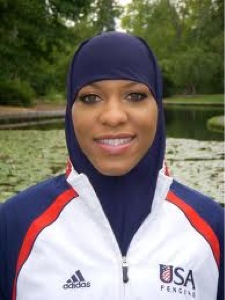
Olympic Hopeful Mixes Muslim Faith And Fencing

World-class fencer Ibtihaj Muhammad hopes to compete in the 2012 London Olympics. If she qualifies, it is believed that she will be the first practicing Muslim to represent the U.S. in women's fencing, and the first American to wear Islamic head-covering while competing. She speaks with host Michel Martin.
Copyright © 2012 National Public Radio®. For personal, noncommercial use only. See Terms of Use. For other uses, prior permission required.

MICHEL MARTIN, HOST:

We want to turn our attention now to sports. Ibtihaj Muhammad is currently training about 40 hours a week, hoping to qualify for the 2012 London Olympics. Her dedication and skill would cause her to stand out, anyway, but there's another reason she does: her hijab, which she wears while competing. She hopes to become the first American Muslim woman to compete and hopefully win at the Olympic Games wearing a hijab.

And she was nice enough to take a break from her busy schedule to talk with us more about her sport and her faith. Welcome. Thank you so much for joining us.

IBTIHAJ MUHAMMAD: Thank you.

MARTIN: For listeners not familiar with fencing, could you tell us a little bit more about the sport and also about your particular weapon? You compete in the saber, if I have that right.

MUHAMMAD: Yes. A lot of people have seen fencing in movies like "The Parent Trap," or have an idea of it from "Zorro." And it's, I guess, something similar to that. We use weapons, and I'd like to describe it as the physical chess. It's very tactical, and you have to be athletic, and it's really exciting.

MARTIN: I do want to mention that you are ranked number two among U.S. women using that weapon.

MUHAMMAD: Yup.

MARTIN: So that's no small achievement there. I just want to let people know that, you're highly accomplished in your field. How did you get interested in fencing?

MUHAMMAD: I was driving past my local high school - I think I was about 12 - with my mom, and she noticed the fencing team practicing in the high school from the road and, you know, she suggested that I try out when I got to high school. And what drew us to fencing was the long sleeves and long pants that the fencers wore.

As a practicing Muslim woman, I knew that I would not only have to find a sport that accommodated my religious beliefs, but also where I could be fully covered and not have to change the uniform.

MARTIN: And had you played any sports before?

MUHAMMAD: Yeah, I have. I think back then I ran track. I played softball and a little bit of tennis.

MARTIN: But you were younger than 12, so you were not yet at the age where you would be expected to begin covering. Is that it?

MUHAMMAD: No, no, no, no. But when I got to high school, I played four years of volleyball. I played softball. And, you know, with volleyball, you wear - my teammates wore spandex and, like, a tank top. That was our team uniform. And I wore a t-shirt underneath the tank top and I swore sweatpants. So fencing was a bit different in that I didn't have to alter the uniform at all, and I really felt a part of the team.

MARTIN: What is it that you like about it? Obviously, it took to you and you've taken to it. What do you think you - what do you like about it, and why do you think you're good at it?

MUHAMMAD: You know, it's tough. I enjoy being able to critique myself when I'm finished fencing, whether I win or lose. I like that I can, you know, pick apart that particular bout. I know how I scored touches, how I lost touches or points. You know, it's really easy to, you know, lose and be able to fix your mistakes, whereas on a team, you know, I guess whether you win or lose can be in the hands of someone else, and I've never felt comfortable with that.

MARTIN: If you're just joining us, this is TELL ME MORE, from NPR News. I'm speaking with Ibtihaj Muhammad. She is a fencer. She has her sights set on the 2012 London Olympics. She's currently ranked number two among U.S. women using her weapon, the saber. And she is also a Muslim American, and she plans to compete wearing her hijab. She hopes to be the first Muslim American woman to compete at an Olympic games, in fact, wearing hijab.

I notice you said you were looking for a sport where you didn't have to modify the uniform, where hopefully you actually just fit in more and didn't feel kind of having to make these accommodations. But you have had to make accommodations to compete.

For example, I understand that you participated in a training camp in Colorado Springs which was during Ramadan, where the observant fast from sunup to sundown. How did you accommodate the rigorous training schedule - especially at altitude, right - while fasting? And also refraining from taking water. How did you do it?

MUHAMMAD: You know, that was, honestly, I think, one of the toughest Ramadans that I've had in my experience while fasting, not only, you know, abstaining from eating or drinking, but also, as you said, the altitude. Trying to be an athlete and train at a really high altitude is tough. You dehydrate a lot faster. You're susceptible to injury when you're dehydrated. So we were training twice a day, and I found that meeting with the trainers at the Olympic training center, they were really, really helpful.

They put me on a strict diet, like I didn't have a lot of salt intake. I had to wake up periodically in the night to consume Gatorade and water to make sure that I didn't suffer from dehydration. And the tough thing about it is, you know, when you're not drinking and you're training at this level, you do suffer from dehydration, and I did have a few muscle strains and pulls during that time. But, you know, fasting is a part of my life. Being Muslim is a part of my life, and, you know, fencing, I work into it, but I wouldn't fence if it hindered, you know, me practicing my religion in any way.

MARTIN: But won't the Olympic Games in 2012 coincide with Ramadan?

MUHAMMAD: Yeah, they will.

MARTIN: Well, how do you anticipate adjusting? I guess you'll have to do the same thing, right? Hydrate at night and - I don't know. What are you going to do?

MUHAMMAD: Yeah. I mean, honestly, if I'm blessed to make the team, then that's like the furthest thing from my mind, you know, having to fast while competing. I've done it before and, you know, I feel as though I'll cross that bridge when I get to it. It's not something that I worry about.

MARTIN: You know, people often - these days, the narrative around being Muslim American is, you know, you get sort of these sort of polar opposite perspectives. On the one hand, you know, there was a series on - a reality series - it's just actually concluding this weekend - called "All-American Muslim." The idea, obviously, is to show that, you know, Muslims are Americans like everybody else and they do the same stuff and, you know, they want to play sports and, you know, they have their family squabbles and, you know, men do the dishes and, you know...

MUHAMMAD: Right.

MARTIN: ...excuse me, it's not a big deal. And then there's this other thing, where there's this other sort of narrative where people are - there's a constant tension, and are people treating you differently because of your hijab or your religious practices. And then there's the other story of: Can we really trust these people? Are they really our fellow, you know, patriots? Are they really loyal to the country and so forth?

And I'm just - you know, we're talking about your sport and, really, if we weren't talking about the accommodations of Ramadan and the uniform, we could really be talking to, sort of, any other athlete. I guess what I'm wondering is, in your world, does the fact of your being a Muslim American matter a very great deal, except for the fact that it is important to you in your own individual way and as a part of who you are? Does that make sense? Do you know what I'm asking?

MUHAMMAD: It does. You know, being a Muslim American is not easy at all. It's very difficult. And the way I practice Islam speaks for itself and, you know, people can either accept me or they can choose not to. And I feel the same way about the show. I don't think that "All-American Muslim" in any way represents who I am. I like to think that I'm a very conservative Muslim, and I think that a lot of the Muslims on that show, I would say, are extremely liberal.

But when you do have people who have this close-minded view of what Islam is, it's easy to group us all into one box or one category.

MARTIN: Do you hope, though, that in part, your participation in the Olympics will - if you are lucky enough to make the team - will have some positive benefit in how people view Muslims and Islam? Or would you really prefer that they not think about your religion or your religious identity when you're competing?

MUHAMMAD: I mean, the reality is that I am different. I mean, I'm African-American and I do wear the hijab. So I know that I look completely different from my teammates, and I don't expect everyone to ignore that fact. I mean, even with them fencing, yes, there are very, very few Muslims. I'm the only Muslim on the team, but there are even fewer, I'd say, minorities.

To some way, you know, encourage or inspire minorities - religious minorities in the country to see themselves in this space, I know that I have accomplished a lot, but I think that there's definitely more ground to cover. I mean, fencing has done so much for me. You know, it helped me get into a really great university, and I wouldn't be where I am in my life without fencing, without sports. And it's helped me focus in so many ways.

So if my message reaches anyone, I hope that it reaches more kids than anything. I want them to be comfortable in their own skin and be comfortable with practicing their religion, and not only in the United States, but everywhere.

MARTIN: Ibtihaj Muhammad is a fencer. She currently ranks number two among U.S. women using her particular weapon, the saber. She is training to compete in the 2012 Olympics, which will be held in London. And she was kind enough to join us today from our studios in New York.

Ibtihaj, thank you so much for speaking with us, and good luck to you in everything. Keep us posted.

MUHAMMAD: Michel, thank you so much for having me. I appreciate it.

MARTIN: Please join us tomorrow for our regular Faith Matters conversation. We'll talk about the observance of Epiphany, or Three Kings Day.

Copyright © 2012 National Public Radio®. All rights reserved. No quotes from the materials contained herein may be used in any media without attribution to National Public Radio. This transcript is provided for personal, noncommercial use only, pursuant to our Terms of Use. Any other use requires NPR's prior permission. Visit our permissions page for further information.

NPR transcripts are created on a rush deadline by a contractor for NPR, and accuracy and availability may vary. This text may not be in its final form and may be updated or revised in the future. Please be aware that the authoritative record of NPR's programming is the audio.
Listen To The Interview From The Source: http://www.npr.org/tablet/#story/?storyId=144737954

A case of the defunct kabaddi team

By Fawad Hussain

Tides have change in recent times when it comes to women taking part in sport and even going on to represent the country on global arena.
Besides various indoor games, the nation is represented in cricket, football, tennis and even athletics, but when it comes to the most talked-about cultural sport of the region – kabaddi– it’s only the men who don the greens and have taken Pakistan to being a major force along with India and Iran.
Pakistan’s involvement in the kabaddi World Cup was a credible effort, ending third in the event. The World Cup Kabaddi Championship, solely for the women for the first time, will be held in March where 16 countries will showcase their skills for the title. But there will be no female participation for Pakistan despite a huge following of the sport complemented aptly by effort. The simple reason: Pakistan do not have a female kabaddi team. The reason behind it is very complicated: a potential threat for those who show an effort to form one.
Ironically, Muslim countries including Bangladesh, Iran and Indonesia will be among the participants. But it’s not that Pakistan’s kabaddi officials have not tried to form a team. Sensing a realistic chance of winning a medal at the 2010 Asian Games, where the discipline made its debut, the Pakistan Kabaddi Federation (PKF) assembled a team a couple of years before the competition. The team visited Iran for a series but was soon disbanded after criticism from various quarters.
“We became an instant enemy for many after we formed the women’s kabaddi team,” recalled a senior PKF official. “We were suppressed in many ways and we even received death threats and were abused. There were complaints lodged against us with ministers, calling an end to the national squad. We were left with no other option but to disband the team.”
The official added that Pakistan have the potential to win laurels in women kabaddi in international events.
“This sport is played at the highest level, including the Asian Games. Our women have a good chance of winning medals as we have a lot of talent. Plus our country is full of mentors and there won’t be any training or guidance issues.”
The official rued the fact that the sport had fallen victim to misconception, adding that ‘the dress code in women’s kabaddi is not rigid and the team played with full track suits in the series against Iran’. The hopes, however, of forming a women’s team still exist, confirmed the official, who added that they were just waiting ‘for the right time’.
The writer is a sports reporter at The Express Tribune.
Published in The Express Tribune, January 8th, 2012.
Photo Note: While several Muslim countries, including Bangladesh and Iran, have formed women’s kabaddi teams, the notion has been frowned upon in Pakistan. PHOTO: AFP
Source: http://tribune.com.pk/story/318143/a-case-of-the-defunct-kabaddi-team/

1/2/12

Visa delay forces Welsh golfer out of Indian tournament - because her father is from Pakistan

by Martin Shipton, Western Mail
PROFESSIONAL golfer Sahra Hassan should tomorrow be teeing off in one of the biggest tournaments of her career.

But the 24-year-old from Newport will not be taking part in the DLF Indian Open in Delhi because of delays in obtaining a visa caused by the fact that her father was born in Pakistan.

Miss Hassan applied for a visa to play in the Indian tournament seven weeks ago – but has had no success. She said she was not expecting any difficulties, with other players having obtained a visa with ease.

She said: “I paid an agency to sort out a visa for me, and I didn’t expect any problem. Some friends of mine got visas back within four days.

“I played in India two-and-a- half years ago and the people at the Indian High Commission were a bit abrupt but the visa came through OK.

“This time I kept getting requests for more information, but even when I provided it the visa wasn’t forthcoming.

“I’m very disappointed at not being able to take part in the tournament – it would have been a great experience.

“I’m sure it’s to do with the political tensions between India and Pakistan, but that’s got nothing to do with me. My father may have been born in Pakistan, but I’m Welsh. Politics over there is nothing to do with me – I just want to play golf. This is the end of my season so far as tournaments are concerned – all I can do is practise.”

Her father Ash Hassan, who runs Duffryn post office in Newport, said: “I came here from Pakistan in 1967 when I was a child. My wife was born in Britain, as was Sahra. We’re all Welsh, and Sahra has represented Wales and Great Britain.

“It seems ridiculous to me that she’s been stopped from playing golf just because I was born in Pakistan.

“I can understand the need for security because of terrorism, but stopping a young golfer playing in a tournament is just ridiculous.”

Miss Hassan turned professional in January 2009 and plays in the European Ladies Tour, In June this year she was 12th in the Deloitte Dutch Ladies Open, and in October she came 13th in the Sicilian Ladies Italian Open. She is attached to Vale of Glamorgan Golf Club and practises at the Celtic Manor Resort in Newport.

She appears on the website Muslim Women in Sport as a role model for Muslim girls.

On it she says: “My parents wanted me to get a proper profession like a doctor, accountant or barrister, but I have always loved sport and admired people like Tiger Woods, Annika Sorenstam and the Williams sisters. My Dad’s family especially wanted me to get a proper profession like most Asian families – they didn’t agree with having golf as a profession.”

Nevertheless her parents have been fully supportive of her career choice.

Asked by the website what role Islam plays in her life, she said: “To be kind to others and be a nice human being.”

Political tension between predominantly Hindu India and Muslim Pakistan – always a factor since the two countries gained independence from Britain in 1947 – has intensified since a number of terrorist attacks blamed by India on Pakistan.

In November 2008 more than 100 people were shot dead in Mumbai in a co-ordinated attack India says was organised from Pakistan.

The two countries are also involved in rivalry involving nuclear weapons.

While India has long held a position of “no first use”, Pakistan, with weaker conventional forces, refuses to rule out the option of starting a nuclear war against India. Earlier this year it test-fired a new missile, the Hatf IX, with a range of just 60 kilometres and specifically designed for warfare.

A spokeswoman for the Indian High Commission in London said she was looking into Ms Hassan’s case.

Source: http://www.walesonline.co.uk/news/wales-news/2011/12/08/banned-from-golf-in-india-because-my-dad-was-born-in-pakistan-91466-29915562/#ixzz1iKuyg1VP

Somali women defy danger to write basketball history

By Teo Kermeliotis, for CNN
(CNN) -- It's just a few minutes after the final whistle has blown and the shiny basketball court of the Al Gharafa Sports Hall in Doha is filled with shouts and cheers.
The sky blue-clad national women's basketball team from war-ravaged Somalia has just beaten Qatar, the host nation, at the 2011 Arab Games, in a hotly-contested match that ended 67-57 to the East African country.
"Words can't describe how I felt," says Canadian-born Somali team member Khatra Mahdi about last week's triumph. "We were all jumping up and down, there were tears in the girls' eyes -- history was made right there," she adds.
The victory marked a remarkable feat for the Somali players as it came against a backdrop fraught with difficulties and danger.
Notwithstanding Somalia's prolonged civil war and shattered sports infrastructure, the team says it had to prepare for the Games in the bullet-ridden police headquarters in Somalia's capital, Mogadishu. There, the women would train for two to three hours a day under the watchful eye of security officers, tasked to safeguard them against religious militants targeting women playing the sport.
Fertile territory for Al Shabaab in chaos of Somalia
The threat is always there -- there are people who will see girls playing sport as a devil's thing and they will not allow it.
Duran Ahmed Farah, Somali National Olympic Committee
"We try to protect them outside and inside," says Said Duale, the secretary general of the Somali Basketball Federation, adding that the safety of the women is "taken very seriously."
In recent years, many Somali athletes have been threatened by members of the militant Islamist group Al Shabaab who see sport as an "un-Islamic" activity, according to Duran Ahmed Farah, the Somali National Olympic Committee (NOC) senior vice president for international relations.
In summer 2006, the Islamic Courts Union (ICU), which then controlled Mogadishu, labelled sport as a "satanic act" and issued an order prohibiting women from playing sport, including basketball.
A few months later, the ICU was deposed but Al Shabaab, which has connections to al Qaeda, is still fighting to impose its own interpretation of Islamic law, or Sharia, on the country.
"The threat is always there -- there are people who will see girls playing sport as a devil's thing and they will not allow it," Farah says.
Women have been stoned to death for adultery; amputations and beheadings are common while in some areas Al Shabaab has banned listening to the radio.
Inside Kenya's war with Al Shabaab
"These girls are brave: in that kind of environment they're still playing their sport, the sport they like," says Farah.
Basketball is one of the most popular sports amongst women in Somalia. Duale says that the country's first national female basketball team was created in the early 1970s but hadn't performed at an international tournament since 1987.
The Islamist ban, coupled with the challenges presented by the lack of sponsorship and destroyed facilities, have all hindered the development of the sport in recent years.
Yet, despite the threats and all the setbacks, Somalia's national women's basketball team concluded its participation at the Games on Monday with the very respectable tally of three losses and two victories -- Kuwait also lost to Somalia.
We want to use sport as a peace-building tool to bring the Somali people together.
Aden Hagi Yeberow, NOC president
Like some other teams representing Muslim countries, the national team plays in relatively modest uniforms: track pants and shirts with elbow-length sleeves; players also wear scarves that cover their hair.
Coach Mohamed Sheekh put together an ambitious team comprised of women based in Somalia and the diaspora -- the United States, Canada, UK and Germany. Many of the players hadn't even seen their teammates before, let alone played a basketball game with them.
"I'm very happy and proud of them," says Sheekh of his players. "They were excellent and everyone was talking about them."
NOC president Aden Hagi Yeberow says the team's success in Doha can act as a unifying factor in a country that's been plagued by insecurity, political instability, lack of unity and scarcity of resources.
"We want to use sport as a peace-building tool to bring the Somali people together," he says. "What these young girls are doing in this tournament has laid the foundations, hopefully, of a good future of our people.
"We would like to capitalize on this and also to move forward and, hopefully, this will be the beginning and the start of the unity of our people."
Source: http://edition.cnn.com/2011/12/22/sport/basketball-somalia-women-al-shabaab/

12/30/11

Qatar women hope to make history at 2012 Olympics

DOHA: Three weeks before the Arab Games in Doha, Qatari sports officials called Nada Mohammed Wafa to tell her she would be competing in the Middle East's biggest sporting event.

Surprised - and a bit scared - the 17-year-old swimmer replied: "Oh wow! Sure!"

Wafa, who had only competed in school-level events until then, trained hard to make up for the short time she had before making history by becoming the first woman on Qatar's national swim team.

"It's a good feeling, but it's also very lonely," Wafa said. "It's just me, myself and I."

Wafa may be Qatar's lone female swimmer, but she is part of a group of emerging athletes in the conservative Muslim country that hopes to send women to the Olympics for the first time in London next year.

And if Wafa's phone rings in five months or somebody confirms her name is on the list, she would be delighted to go and compete.

"I'd be over the moon," Wafa said.

Along with Saudi Arabia and Brunei, Qatar has never sent female athletes to the Olympics. Last year, the International Olympic Committee urged the three countries to end the practice of sending all-male teams to the games, hoping that naming and shaming would do more for female athletes than banning their nations from the Olympics.

While Saudi Arabia's plans to send women to the London Games remain wrapped in secrecy, Qatar is feverishly working to escape the stigma that comes with failing to include women.

Over the past decade, the tiny but rich Gulf country has been targeting sports as a vehicle to showcase its global aspirations. Last year, it became the first Arab country to win the right to host the World Cup in 2022. And Qatar's bid for the 2020 Olympics adds the pressure to include women on the teams in London.

Qatar Olympic Committee president Sheik Saoud bin Abdulrahman Al Thani said female athletes have been competing in international tournaments for the past three years, including last year's Youth Olympics in Singapore.

The only reason women were not included for the 2008 Beijing Games is because they didn't qualify in any sport, Sheik Saoud said. He added that Qatar is talking to the IOC about sending female athletes to the games next year on wild-card invitations.

"That's the thing with the Olympics. They can't go if they don't qualify," Sheik Saoud said. "It's not about us being unwilling to send women to the tournament. But it takes time to prepare athletes to compete on the international level."

It also takes time to change mindsets in a deeply conservative society. Qatar follows the Wahhabi branch of Islam, a strict version that predominates in Saudi Arabia.

There are no written laws in Qatar - or Saudi Arabia - that ban and restrict women from participating in sports. Rather, the stigma of female athletes is rooted in conservative traditions and religious views that hold giving freedom of movement to women would make them vulnerable to sins.

Unlike in Saudi Arabia, where women are still banned from driving, much has changed in Qatar since the country began an ambitious process of opening up to the world, largely through hosting high-profile sporting events in tennis, soccer, and track and field.

But getting women to compete in Qatar is quite a different thing than sending then to compete abroad.

"It's unusual in this culture," said Hana al-Badr, a 20-year-old handball player who has seen the change since she joined Qatar's first female handball team four years ago. "My teachers and my friends in school use to look at me and say, 'You are a girl and you are traveling to play outside? How can your family let you?' But now it's become normal."

Wafa, the swimmer, didn't win any medals at the Arab Games but succeeded in improving her times.

She beat her best in the 50-meter breast stroke by 3 seconds and missed the finals by a second. She also improved her time in the 50 freestyle by a second, beat her personal best in the 100 breast stroke by 15 seconds and was happy with her time of 1 minute, 10 seconds in the 100 freestyle.

"It was amazing experience," Wafa said. "I had so little time to train, but I finished seconds away from champions. I am so happy with my results."

Qatar has invested heavily in women's sports over the past decade, introducing special programs for girls in school and organizing training camps at home and abroad for female athletes with talent and ambition to compete on the international level.

In the past three years, al-Badr and her teammates played in three international tournaments, including last year's Asian Games in Guangzhou, China, where 90 Qatari women competed in a half-dozen disciplines.

Qatar also started a six-team women's soccer league last year and hosted a Gulf basketball tournament. The shining moment for Qatar's female athletes came at last year's inaugural Youth Olympic Games in Singapore, where two qualified to compete.

"It's a big challenge for us," said Lolwah al-Marri, the general secretary of Qatar's Olympic committee who is charged with developing sports for women. "When we started, families were concerned for the girls' safety and were afraid people would start talking badly about their daughters."

The focus 10 years ago was on building women's team sports, but by December 2011, when Doha was hosting the Arab Games, 40 percent of the Qatari delegation were women, competing in volleyball and basketball and eight individual sports, including gymnastics and swimming.

"The dress code is a big problem in these sports," al-Marri said.

There are signs, however, that the times when families in the desert nation of 1.6 million kept their women confined to the home are receding into the past.

"It's not an issue, the dress," said Shaden Wahdan, a 16-year-old gymnast.

One of the costumes she wore at the Youth Olympics will one day be on display at an Olympic Museum that Qatar plans to open, Wahdan said. She is the first woman to have competed for Qatar in an Olympic event last year.

"I don't really care what people think. I want to compete and win medals," Wahdan said during this month's Arab Games, the region's biggest multi-sports event.

And win medals she did: two golds, one on the floor and another in the beam. She also was awarded two silver medals and a bronze, a tally that definitely boosted her chances of going to the London Games.

"It would be such a great experience," Wahdan said.

Saudi Arabia's 18-year-old equestrian athlete, Dalma Rushdi Malhas, was the first woman to compete internationally for the ultra-conservative kingdom. She won a bronze medal at the Singapore Youth Olympics.

Sticking to tradition, Saudi Arabia sent an all-male team to the Arab Games, but local media have reported that Riyadh might send Malhas to the London Games to avoid criticism.

Women's rights organizations - and some IOC members - say Saudi Arabia should be banned from the Olympics for excluding women.

"Dalma is being used as a token woman they want to send to London to avoid being banned," said Ali al-Ahmed, director of the Washington-based Institute of Gulf Affairs that has been behind the "No Women No Play" campaign that advocates the Saudi Olympic ban.

Qatari sports officials say it is unfair to lump their nation with Saudi Arabia. Many credit Sheika Mozah bint Nasser al-Missned, Qatar's first lady and a campaigner for women's empowerment, for successfully conveying the message to society that sports can be good for girls.

"Going to the games is not an issue in Qatar. Changing mindsets is," said Noora al-Mannai, the CEO of Doha's 2020 Olympic bid, adding that Doha will in the next three years open a high-performance training center for female athletes from all over the region.

"It's happening," al-Mannai said, "but changes take time and I am sure that by the time Olympics come to Doha, there will be many female athletes who qualify to compete."
Source: http://timesofindia.indiatimes.com/sports/events-tournaments/london-olympics/Qatar-women-hope-to-make-history-at-2012-Olympics/articleshow/11213673.cms?prtpage=1

French Women Groups Protest FIFA Decision To Endorse Hijab – Analysis

Written by: James M. Dorsey

Three French women’s organizations have expressed concern and disappointment with world soccer body FIFA’s endorsement of a proposal to lift the ban on women players wearing a hijab, an Islamic hair dress, on the pitch.

“To accept a special dress code for women athletes not only introduces discrimination among athletes but is contrary to the rules governing sport movement, setting a same dress code for all athletes without regard to origin or belief,” the three organizations said in an open letter to FIFA president Sepp Blatter.

Anne Sugier, president of the League of International Women’s Rights (LDIF) founded by Simone de Beauvoire, said in an email that she had sent the letter together with the heads of FEMIX’SPORTS and the French Coordination for the European Women’s Lobby, following publication on December 19 of the FIFA executive committee decision in The Turbulent World of Middle East Soccer.

FIFA endorsed at its December 16-17 executive committee meeting in Tokyo the proposal to lift a controversial ban on women wearing a hijab in a move that brings closer a resolution to demands by religious female Islamic soccer players that they be allowed to wear a headdress in line with their interpretation of their faith.

FIFA said it would submit the proposal put forward by Asian Football Confederation (AFC) vice president Prince Ali Bin Al Hussein, a half-brother of Jordanian King Abdullah, to the International Football Association Board (IFAB), which governs the rules of association soccer.

IFAB is expected to discuss the proposal that calls for the sanctioning of a safe, velcro-opening headscarf for players and officials at its next scheduled meeting on March 3. England alongside FIFA, Wales, Scotland and Northern Ireland form the secretive IFAB.

The FIFA endorsement follows an earlier approval of the AFC proposal that resulted from a workshop convened in October in Amman by Prince Ali that was attended by prominent soccer executives, women players and coaches, including head of FIFA’s medical committee Michel D’Hooghe, AFC vice president Moya Dodd, members of FIFA’s women committee and representatives of the soccer bodies of Jordan, Bahrain, Iran and England.

The dispute over observant Muslim women player’s headdress led in June to the disqualification of the Iranian women’s national team after they appeared on the pitch in the Jordanian capital Amman for a 2012 London Olympics qualifier against Jordan wearing the hijab. Three Jordanian players who wear the hijab were also barred.

The three women’s organizations said FIFA’s acquiesce in the AFC’s assertion that the hijab, a headdress that complies with Islamic law that obliges women to cover their hair, ears and neck, as a “cultural rather than a religious symbol” and therefore did not violate IFAB rules was unacceptable.

The letter suggests that FIFA and AFC efforts to reach a compromise between world soccer rules and Islamic law followed by conservative female Muslim players was, likely to meet resistance from non-Muslim women’s and feminist groups. It is a battle between value systems in which conservative female Muslim players demand a right and non-Muslim women activists seek to impose what they see as a universal value.

Ironically, the two opposing groups may find common ground when it comes to Iran, which welcomed world soccer’s efforts to seek a compromise, but is likely to remain in the firing line because of its imposition of the hijab on its players rather than allowing it to be an individual voluntary decision. Iran is further likely to run afoul of world soccer because of its insistence that visiting foreign women soccer teams dress in accordance with the Islamic republic’s interpretation of Islamic law.

The three women’s organizations charged that the FIFA decision constituted an effort to kowtow to the most conservative Islamic states, presumably a reference to Iran and Saudi Arabia, which effectively bans women’s sports.

“To pretend that hijab is a cultural and not a religious symbol is not only preposterous, but untrue… You neither can put aside the fact that the conflict that has opposed FIFA to the Iranian regime is linked to Tehran’s will to impose its own religious law to women’s sport,” the organizations said in their letter.

They charged that Iran rather than seeing the hijab as a cultural symbol was seeking “to impose a political religious outfit for women, that covers entirely their body… Sport must stay clear of political and religious interfering. Its aim also is to eliminate all forms of discrimination. FIFA ruling is about to abandon this noble aim and FIFA will be accountable for that,” the organizations said.

About the author:
James M. Dorsey

James M. Dorsey is a senior fellow at Nanyang Technological University's S. Rajaratnam School of International Studies in Singapore and the author of the blog, The Turbulent World of Middle East Soccer.
Source: http://www.eurasiareview.com/29122011-french-women-groups-protest-fifa-decision-to-endorse-hijab-analysis/

12/22/11

Coaching women's basketball in Qatar

WHAT WOMEN REALLY THINK ABOUT NEWS, POLITICS, AND CULTURE.
Coaching Women’s Basketball in Qatar

Most of them had never even dribbled before—but soon they were boxing out like Dennis Rodman. By Clare Malone|Posted Monday, Dec. 19, 2011, at 11:30 AM ET


The arc of my basketball career began rooted in one Abrahamic faith and over the years, in a cosmic curveball found itself inextricably linked with another. It was a Hail Mary-to-hijabs experience that went Midwest to Mideast.

My first layups were practiced in the St. Dominic School café-gym-atorium under the watchful eye of God, the Communion of Saints and Mr. Sweeney, a gruff middle-aged dad who sounded like he’d swallowed gravel and Mae West. He called 8-year-old-girls “schmucks” and favored suicides over pep talks. As a result, we were unstoppable. For five glorious years we reigned as Catholic Youth Organization champs for the East Side of Cleveland, no small feat; along with the Kennedy family and novelty boxing nun dolls, American Catholics are most proud of the fierce athleticism of their youth leagues. By the time I dropped basketball in eighth grade for what would become other serious athletic pursuits, I was hardwired for competition.

Armed with this belief in the liberating power of athletics, I marched into coachdom when I moved to Doha, Qatar, after college to work for an American university. Despite the prevailing local notion that women should confine themselves to the domestic sphere, the university had women’s basketball—part of the American college experience we were serving up for our predominantly Middle Eastern students. I volunteered to coach in September, and was excited to find a little bit of home in sports. To be part of a team again. To wear really slick suits to games, Rick Pitino-style. After years of furtive competition with fellow gym-goers on adjacent treadmills, I would regain a valid competitive outlet. In short, I was in it to win it.

What struck me about my first open practice in Doha was the sheer amount of hair. During school hours, when they were surrounded by men, many of the girls, practicing Muslims, wore hijabs, abayas, and stylish combinations of turtlenecks and flowing fabrics. Here, they’d literally let their hair down. All our practices were conducted with the door barred and a sign proclaiming “ladies only,” so that the privacy of girls whose religiosity prohibited men to see their bare head, legs, or arms would be protected. There was a lot of giddiness that first practice, partially due to the shorts and ponytail freedom, but also because, much to my alarm, a good number of them appeared to have never dribbled a ball. Nor had many ever run a lap. For many women in the region, exercise—let alone athletic competition—just isn’t a part of everyday life. Most of these waifish girls had the cardiovascular capabilities of hard-living 65-year-old teamsters. Whipping them into shape was going to be more difficult than I’d imagined.

My first dictum as coach was to initiate conditioning practices. I began the first session with the proclamation that we were going to go on a jog around campus, but some of the girls who wore hijab either didn’t have the proper clothing or were uncomfortable with the idea of an outdoor trot—I had only to think back to the catcalls of suburban lawn crews ogling hordes of high school field hockey players to understand this instinct. I learned to draw up an alternative indoor workout plan. Those willing to brave the desert heat and bewildered stares from passers-by I led on Indian runs and agilities, tearing up the sole green space on campus, a meticulously watered patch of grass in a sea of beige buildings and sand.
For the first couple of weeks, I tried to play elementary school gym teacher—I was there to push them, but gently. I had to demonstrate what high-knees running and the grapevine looked like. I tried to make them stretch as a team, counting in unison, the way American youth athletes do almost by instinct, but often ended up as the only voice by the time we reached “five.”

I tired of the Montessori act after the second week and got tough. The girls would feel real pain, dammit, and that pain would be suicides. I had a whistle and everything. Their first time up and down the court there was laughter and jogging, slight amusement at coach’s newest practice element. (I was only a couple years older than many of my charges, and a favorite topic of conversation between drills were their plans to set me up with a nice Muslim boy.) But by the end of the third round, the doubled-over panting of my players brought joy to my cold, cold heart. Now we were getting somewhere.

It was an uphill slog throughout the fall and early winter. They would tell me that they couldn’t run because they had their periods, and that they couldn’t make practice because of an impending paper. As someone who had both menstruated and been assigned homework while also playing a college sport, I was less than amused. There were also the family-imposed curfews to contend with, which prevented certain girls from making late practices, or weekend obligations with aunts and uncles that they just couldn’t get out of.
I sometimes wished that my girls had the discipline and experience of the players we came up against at the American expat high schools in the region, the freakishly tall, blonde Anabaptist beasts, offspring of Texas oil elite and pathologically wholesome Canadians who played with assurance and panache. I‘m certain that their coaches never had to explain that using your derriere to box someone out underneath the basket is not immodest or in the least way sexual. But I came to realize that it was the sheltered lifestyle of so many women in the region that kept some of the girls from pushing themselves. Sure, there’s the overt stuff that we see all over the news in the West—women covered head-to-toe in stifling black fabric and their supposed inability to operate motor vehicles. But in Qatar, people were constantly getting upset over the more subtle corrosion of “traditional values.” These usually have something to do with women and the things they’re allowed to do—like, say, play sports seriously. It’s as if traditionalists fear the entire country is going to erupt into one big ladies’ night if they’re not careful—all short skirts and tippling cosmos and marrying for love.

Cultural circumstances weren’t the only thing holding my players back either. Their personal travails were often quite serious. My big recruiting campaign was to convince a girl, who was worried about schoolwork and her husband who was stuck in Yemen, to join the team. And unlike typical American college students, she faced the additional pressure of keeping up with day-to-day family obligations in Qatar. Basketball ended up serving as an outlet of sorts for her, an hour or two of relief from the stresses that crowded the rest of her life.

Lebanon’s women bring in 3 gold medals

Lebanon’s women bring in 3 gold medals
December 20, 2011 02:47 AMBy Kenny Laurie

BEIRUT: Lebanese sport had its most productive day yet at the Arab Games in Doha Monday with Lebanon collecting three gold medals, all of which were won by female athletes.
Lebanon’s women’s basketball team showed up their male counterparts by clinching the gold medal at the Arab Games with a 72-34 win over hosts Qatar while Gretta Taslakian won the women’s 200-meter race and Katya Bachrouche clinched her second gold medal of the games in the 400-meter freestyle.
While the women’s team managed to go through the entire championship unbeaten, Lebanon’s men have slumped to two abysmal defeats, as well as suffering the embarrassment of revoking center Sam Hoskin’s citizenship for having once played basketball in Israel. Even more embarrassingly, the Sports and Youth Ministry admitted that it knew about Hoskin’s previous appearances in Israel but chose to cover up the detail. The women’s side, however, restored some much-needed credibility to the federation thanks to the sublime performances throughout the Arab Games.
As if to highlight Lebanon’s domination and philosophy, not one single player scored in double figures against Qatar, as the team instead shared the ball, resulting in only two players on the 15-woman roster failing to score. The team managed to create 22 assists in a blinding performance of team basketball. Rebecca Akl once again set the tone for Lebanon, handing out seven assists and troubling Qatar on the defensive end with five steals.
Taslakian’s gold medal will have gone some way toward atoning for her disappointing silver medal in the 100-meter race last week. The Lebanese athlete clocked a time of 24:10, two tenths of a second slower than her personal best and national record. Taslakian has now won three of the last four gold medals available to her in the Arab Games.
Bachrouche’s second gold medal marks the swimmer’s place as the nation’s most successful athlete at the games, having won the 400-meter butterfly race Saturday. The swimmer clocked a time of 4:15.24 to win gold.
Despite the slew of wins, Lebanon still sits in 13th place in the overall medal table with 18 medals, including four golds, four silvers and 10 bronze medals. Egypt still sit at the top of the table with more than double the medals (168) of second placed Tunisia (83).
A version of this article appeared in the print edition of The Daily Star on December 20, 2011, on page 15.

Read more: http://www.dailystar.com.lb/Sports/Basketball/2011/Dec-19/157342-lebanons-women-bring-in-3-gold-medals.ashx#ixzz1hGEtPxtQ
(The Daily Star :: Lebanon News :: http://www.dailystar.com.lb)

12/17/11

Barriers exposed

'Sporting Equals' finally acknowledges "religious and cultural misinterpretations" as a barrier to Muslim women's full and active engagement in sport in the UK... now that, after decades of research, we have successfully managed to expose the tip of the ice-berg, we can pave the way to understanding the rest of the ice-berg!!

The latest book on Muslim Women and Sport

This book by Prof. Tansin Benn (University of Birmingham) and colleagues examines the global experiences, challenges and achievements of Muslim women participating in physical activities and sport. It makes a profound contribution to our understanding of both contemporary Islam and the complexity and diversity of women’s lives in the modern world. A must-read for anyone interested in learning more about this fascinating topic. The book confronts many deeply held stereotypes and crosses those commonly quoted boundaries between ‘Islam and the West’ and between ‘East and West’. It makes a great-read reading for anyone with an interest in the interrelationships between sport, religion, gender, culture and policy.
Also: http://muslimwomeninsports.blogspot.com/2010/05/new-book-on-shelves-muslim-women-and.html

12/14/11

MWSF Ambassador Awards 2012

It's about celebrating diversity and the contribution of "everyday" women in sport
The Ambassador Awards is a showcase event which will highlight the contribution of individuals and organisations to the unique arena of minority ethnic sports.  This event, the first of its kind, will specifically focus on female role models from the Muslim community and those that have worked to increase access to sports for Muslim women across the globe.
Hosted by the Muslim Women’s Sport Foundation (MWSF) and supported by the Football Association, the Ambassador Awards will take place in April 2012 at the prestigious home of football, Wembley Stadium.
AWARD CATEGORIES
UK Sportswoman of the Year

The UK Sportswoman of the year award celebrates an exceptional Muslim woman who is a British citizen and has excelled or has the potential to succeed in her chosen sport and is an inspiration to the community.
International Sportswoman of the Year

The International Sportswoman of the year award celebrates an exceptional Muslim woman who is not a UK citizen and has excelled or has the potential to succeed in her chosen sport and acts as an inspiration to the community
UK Coach of the Year 

The UK Coach of the year award recognises an individual, male or female, who has put particular effort into encouraging, improving and developing Muslim sportswomen in the UK and deserves merit for their efforts & accomplishments
Community Award

The Community Award applies to an organisation based in the UK or abroad that has made significant strides in promoting inclusion and equality as well as creating opportunities for Muslim women to participate in sport.
Volunteer of the Year

The Volunteer of the year award celebrates the contribution of an individual, male or female, for their invaluable and selfless commitment though volunteering to enhance, support and promote sport for Muslim women in the UK.
Outstanding contribution 

The Outstanding Contribution award is intended to recognise an individual, male or female, whose contribution through their daily work has made a significant impact on the development of women’s sport in the Muslim community. This person would have gone above and beyond their call of duty to ensure sports activities for this community became and remains a reality.