1/6/16

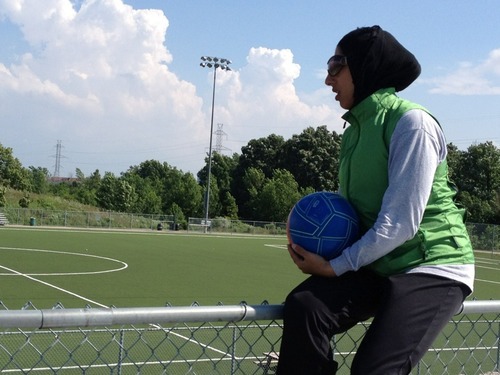
THE KEY TO FIGHTING GENDERED ISLAMOPHOBIA

By Shireen Ahmed
"Hands Up... SCREAM," he shouted. "HANDS UP! Faster! Faster!"
Konga blew his whistle and I jumped into fight stance, my hands protecting my face and head, trying to emulate his agility. I was panting and tried to keep up with the pace and the demands of the instructor. I faced Jihad, my 13-year-old daughter. Beads of sweat covered her forehead and her eyes were dark and intense.
A few weeks ago, I committed to attending this self-defence session offered by Konga Fitness at Battle Arts Academy in Mississauga, Ontario, located just west of Toronto. It is one of the 20 self-defence workshops and sessions being offered for women in the last two months. After an alarming number of attacks on identifiable Muslims occurred in the Greater Toronto Area following the tragedies in Paris and San Bernardino, a few community members and organizations mobilized to offer workshops and self-defence classes.
Islamophobia has reared its ugly head in Canada and a lot of women in the Muslim community were feeling particularly vulnerable, angry, frustrated and, yes, scared—I certainly was.
Our instructor, Khaled Konga, yelled directions for our body positioning and sequences. We continued for another three minutes. When he was satisfied with our movements and our responses to his commands, we were permitted to take a water break.
"Confidence. It is about confidence" Konga reiterated as we gulped, "You must be confident. You must be aware. You must use your voice!" His Egyptian accent dotted his directions. "You are strong. I am not going to teach you superman kicks and fancy punches. I am teaching you the basics so you can be safe. This is reality and function."
Above all, he reminded us, screaming is imperative. I look over and see my child nodding in agreement. I was grateful that she was absorbing all of this. Some of the other participants were smiling and chatting intermittently but we both stayed in battle mode. This was important. We both knew it. 
This session had about 30 attendees. All but two were women of colour. The majority of the women in the group were wearing the hijab. When I first brought up personal safety in the wake of an increase of attacks on Muslims, Jihad confessed she was more concerned for me since I cover and she does not. I realized that the best thing was for both of us to attend together.
I am an identifiable Muslim woman. I wear a hijab. I have worn it for almost 20 years—by choice. That my decision to wear a headscarf could be a trigger for ignorant people to attack me is unsettling, to say the least. My daughter does not choose to cover. But she identifies as a Muslim and her name is unmistakably and unapologetically Arabic. I trust her but I feel burdened by an anxiety that she could be targeted because of her beliefs, her skin colour and even her name. Most of the victims of recent attacks have been young women. And some close to my home. As a result, some have decided to not go out at night as often. I don't blame them. But I opted for physical preparedness in case my daughter or I were ever in that situation.
My friend Noor, who happens to be a black belt in karate and also a sexual assault prevention instructor, shared the information about Konga's free sessions, and I immediately registered for two spots. Jihad initially groaned and insisted that the wrestling sessions in our living room with her dad and three brothers were sufficient. But I wouldn't have any of it, fearing that Islamophobes and misogynists could unleash their ignorant rage on her. She would come to this workshop; if only for giving me and her father some peace of mind.
I might have reconsidered when I saw how eager she would be to partner with me and attack me on Konga's cues. She was fierce and determined. "At least this attitude you giveme can empower you in something," I muttered to her. She rolled her eyes but we continued the drill.
In between bouts of emphasizing the importance of spatial awareness and quick footwork, Konga reminded us that our main purpose was, in fact, not to maim aggressors but to get to safety. Our sharp responses of an elbow or a kick might only irritate or confuse a person attacking us. But it would give us that opportunity to get the hell out of there and get help.
Jihad remained rapt with attention. She is used to physical demands of an athlete but this training is about awareness and smart decisions under pressure. We are told that ultimately we should practice these maneuvers until they become second nature. Constant awareness of the spaces we are in is so important for all women—Muslim, or not, and for all ages.
Jihad was the youngest one in the session but victims of such attacks can be quite young. I think about this a lot. In the United States, one such victim was a girl in sixth grade and beaten by three schoolboys who shouted "ISIS" at her as they punched her.
I want my daughter to be able to defend herself, and I will not always be there. Those thoughts weigh heavily on me. Young Muslims, who grew up on timbits and homogenized milk in Canada—the only home they have ever known—worry about their safety. Those young female Muslims cheer for the same hockey teams, volunteer at community hospitals and inhale poutine like any other teenager from Canada. But they worry about being targets of racist violence, which many in this country will never experience.
"Mama, focus!" she snapped and then promptly pushed against my arms. I shook myself to attention and straightened my posture. The I re-engaged with her. She needs to see me learning and fighting. The information we received was mentally exhausting and physically demanding. My arms hurt and my calves are sore but I feel I need to continue.
In every class, workshop or seminar I have ever attended, the instructors all underline how confidence is essential. A two-hour session is not enough to master all martial arts moves, but consistent training can certainly help. In one of our many conversations, Noor told me that, "Participants having a false sense of security is always a concern, but you want to ensure women understand martial arts is about having positive headspace." She adds that a sense of sisterhood is also strengthened by these initiatives. This is also an important lesson for my daughter to learn. I wish that personal and community development didn't have to be in the context of protection from violence, but it is her reality right now.
Gendered Islamophobia is rooted in racism and misogyny. It is a constant in the lives of women. Misogyny has lurked in the true north strong and free for a long time. It is not something new to Canada. Our government just released an inquiry about over 1,200missing and murdered Indigenous women.
With powerful Western figures like Republican presidential candidate Donald Trump and former Canadian prime minister Stephen Harper having spewed hateful vitriol, the increase in anti-Muslim sentiment is notable. But we go forward. We practice that jab, that block, that kick to an attacker's groin, again and again.
Konga wraps up the session lightheartedly and says: "This is just a small key. A key you can use to open the door and get out of danger."
We grabbed a coffee with Noor after the workshop to decompress and discuss the afternoon. I didn't want Jihad to feel burdened with a reality that seems grim. But she ordered two pieces of cheesecake and was her normal self.
Noor hasn't been attacked before, and I certainly hope both Jihad and I are also fortunate enough to never have to defend ourselves from a physical attack. Safety is not a privilege, it is a right. But sometimes you have to fight for it—you have to burst through the door to a safe space. And now at least Jihad has a key.
All photos courtesy Konga Fitness
Source: https://sports.vice.com/ca/article/the-key-to-fighting-gendered-islamophobia 

1/12/15

Honey Thaljieh on TEDx

Honey Thaljieh is former captain of the Palestinian Woman's football team and currently working at FIFA in Zurich. 


11/13/14

Mumbra's Muslim girls kick out stereotypes

By Kamayani Bali-Mahabal
They started off as a secret sports club. What brought them together was their shared love for football, a game they couldn't dream of playing owing to their conservative family backgrounds. After all, how could young girls, who weren't even allowed to step out of their homes without the 'hijab' (veil), run around kicking ball in an open field? But they showed exceptional courage when they defied parental dictate to pursue their passion for the sport. Three years back, Sabah Khan, Salma Ansari, Sabah Parveen, Aquila, Saadia and 40 other girls got out of their homes in Mumbra, a small town 40 kilometres from Mumbai, Maharashtra, to play football. Today, this group that calls itself Parcham, inspired by Asrar ul Haq Majaz, an Urdu poet who saw women as crusaders with an inherent quality to revolt against exploitation and injustice, has truly lived up to its name. They have not only broken gender stereotypes by regularly playing football but have been responsible for bridging the gap between the Muslims and the Hindus in their communally volatile city. 

Sabah Khan, the captain of this unique all-girls team, recalls how their journey of change began, "Around 2011, a bunch of us were approached by the NGO Magic Bus that uses sports as a means to help poor children lead a better life. They wanted to teach football to both girls and boys but we told them that in Mumbra Muslim girls cannot take up a sport let alone play alongside boys. That's when they decided to exclusively train girls who were keen to try out something they had only dreamt of."

The target was to put together a group of 40 girls but that was easier said than done. "Most of us hail from families that struggle to make ends meet. We can never really spare time for fun and games. We study, chip in at home or work. That's why we were unable to personally go to motivate girls to join in. However, some of us decided to make pamphlets and distribute them outside girls' schools and colleges. Apart from that we also approached the local wing of the Maharashtra Mahila Parishad that works with several self help groups to see if any of their members would be interested in sending their girls for this programme. In this way, we managed to build a team," elaborates Sabah. 

The next challenge was to find a ground to practice on. "We went to every school and college in the vicinity that had a ground to find out whether they would allow us to play for two hours every Sunday. Unfortunately, no one was agreeable," shares the articulate leader. It was a member of the Mahila Parishad, who spoke to a board member of a temple trust to secure permission for using the open space around it for playing.

At the outset, the girls decided to call their team 'Parcham'. Aquila, one of the founding members, narrates the story behind it, "We decided to call ourselves 'Parcham' as we are inspired by Asrar ul Haq Majaz, better known as Majaz Lakhnawi. Through his romantic, revolutionary verses, Majaz urged women to look at the hijab not as a barrier but as a flag or banner. He has written: 'Tere maathe pe ye aanchal bauhat hi khoob hai, lekin tu is aanchal se ik parcham bana leti to achcha tha… (The veil covering your head and face is beautiful, but if you make a flag out of it, it would be better)'. We, too, have transformed something that many see as a sign of repression into a symbol of revolution." 

Through sports Parcham strives to build a just and equal society that is respectful of diversity and celebrates difference and interdependence. Their mission is to empower marginalised communities to access their fundamental rights, creating spaces for dialogue among diverse sections of society. "And our one great achievement has been getting official recognition for our struggle to get a playground for the girls," says Aquila. Last year, after they started a massive signature campaign with the support of 900 girls from across Mumbra, their demand for a ground was finally acknowledged. Female students from various schools, under the leadership of Parcham, wrote a joint letter stating: "We wish to play football and other sports. We believe that through sports we also come together in unity, forgetting our religious and other differences."

When they met with MLA Jeetendra Awhad he was amazed to see this strength of association. He told them that it was perhaps for the first time that 900 girls had got together to ask for a playground to be reserved for them. He also assured them of their very own space to play. "That promise was fulfilled and the football-loving girls of Mumbra are now able to practice freely. Moreover, the move gave a boost to our campaign that motivates girls and women to reclaim open spaces," states Aquila. Their dedicated practice sessions have fetched Parcham some rich rewards. They have won two major local tournaments - one in November 2013 and another in March 2014. 

Of course, if the struggles of the group have been remarkable, then so are their individual journeys. Take the case of Saadia Bano (name changed). "When I had first heard about Parcham I immediately wanted to be a part of it. However, I did not have the courage to speak to my parents. I am not allowed to move from home without a 'hijab', so imagine them allowing me to play football! Initially, I used to step out every Sunday telling them that I was going to visit some friend. Then one day when I took my brother's T-shirt to wear for a tournament my mother immediately suspected that I was doing something without telling them. When she confronted me I had to confess to her and my sister."

Saadia's brothers still have no inkling. "After I won a trophy at a tournament I told them that it was a friend's. There are many like me who cannot yet be completely honest with all their family members. We don't want to make them unhappy nor do we want our freedom curtailed. This way we all get what we want," she says. 

Adds Salma Ansari, 22, who has supportive parents and is pursuing an MBA degree, "What we need is for the society to accept that girls have an equal right to public spaces; that they too deserve to experience the joy of being able to run free, kick a ball, hold a bat, sprint, jump or swim. Nowadays, we are trying to break gender stereotypes by training a group of 50 young boys and girls together." The religious divide, too, has been overcome with the inclusion of girls from other faiths. Simran, 15, the youngest member of the team, is a Sikh. "We have so many misconceptions about other religions. But perceptions and attitudes change when we meet and interact. Being in Parcham, I am learning about gender, equality, justice… Watch out, I am a feminist in the making!" she says emphatically. 

What's next on Parcham's agenda? "We want to set up a resource centre for our girls, complete with books, newspapers, computers and a wi-fi network. Every Saturday, we plan to hold meetings where we can discuss the latest news and concepts like secularism and citizenship to enable everyone to think and form opinions on subjects they are passionate about. The centre will be a safe haven for Muslims and non-Muslims to build friendships," says Sabah. 

In the home town of Ishrat Jahan, the young woman who was tragically shot in an encounter in Ahmedabad in 2004, these girls are gearing up to drive out prejudice and hatred. 

—(Women's Feature Service)
Source: http://www.kashmirtimes.in/newsdet.aspx?q=38270

11/12/14

'It may take 10 years to tackle football's lack of diversity' - FA Council member Rimla Akhtar

Five months ago, Rimla Akhtar became the first Muslim woman on the FA Council. In a body which Football Association chairman, Greg Dyke, says is “overwhelmingly male and white”, Akhtar is seen as the ideal role model for the Asian community.
But, when I mention this, the 32-year-old chartered accountant smiles and says: “That’s up to others to decide.”
She is one of six women on the
121-strong FA Council, which helps decide major policy for the governing body, and her appointment comes at a time when the lack of diversity in positions of power within the game is a hot topic.
Yesterday’s report by the Sport Person’s Think Tank highlighted the problem with just 19 of the 552 ‘top’ coaching positions at ­English clubs being held by blacks and ethnic minorities. The only bosses are Chris Powell (right) at ­Huddersfield and Keith Curle at Carlisle.
“It is unacceptable that we have only two black League managers when something like 30 per cent of players within football are from the black community,” says Akhtar. “We need to see how we can open up football to more diverse managers. It’s a problem right across football, we also have very few black board ­members. Change does need to happen.”
It has been suggested that football should adopt its own version of the NFL’s Rooney Rule, whereby clubs must  interview at least one black or minority ethnic candidate for a managerial vacancy.
However, Akhtar says: “For me, ­quotas are a short-term strategy. I wouldn’t want to be selected for something because I’m a woman, because I’m Asian or because I’m Muslim. I would like to be selected on merit. I’ve had people really close to me, relatives even, that have said, ‘you do realise that you’re being included just because you wear the scarf’.
“In the long term, it’s about making the sports environment more inclusive. That’s what’s lacking right now. We need to get an inclusive mindset as well as action on the ground.”
Source: http://www.standard.co.uk/sport/football/it-may-take-10-years-to-tackle-footballs-lack-of-diversity--fa-council-member-rimla-akhtar-9853069.html

6/26/14

Al Sadd wins Women's Handball Cup title


Al Sadd won Qatar Cup title for the women's handball after beating Al Rayyan team today on 37-32 in the match that took place on Wednesday evening at Al Gharafa Club.
 
Qatar Handball Association Ahmed Mohammed Al-Shaabi and Qatar Women Sports Committee (QWSC) President Ahlam Al Mana presented the championship trophy and gold medals to Al Sadd, and the silver medals to Al Rayyan teams.
Source: http://www.qatarisbooming.com/article/al-sadd-wins-womens-handball-cup-title 

6/1/14

Iranian female junior cycling team wins first Asian medal


The Iranian female junior cycling team has created history in their country for winning
Bronze in 2014 Asian Cycling Championship in Astana, Kazakhstan on Monday, making their
mark in Asian cycling
This win has also marked the first Asian Championships medal by Iranian female
cyclists.
With this medal, Iran has received 6 medals, including 2 silvers and 4 bronze ones in the
2014 Asian Cycling Championships.
Photo taken from Josiah Ng’s Instagram: Follow him at @josiahcyclist
(http://instagram.com/josiahcyclist)
Source: http://www.baikbike.com/iranian-female-junior-cycling-team-wins-first-asian-medal/

Pakistani female Judokas to help Indian athletes prepare for Commonwealth Games

According to Pakistan Judo Federation (PJF) secretary Masood Ahmed, the female squad received rave reviews at the South Asian Championship in Nepal in April. PHOTOS: MUHAMMAD JAVAID & ZAFAR ASLAM/ FILE
Pakistani women may not be catching a ticket to the Commonwealth Games themselves, but they can certainly help their Indian counterparts prepare for the Commonwealth Games’ Judo competition scheduled for next month.
The 10-women squad including South Asian Judo Championship gold medalist Humera Ashique, silver medalists Mariam Jabbar, Beenish Khan, bronze medalists Ambreen Masih, Shumaila Gul, Fauzia Mumtaz and emerging talent Aqsa Hussain, Rabia Babar and Iran Shahzadi will travel to Patiala in June.
According to Pakistan Judo Federation (PJF) secretary Masood Ahmed, the female squad received rave reviews at the South Asian Championship in Nepal in April.
Ahmed said that since Pakistan is not fielding a team at Commonwealth Games due to Pakistan Olympics Association and Pakistan Government conflict, the athletes will now help the neighbours to vie for the title in Glasgow in July.
“Since we can’t go, we’ll help them, we are South Asian nationss anyway, it’s a great deal for both parties,” Ahmed told The Express Tribune.
Ahmed said that the Indian official Mukesh Kumar invited Pakistani athletes to Patiala for the training sessions for 20 days.
“It’s going to happen next month, we’ve been invited to Patiala where the Indian squad is preparing,” said Ahmed.
“Kumar invited our female athletes because they are impressive, they’ve given a tough competition to the Indian, Nepalese and Sri Lankan judokas in the championship,” he said.
Furthermore, he proposed that Pakistani women can come to the Indian national camp in Patiala, where they have the best facilities for the sports. Ahmed said that the practice with Pakistani athletes will help the Indian women improve for Commonwealth Games.
“It will also be a great amount of exposure for our squad.”
Ahmed added that the invitation means more than just an opportunity.
“It is recognition of our talent by our counter-parts, and it’s welcoming. It’s an encouragement for our athletes that they are good enough and that their efforts are not going unseen. In many ways it is an honour and a great way to promote healthy relations between two nations,” said Ahmed.
He said that the team’s visas are in the process and hopefully they will get the documents for travel on time, as the Indian Judo Federation is cooperating with Pakistan.
http://tribune.com.pk/story/714442/pakistani-female-judokas-to-help-indian-athletes-prepare-for-commonwealth-games/

4/15/14

Physical education for Saudi girls stirs debate

Reuters
A step to introduce physical education for girls at Saudi government schools has become the talk of the town in the kingdom, with many hailing it as a positive development and some slamming it as a threat to social values.
Last week, the government advisory Shura Council called on the country’s education ministry to look into including sports for girls at state-run schools on condition that they are in line with Sharia rules on dress and gender segregation, according to the Saudi Press Agency.
Meanwhile, Mohammed al-Saleh, secretary-general of the Higher Education Council, told makkahnewspaper.comMonday that the next move would be to recruit sports educators from abroad.
A previous ban on physical education for girls was relaxed in private schools in 2013. The Shura Council’s demand last week to include state-run schools has been welcomed internationally both by the International Olympic Committee and Human Rights Watch.
“It’s a good sign that Saudi authorities appear to realize letting all girls in Saudi Arabia play sports is important to their physical and mental wellbeing,” Sarah Leah Whitson of Human Rights Watch told Agence France Presse.
Al-Watan newspaper published a column on Monday with a title that read: “Would you marry a girl who practiced sports?” The columnist criticized and mocked opponents of the move.
He quoted a two-year old study showing that three-quarters of the country’s population suffered obesity and 75 percent of the women are obese and that 80 percent of secondary diabetes cases were related to obesity.
The article dismissed conservative voices that are critical of making girls play sports at schools. Some conservative clerics had denounced the move as a “Western innovation,” according to the Wall Street Journal.
One cleric Abdullah Al Dawood even tweeted that “these steps will end in infidelity and prostitution.”
Speaking to Al Arabiya News from Jeddah, veteran Saudi journalist Omar al-Mudwahi said there was nothing new in the clerical opposition to the move. “The religious institution has always stood against the advancement of women’s rights.”
Abdullah Hamidaddin, a Saudi writer and commentator on religion and politics, wrote in a recent column on Al Arabiya news that the Shura Counci’s move “is not a decision about girls practicing sports. Nor is it one about women rights. This is a decision to push back the authority of the religious institution.
“The easiest way to explain what happened is to say that there are zealots whose interpretation of Islamic scripture is misogynic and thus believe that the only option women have is to lie down and die. Thus the government decided to intervene and give women some hope of a natural life,” Hamidaddin added.
Journalist Mudwahi noted that the plan to introduce physical education for girls in public schools is part of comprehensive government response to high obesity rates among women.
“Municipalities across the kingdom are also creating long pedestrian walkways special for women especially after repeated health ministry figures showing high obesity and diabetes rates among women,” he said.
“Previously all physical education centers are extensions of hospitals as if it is a disease, as if female sports is a disease and it is very expensive,” al-Mudwahi said.
“As a man, it would cost me 300 riyals ($80) per month to go to gym. But it would cost my wife or my daughter about 1000 riyals ($266),” he explained.
He noted that unlike universities, most schools in the primary and secondary education are not equipped with physical education facilities for girls.
“This issue has been passed in the Shura Council, but the important question remains: Are our schools ready for such thing? Of course no,” he said. But within a few years, most schools are likely to have physical education facilities if there is a legal framework for girls to practice sport.
The Saudi Shura Council move is seen as another step empowering women during the reign of King Abdullah, after appointing women into the legislative Shura Council and allowing them to practice different professions which weren’t allowed before such as law.
Source: http://english.alarabiya.net/en/perspective/features/2014/04/15/Physical-education-for-girls-stirs-debate-in-Saudi-Arabia.html

3/14/14

Tour De Farm and BBQ: Join MADE’s first annual London to Oxford cycle ride

MADE in Europe is a Muslim youth-led organisation working to mobilise Muslim communities in the UK to live more ethically and sustainably. 

Join MADE for a 100km ride through the glorious Oxfordshire countryside to Willowbrook Farm ending with a delicious ethical BBQ of tayyib meat produced on the farm. Experience off­-the-grid sustainable living in action and explore Willowbrook Organic Farm, the UK’s first organic halal farm.

Get your friends and family to come along to spend the day on the farm and join you for the BBQ at the end of your journey. Everyone is welcome!

Please raise upwards of £100 for the cycle or just £12 for the farm visit and BBQ.   


Sarah Javaid
Executive Director


3/5/14

I'm a Footballer Who Happens to Wear Hijab -- I Didn't Need FIFA to Tell Me That


By: Shireen Ahmed

Here is my reality.
I have been contacted many, many times since March 1 when FIFA announced that IFAB formally overturned their decision to ban headcoverings on the pitch. 
Family, friends and colleagues have sent me congratulatory notes and news reports. 
Since July 2012, I have blogged, written and expressed happiness, hope, gratitude and sometimes frustration with this process.
One more step towards the pitch! 
I was elated. 
Women from all qualifying nations will attend the Women’s World Cup 2015 in Canada. My country. There will be women from Asia, Africa and from Europe. There will be women in hijab, in pants and in shorts.
As it should be. I was thrilled initially.  
Now, I am exhausted.
I am drained from the process. I lost time away from the sport I have know and identified with since I was a very young child.
It was a part of my identity. It was a part of my routine. It was a part of my life.
I have written and opined about FIFA’s stance. I have shared pictures of radiating women who love the game and who defy cultural norms to enjoy it. Those connected and inspired by it.
Got this beautiful picture from Lela Ahmadzai’s website.   This particular image makes me incredibly happy. My mother always taught me I could “be anyone and play anything”.   I hope young women all over the world hear that message at some point in their lives.  It doesn’t have to be football. It can be something they love and something they crave. Women’s Advocacy, Sport, Environmentalism, Hobbies but something. So that they know, and the world understands, that everyone has a contribution to make.  Women need that chance. And that encouragement.   Lela has captured the resilience and passion of the women in Afghanistan and their love for the beautiful game.  Do check out her amazing work: http://www.ahmadzai.eu/en/allgemein-en/a-wmans-goal  I watch this short film a lot. It reminds me of my privilege. I am very aware of my ability to play safely and teach my daughter the same.   I have posted it and will continue to post it again. And again. And Again.
And those who risk their lives to play it.
What I did not say was how I suffered from sheer resentment and difficulty when I was not allowed to compete. 
I am allowing myself to say it now. 
I longed for the the thrill of the sprint, and the rush of the challenge.
And the goal. The beautiful goal.
I even craved the hit of the post or the uncontrolled shot that went wide. 
I missed it desperately.
But I chose to cover for personal reasons and told myself my connection to my Creator was stronger than my connection to football.
What I didn’t recognize was those two connections were not mutually exclusive. 
I understand the anger and frustration of women who were told “NO”.Who were told “NO” by an organization that is supposed to create opportunity and advocate for the Beautiful Game.
I started wearing hijab in 1997. I played my last season in the fall. I was told I had to either “take it off on the pitch” or “wait until I was ready to commit fully to the rules of the game”.
There was no specific law against (that would come in 2007) it but nothing allowing it either.
I walked away from the pitch.
My heart broke. But I quickly wiped my angry tears with my hijab. It provided me tight comfort and strength against this sporting injustice.
I played pick-up. I played at picnics. At family gatherings. I played at any opportunity. I played against my husband. I played with my children.
But I was used to playing in leagues, in matches with referees and full of politics and drama. 
I remember watching one of my heroes, Zinedine Zidane hoist the World Cup over his head in glory in 1998.
It was the first summer I did not play.
His victory as a Frenchman of Muslim-Algerian descent was bittersweet for me. He was of my faith. But he was playing.
I practice his roulette anyway. Just in case I might need it someday.
Life went on. I cheered, I watched and I fooled around with a ball. I did not play regularly. 
image
After what seemed like several lifetimes, I found a league that would accept me. 
I went back hesitant and I went back happily.
I tasted the joy in the sweat rolling down my face.
I loved it. I stayed for years and then I found the courage to venture out and challenge this.
I found a club that agreed.
And I remember what I always knew: I was a footballer who wore hijab.
Not a hijab-wearing woman who played football.
Fast forward to 2014 when Jerome Valcke announced: "It was decided that female players can cover their heads to play". 
Muslim women *could* always play.
Now they are *permitted*.
Semantics.
image
How can I laud FIFA for striking down a law that should have never been implemented in the first place?
How can I be grateful for someone allowing me to do what I should ahve always been allowed do?
Why was I made to choose?
How can you choose between your heart and soul?
Thank God my daughter won’t have to face that choice.
Someone pointed this out to me: “funny how the west tells us that hijab is oppressive yet they use it to oppress hijabis by banning them from playing sports”.
That isn’t funny. It is horrible. 
Last year, I was sidelined from football due to what turned out to be a full blowout of my ACL . Being ripped away from the game in this manner was painful. But it was of my volition. I was injured in a match, while in play. My choice.
Being ripped from the game because a lot of white, privileged men decided it was dangerous for me and the sport was torturous. Their choice.
And it was unfair.
So, today I am not “happy”. I am disappointed that I lost time and energy.
My joy is tapered with simple relief. 
In future, I will not let it ruin other childhoods and affect and exclude people.
Football is for all of us.
It should always have been.

Source: http://footybedsheets.tumblr.com/post/78519986470/my-thoughts-hijab-on-the-pitch

3/4/14

This MMA Fighter Is Asian, Female and Muslim

BY: DAVID STOUT
In the first round of her professional mixed-martial-arts (MMA) debut, Malaysia’s Ann Osman took close to 30 knees to the midsection from her opponent, Singapore’s Sherilyn Lim.
“You’ve broken her!” Lim’s trainer could be heard shouting, as Lim leaned against the cage of the Singapore Indoor Stadium.
In the second and third rounds, Osman took more devastating knee and head strikes, but responded with knees of her own along with takedowns and crushing ground and pound. Both fighters were unloading whopping lefts and straight rights as the final bell rang. But after 15 minutes of brawling, Lim’s hand was raised in a split-decision victory.
ONE Fighting Championship’s Total Domination event, held in October, was a disappointment for Osman, but “I definitely gave my best during the fight,” the Malaysian tells TIME.
And despite her defeat, the bout captured the public’s imagination. On March 14, following immense pressure from both fans and media, ONE FC, the largest MMA promotion in Asia, will host a rematch between Lim and Osman — only this time in Osman’s home country.
The fight, which will be broadcast in 28 different countries, will contain several firsts. This will be Osman’s first fight in front of her fellow Malaysians, and it will be the first time a female Muslim fighter has competed on the global stage in a country where the official religion is Islam.
“There’s an empowering element to women in Asia to see a strong, confident, fit female competing on a world scale, on a world stage, especially if you’re Muslim or if you’re from a Muslim country like Malaysia,” says ONE FC CEO Victor Cui.
Not many sports give women similar prestige as their male counterparts, but the growing prominence of female UFC stars such as Ronda Rousey, Liz Carmouche and Miesha Tate has almost given MMA that distinction. And with the meteoric rise of MMA in Asia, ever more women are taking up the sport, and breaking fresh ground as they do.
“Having a female fight in a Muslim country like Malaysia is going to be a first,” says Cui. “There’s a huge cultural implication.”
Malaysia may not be Saudi Arabia or Iran, but religious conservatism is increasingly prevalent there. In October, the country’s courts ruled that only Muslims have the legal right to use the word Allah, sparking fierce protests from the nation’s Christian minority, who have longed used the same word for God.
Nevertheless, Osman, 27, says she has never felt ostracized because of her gender or decision to push boundaries. “I’m fortunate to not have felt any of that pressure about me being Muslim and a female MMA fighter at the same time,” says the Sabah native. “I’m very fortunate to have the support from everyone I know.”
According to Malaysian MMA pioneer Melvin Yeoh, Osman’s acceptance comes from both ONE FC’s assertive marketing in tandem with MMA’s official recognition by the Ministry of Youth and Sports, one of three sports to have the state’s blessing.

One Fighting Championship - Total Domination: Weigh In
Ann Osman of Malaysia poses on the scale during the official weigh-in for her bout against Sherilyn Lim of Singapore ahead of the One Fighting Championship bout in Singapore on Oct. 17, 2013
“She’s a Muslim and people saw what she can do and then they thought, this we can also do,” says Yeoh.
While only 10 or so women trained at Yeoh’s fighting camp in Johor Bahru throughout 2013, in the wake of Osman’s October bout and the hype surrounding the upcoming rematch, interest in MMA from female athletes has snowballed. In January alone, he saw more than 20 women sign up.
According to Cui, it’s emphasizing narratives like Osman’s and playing off historical geopolitical rivalries like the one that exists between Singapore and Malaysia that is essential to MMA sinking deep roots into emerging Asian markets. “It’s Malaysia vs. Singapore, and those guys have a very, very extremely heated competition,” he says.
When ONE FC started investing in Malaysia in earnest two years ago there were only a handful of MMA gyms. Fast-forward to 2014, and there are now more than 30 operating in the capital Kuala Lumpur. This only adds to the competition between the nations. Singapore currently has around 10 fighting gyms.
“Singapore says they have better fighters, Malaysia says they have better fighters, so it’s a never-ending debate,” explains Yeoh.
But it’s not just regional rivalry that is stoking anticipation, as these women can actually fight. MMA blog Bloody Elbow nominated the third round of their previous encounter for the site’s “Round of the Year” for 2013.
For Osman, though, there’s only one prize in her sights. “I am definitely taking home the win in front of my hometown crowd,” she says. “First-round knockout!”

Source:
TIME.com http://keepingscore.blogs.time.com/2014/03/04/muslim-female-mma-fighter-ann-osman/#ixzz2v2VIwl6J

2/15/14

Soccer Scandal: Iran's Female Stars Face Random Gender Tests

TEHRAN -- Iran’s female soccer pros face random gender tests after seven people were disqualified from the league because they were deemed not to be women.
The "snap checks" have been introduced by the Football Federation Islamic Republic of Iran, according to Ahmad Hashemian, who heads its medical committee.
Teams are required to perform gender tests on any woman signing a professional contract and pass the results on to the federation, Hashemian said. However, many clubs previously failed to comply with the regulation. The rule was introduced about three years ago after a team raised concerns that an opponent's goalkeeper was a man.
Seven people have now been disqualified from playing in the women’s league, while four others are waiting to hear back from the federation.

Iranian female soccer players attend in a training session in Tehran on June 25, 2009.
The checks are similar to those carried out on South African runner Caster Semenya, who was forced to undergo gender tests before eventually beingcleared to return to action against women.

In cases where players are undergoing sex changes, Hashemian said they would be allowed back onto the field when their gender-reassignment procedures had been completed.
"If these people can solve their problems through surgery and be in a position to receive the necessary medical qualifications, they will then be able to participate in [women's] soccer," he added.
While Iran has strict laws governing homosexuality, which is punishable by death, sex-change operations are legal as a result of a fatwa - or religious ruling - pronounced by the late Ayatollah Ruhollah Khomeini.
Sex changes are recognized in Iranian passports and only Thailand performs more gender-reassignment surgeries.
Henry Austin reported from London.

2/11/14

Meet Muslim Figure Skater Zahra Lari

Zahra Lari is an 18-year-old figure skater from the United Arab Emirates who’s known to the folks back home as the “Ice Princess.” This year, she’s already making headlines at the Winter Olympics in Sochi.
Source: http://colorlines.com/archives/2014/02/meet_emirati_figure_skater_zahra_lari_who_performs_in_hijab.html