5/11/11

Badminton's skirt rules cause unease

A new ruling that requires female badminton players to wear skirts on court is causing unease among players as they prepare to adopt the new compulsory dress code.
Diju Valiyaveetil, right, and Jwala Gutta of India play a World Badminton Championships match against Poland in Hyderbad in 2009. A new ruling that requires female badminton players to wear skirts on court is causing unease among players as they prepare to adopt the new compulsory dress code.
The Indian Open, which begins next Tuesday, will be the last tournament in which women can wear shorts on court before the skirt requirement comes into force on May 1.
The Badminton World Federation (BWF) announced the change in 2009 in a bid to boost the sport's profile among viewers and sponsors.
Doubles specialist and Indian glamour girl Jwala Gutta, who has always played in skirts, said the new dress code might help to raise interest but players should not be forced to conform.
"You cannot make it compulsory for everyone to wear skirts. It depends on each individual and their comfortable level. I am not sure people will like being told what to wear and what not to," she said.
World number three Saina Nehwal, the top seed at the April 26-May 1 Indian Open, is one of the many players in India who prefers to wear shorts on court.
Gutta, who won the Commonwealth Games gold last year with her partner Ashwini Ponnapa, endorsed efforts to make the sport more glamorous.
She said that interest in tennis was greater partly because of the attraction of female stars such as Maria Sharapova or the Williams sisters, whose on-court outfits are often as remarked about as their game.
India's top female tennis player Sania Mirza came under fire from Muslim clerics four years back for wearing short skirts on court.
"Anything that helps makes the sport attractive should be welcomed," said the 27-year-old Gutta, whose eye-catching looks and daring dress sense on and off court have won her a loyal following at home.
"But instead of enforcing rules on players, the federation should ask sponsors to come up with innovative dresses.
"You can add a lot of colour, experiment with styling and stuff like that. That way it will ensure players' comfort and take care of the glamour aspect as well."
Another Indian player, who asked not to be named, said she was uncomfortable with the new ruling.
"I wear skirts or dresses only on special occasions, but never in tournaments," she said. "Skirts hamper my movement when I play."
Despite rapid modernisation, India remains a generally conservative country where public displays of sexuality are taboo and women are expected to dress modestly.
Source: http://www.bangkokpost.com/breakingnews/232468/badminton-new-skirt-rules-cause-unease

Badminton star Jwala Gutta smashes compulsory skirt rule


A new ruling that requires female badminton players to wear skirts on court is causing unease among players as they prepare to adopt the new compulsory dress code.
The Indian Open Super Series, which begins next Tuesday, will be the last tournament in which women can wear shorts on court before the skirt requirement comes into force on May 1.
The Badminton World Federation (BWF) announced the change in 2009 in a bid to boost the sport's profile among viewers and sponsors.
Doubles specialist and glamour girl Jwala Gutta, who has always played in skirts, said the new dress code might help to raise interest but players should not be forced to conform.
Jwala Gutta
Doubles player Jwala Gutta feels that players should not be forced to wear skirts.
"You cannot make it compulsory for everyone to wear skirts. It depends on each individual and their comfortable level. I am not sure people will like being told what to wear and what not to," she said.
World number three Saina Nehwal, the top seed at the April 26- May 1 India Open Super Series, is one of the many players who prefers to wear shorts on court. Gutta, who won the Commonwealth Games gold last year with Ashwini Ponnapa, endorsed efforts to make the sport more glamourous.
She said that interest in tennis was greater partly because of the attraction of female stars such as Maria Sharapova or the Williams sisters, whose on- court outfits are often as remarked about as their game.
Ace tennis player Sania Mirza came under fire from muslim clerics four years back for wear- ing short skirts on court.
"Anything that helps makes the sport attractive should be welcomed," said the 27-year-old Gutta, whose eye- catching looks and daring dress sense on and off court have won her a loyal following at home. " But instead of enforcing rules on players, the federation should ask sponsors to come up with innovative dresses.
You can add a lot of colour, experiment with styling and stuff like that. That way it will ensure players' comfort and take care of the glamour aspect as well." Another Indian player, who asked not to be named, said she was uncomfortable with the new ruling. " I wear skirts or dresses only on special occasions, but never in tournaments," she said.
"Skirts hamper my movement when I play."
ASIAN CHAMPIONSHIP
India's young brigade, including Sai Praneeth and Saurabh Verma, will look to create a few upsets when they take on their higher- ranked opponents in the Asian Badminton Championship starting on Tuesday in ChengDu, China.
The Indian team, besides Ajay Jayaram who pulled out at the last moment due to injury, will be led by Praneeth and Saurabh in the men's singles and the duo would hope to make their presence felt in the prestigious international tournament.

4/12/11

Turkey wins Several Medals in European Weightlifting Championship

Nurcan Taylan
Turkish weightlifter Nurcan Taylan has won three gold medals in the 24th European Weightlifting Championship in Kazan, Russia. Turkish weightlifters won eight medals on the first day of the European Weightlifting Championship. 
Taylan won the medals in the women's 48 kg category after lifting 90 kg in snatch, 105 kg in clean and jerk and 195 kg in aggregate. 
Nurdan Karagoz (Source:Getty Images)
Another Turkish weightlifter Nurdan Karagoz finished third in snatch and won the bronze medal with 80 kg. Karagoz lifted 100 kg in clean and jerk and won the silver medal. She was also the winner of another silver medal with 180 kg in aggregate. 
Aylin Dasdelen (Source: Getty Images)
Aylin Dasdelen of Turkey competes during the women's 53 kilogram weightlifting finals of 24th Women European Senior Weightlifting Championships in Kazan on April 12, 2011. Dasdelen won the event.
Source: Anatolia News Agency

4/2/11

A Middle East Female Sports Revolution?

Al-Jazeera has called the current uprisings in the Middle East a feminist revolution. The news channel also argues that women’s participation has made the protests more peaceful than they might have been otherwise. Could the happenings in the Middle East also spill over into sport?
By Andreas Selliaas
Few female role models
Female role models in sports are few in this part of the world. In the biggest championships few women represent and/or do well in sports at the highest level. Barely a handful of winners are born in this part of the world. Moroccan Nawal El Moutawakel won Olympic gold in the 400m hurdles at the Olympics in Los Angeles in 1984. She was the first African-born Muslim who managed such a feat.
In 1995, Ghada Shouaa from Syria won the World Championship gold in heptathlon, a feat she repeated at the Olympics in Atlanta in 1996. These two are among the few great female athletes from the Middle East, born in the countries they represent.
This does not mean that Middle Eastern women do not participate. In the Asian Games in China last year, there were large numbers of women competing. Iran, for example, had 92 female participants, Qatar 56 and Jordan 32. However, we can still talk of a glass ceiling for female athletes in this part of the world.
Saudi Arabia bottom of the list
Worst is Saudi Arabia. They did not send a single female athlete to the Summer Asian Games in China last year. Nor have they ever sent female athletes to the Olympics. Second worst in the 2010 Asia Games was Oman participating with only one woman, the tennis player; Fatma Al Nabhani.
It is ironic that Saudi Arabia in 2010, obtained board membership in the UN's newly formed women's agency UN Women – at the expense of Iran. They were certainly not awarded the post because of good work on women in sports. It remains to be seen whether the UN body can influence Saudi Arabia in the right direction, or whether Saudi Arabia will affect the agency in its hostility towards women in sports?
Will horses break the glass ceiling?
But there are rays of hope for women in Saudi Arabia and elsewhere. At the moment they are to be found within equestrian sports. Ahead of the Olympics in Beijing, Saudi Arabia had their first female representative in an Olympic delegation when Arwa Mutabagani worked as coach for the Saudi Arabian equestrians.
Equally encouraging is the fact that Dalma Rushdi H Malhas won bronze in equestrian at the Youth Olympics in Singapore last year. It seems that this sport has a great stake among women in the Middle East. Most visible through Princess Haya of Jordan who is the President of the International Federation for Equestrian sports (FEI). Last year she was re-elected as president for another four years.

Iran and FIFA
On the gender issue we also have to bear the policies of the international sports organisations in mind. The conflict between Iran and FIFA prior to the Youth Olympics last year indicates why. The conflict began when FIFA refused Iranian girls to wear hijab during matches. Due to this prohibition the Iranian Football Federation appealed to five international federations, including the IOC, to get the ban lifted.
The argument was that Muslim women must always wear headscarves, even on the football pitch. FIFA's reasoning for denying the hijab was that FIFA does not allow any religious headgear (Rule 4). In this case, it could seem that the frontlines between the Muslim world and FIFA were firmly locked. This is - at best - only half true. This gives us room for hope.

Both parties are wrong
Firstly, it is not so that all female Muslim sports teams wear headgear. It is rather the exception. Different countries and different groups of Muslims interpret the use of hijab differently. Secondly, there are many international sport federations that allow the hijab and several international matches are played with players wearing hijab. In other words, there are no absolutes in this case.
The first case about the hijab in football was in 2007, when 11-year-old Asmahan Mansour received a ban in Canada because she was wearing hijab while playing. The reason was security. They did not want her to suffocate if someone pulled her headscarf. This case has in many ways set a precedent for FIFA.
On the other hand, matches have been played with women wearing hijab. In last year's South Asian Games the Pakistani team played with very fashionable headgear, and in the match between Jordan and Palestine in November 2008, the Jordanian team played with headgear. This is just two of several examples and both had FIFA's approval. Why was it so hard to play with headscarves in Singapore?
Sport is too important?
The Iranian struggle for the use of jihab in football should be seen as part of the Iranian struggle for international recognition, both in politics and sport. But so far it does not look like Iran has succeeded. The most striking is not that they face opposition in the international sports world, but rather that they do not get strong support from other Muslim countries. This can be interpreted in two ways. Either that sport is too important to let the hijab issue disturb the international sports order, or that sport is so unimportant that it is of no relevance at all.
Saudi Gold in London?
Many fights remain on the matter of women’s rights in sports in the Middle East and it will be interesting to see if the political revolution in the North African countries spills over into other countries in the Middle East. What we can hope for is that a Saudi Arabian woman wins Olympic gold in London 2012. That would give both the London Olympics and the fight for gender equality in the Middle East a boost!
--------------------------------------------------------------------------------
This article first appeared on Andreas Selliaas' blog 'Sportens Uutholdelige Letthet' on 8 March 2011. Follow Andreas' blog (in Norwegian) on sportensuutholdeligeletthet.blogspot.com
Source: http://www.playthegame.org/news/detailed/a-middle-east-female-sports-revolution-5127.html

Women’s basketball league dunks into action!

By Ayesha Abdeen
The first week of the new Muslim Women Sport Foundation (MWSF) Exclusively Women’s Basketball League (EWBL) tipped off on March 5 in Wembley.
The league, spread over five months, has six teams competing from across London.
The first of its kind to be held in the UK, the EWBL provides a platform for women, particularly from Muslim and other ethnic minority communities, to gain competitive experience as players, coaches, officials and spectators in an environment sensitive to their religious and cultural needs.
Organised by the MWSF, teams competing comprise the MWSF Ravens, MWSF Heat, Elite Youth, Ealing Phoenicians, Camden Panthers and London Lionesses.
The first fixtures saw Ravens beating Heat 44-8, Elite Youth defeating London Lionesses in a very closely contented match 26-24 and Camden Panthers overcoming Ealing Phoenicians 41-26.
Sena Jawad, member of the MWSF Ravens, commented, “Training and competing in a completely female environment is very important to us. This league is our opportunity to put our skills to the test and truly feel like ball players!”
For many ladies, including members of the London Lionesses - a deaf women’s basketball team and MWSF Heat - the latest addition to the MWSF set up, the EWBL is their first encounter of league competition. When asked about their experience there was a resounding thumbs up with members of Heat commenting they can’t wait to get back into training in preparation of their next fixture!
The MWSF is a registered charity providing exclusively female sporting opportunities in the UK since 2001.
On April 17, the MWSF will be hosting Summer Fusion, the largest female only basketball tournament in the UK.
For further information on how to get involved in this and other events visit www.mwsf.org.uk or call 020 8427 0873 begin_of_the_skype_highlighting 020 8427 0873 end_of_the_skype_highlighting.

MWSF Cobras continue winning streak

By Ayesha Abdeen


Reigning women’s Futsal Festival champions the MWSF Cobras beat FC Eighties 11-10 in a friendly on March 12 at Preston Manor High School, Wembley.
The closely contended match saw the Cobras score the winning goal in the final minute of the game. Both team and vice captains, Sana and Anisa Tirmizi scored together with Meera Sivasundram and Ayesha Abdeen scoring a hatrick each. Raneem Zabadne and Rosemin Abdeen also added to the tally with the latter claiming goal of the match. Rimla Akhtar was named player of the match.
The Cobras are managed by the Muslim Women’s Sport Foundation (MWSF) and train weekly in a female only environment.
For further information visit www.mwsf.org.uk

3/14/11

UAE women win Excellence Shield

By Yasir Abbasher, Senior Reporter from Gulf News


  • A UAE player (in green) attempts to spike the ball as a Bahraini player tries to block it during the volleyball final at the GCC Women’s Games in Abu Dhabi. Image Credit: Abdel-Krim Kallouche/Gulf News
Abu Dhabi: The UAE won the Excellence Shield of the Second GCC Women's Games after winning the most medals in the 7 sports which were contested in the tournament with 12 gold, 6 silver and 9 bronze medals.
Bahrain came second with 8 gold, 8 silver and as many bronze followed by Qatar with 5 gold, 9 silver and 8 bronze, then Kuwait with 4 gold, 6 silver and 8 bronze while Oman finished fifth with one gold, one silver and 4 bronze.
The UAE teams dedicated the Excellence Shield to Her Highness Shaikha Fatima Bint Mubarak, the Supreme Chairperson of the UAE General Women's Union and the Patron of the Games, for her continuous support to the women in all fields of life in general and in the sports field in particular in a gesture of gratitude and thanks.
Noura Khalifa Al Suwaidi, the Chairperson of the local Organising Committee, expressed her pleasure with the achievement of the UAE teams in the Games and said, "This victory would not has been achieved if it wasn't for the continuous and unlimited support of Shaikha Fatima to the women not only in the UAE but in the GCC states as well as we have seen the improvement in the teams recently and since the first Games two years ago.
"We, organisers, officials and players, dedicate this victory to Shaikha Fatima in recognition of her support and encouragement and we promise that we will achieve more brilliant results in the future in all levels, regional, continental and international," she said.
The last day of the Games witnessed the end of the athletics competitions which were dominated by Bahrain with Mariam Al Ansari winning the long jump event registering 5.16 metres followed by Riam Allen Thomas from Qatar in second place with 5.16 metres and Nour Ebrahim from Bahrain with 5.11 metres.
Bahrain added the gold of the Discus with Basma Mohammad throw of 32.78 metres leaving the silver medal to Shahd Salah, from Kuwait, with 24.53 and the bronze to Buthaina Nabil from Qatar with 24.49.
Oman won their only gold medal in the Games when Shannona Al Hibsi finished first in the 200 metres race in 26.4 seconds followed by Noura Al Malki of Qatar, in second place in 26.6 seconds and Fatima Amr from Bahrain who came third in 27.7 seconds.
UAE's Alya Saeed won her second gold medal in athletics as she finished first in the 800 metres race in 2.15 minutes followed by Nada Nabil from Qatar in 2.34 and Shahd Jasem from the UAE in 2.43.
The competitions came to an end with the 4x400 metre relay which was won by Qatar in 52.3 seconds with Bahrain in second with 52.5 as the UAE won the bronze in 55.9 seconds.

Source: http://gulfnews.com/sport/other-sports/uae-women-win-excellence-shield-1.775395

UAE get off to impressive start in Games volleyball


  • Defending champions UAE in action against Oman in GCC Women’s Games volleyball at the Al Jazeera Indoor Stadium in Abu Dhabi. The hosts cruised to victory. Image Credit: Ahmed Kutty/Gulf News
By Yasir Abbasher, Senior Reporter

Abu Dhabi: The UAE team look set to defend the volleyball title they won in the first GCC Women's Games in Kuwait two years ago as they trounced Oman 2-0 at the Al Jazira Indoor Stadium on Wednesday.
The UAE dominated the match, winning 25-10, 25-9, with good striking, solid defending and accurate service.
The team was represented by Fatima Hassan, the captain, Alya Nasir, Abrar Ali, Nadia Ali, Samiha Hassan, Fatima Mohammad, Rawiya Mubarak, Muna Abbass, Sana'a Aref, Kolaithim Rahma and Muna Haider.
In the first match of the opening day, Kuwait beat Bahrain 2-1 (22-25, 28-26, 25-18) in an encounter that lasted more than 90 minutes.
In the final day of competition, Oman will face Kuwait while Bahrain will play against the UAE.
Meanwhile, Haya Sameer added another gold medal to the UAE haul after winning the 53kg taekwondo competition in the GCC Women's Games held under the patronage of Her Highness Shaikha Fatima Bint Mubarak, Chairwoman of the General Women's Union and patron of the Games.
Haya was followed by Kothom Mubarak from Qatar who won the silver, while Zuwaina Abdullah from Oman and Noura Adil from Bahrain shared the bronze.

  • Shaikha Maitha Bint Mohammad Bin Rashid Al Maktoum, captain of the UAE taekwondo team, won the gold in the Open Category of the over 73-kg in the GCC Women's Games in Abu Dhabi on Thursday. Shaikha Maitha was in a class of her own against Oman's Niven Khalfan, winning 12-4 in her first bout, before defeating Kuwaiti champion Hamayel Gazi Al Yagoot 6-1. Image Credit: Abdul Rahman/Gulf News
Support
"I dedicate this victory and the gold medal to Shaikha Fatima and to Shaikha Maytha Bint Mohammad Bin Rashid Al Maktoum for their unlimited and continuous support.
"I was confident of winning the gold medal because we are well prepared for the competition in addition to the fact that the presence and support of Shaikha Maytha was a motive to all of the UAE players to excel and do their best in the competitions.
"I believe such competitions will encourage more women to practice the game and will lead to its spread and improvement in the region."
Dina Eid Mahbout from Bahrain won the gold medal in the 46kg category, with the UAE's Al Ghaliya Askar winning the silver and Aisha Salem from Qatar taking the bronze.
Dina Al Mansouri from Qatar won the 62kg category leaving the silver to Anood Al Malkawy from Kuwait and the bronze went to Muneera Al Ka'abi from the UAE.
Sameer Juma, the coach of the UAE team, said: "I am happy with this performance because it is the first participation for our players in the taekwondo competitions."

2/27/11

MW Sports Interview Series Begin With Prof Homa Hoodfar

MW Sports is honored to begin the new project, "MW Sports Interview Series" with Prof. Homa Hoodfar
Who is Homa Hoodfar? Prof Hoodfar is an anthropology professor at Concordia University in Montreal, Canada and is the coordinator of the Iran Module of the Women and Law programme of Women Living Under Muslim Laws Network.Hoodfar has conducted field research on development and social change issues in Egypt and Iran, with an emphasis on gender, households, work and international migration in the Middle East. Further key research areas are women and Islam, and codification of Muslim family laws in the Middle East, Muslim dress code in diaspora, and the impact of long term forced migration on family structure and gender relations on Afghan refugees in Iran and Pakistan. She is an activist feminist and a prominent anthropologist working on issues related to empowerment of women in Muslim world, with geographic focus on Iran, Afghanistan and Egypt. 
  • MW Sports: Prof. Hoodfar, Thank you for joining this interview project. It is very precious to begin our interview series with you, as you are the pioneering mentor of MW Sports Blog. How have you become interested in Sports in the lives of Muslim women? Why sports?
  • MW Sports: Is your interest related to your feminist concerns regarding the empowerment of women in the Middle East?
  • MW Sports: Iranian women started becoming very active in sports. Their participation is particularly influencing the success of their country in international games as well. How do you explain the interest?
  • MW Sports: You have organized a symposium three years ago in Montreal, during which we first worked together. It was very welcomed by Western public. Why have you decided to organize a conference focusing specifically on Muslim women in sports? Have you achieved your goals?
  • MW Sports: What are your future plans?
This first interview is also submitted to Dr Sara Shneiderman, as visual anthropology project for my PhD program in social anthropology at the University of Cambridge - Sertaç Sehlikoglu.

The Short biography of Prof Hoodfar is taken from http://www.muslimreviewonline.net/wiki/index.php?title=Category:Hoodfar,_Homa 

2/20/11

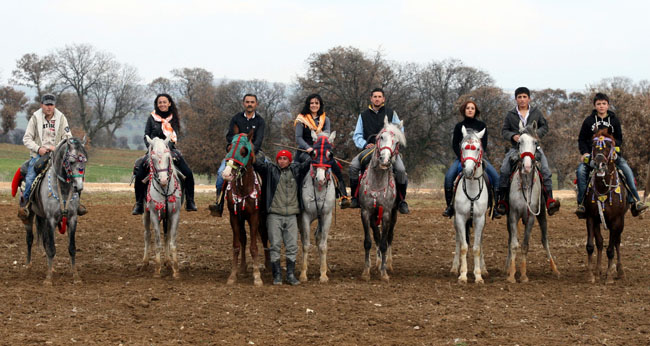
Turkish Female Cirit Players are Seeking for Support

 
The women of the Uşak Women’s Equestrian Sports Club’s cirit team are training regularly for the coming Spring Festival in Uşak’s Ulubey district. As the only women's cirit team in Turkey, they are facing with several challenges, may of which are related to financial issues. Coach Aysun Yilmaz says that her team members have to borrow horses from their friends for the training. She adds that they are hopeful to find another female cirit team to compete against one day, as they can only compete with male cirit teams, since they are the single female group interested in this traditional sport in Turkey. The team consists of women, aged from 20 to 30, who have learned this sport from their families when they were very young. They say that they feel liberated while riding horse. 


Turkish Young Female Wrestlers are Competing in Izmir

124 athletes from 22 different cities of Turkey will be competing in 10 divisions of wrestling. Maximum number of athletes attended the game was from Izmir, partly because of the limited funding for transportation from other cities for the championship. The champions will be announced today, after the final games. 

Muslim Women in SPORTS Launches its Logo

2/17/11

Multiple voices: improving participation of Muslim girls in physical education and school sport

Authors: Symeon Dagkasa; Tansin Benna; Haifaa Jawadb

Abstract

This study reports on data from a larger-scale research project in one city in the West Midlands, England. The study was commissioned by the local education authority because of the rising incidence of parental withdrawal of Muslim girls from physical education. The aim was to provide evidence-based guidance to schools on improving the inclusion of Muslim girls in physical education and school sport. In-depth interviews in eight case study schools provided a thick description of the lived realities for 19 head teachers and teachers, 109 young people and 32 of their parents. Four additional focus group interviews were held with 36 Muslim young people in community/supplementary schools. Questionnaires were sent to 402 city schools and 12 supplementary schools (50 of which were returned). Methods focused on capturing views on experiences and concerns regarding the inclusion of Muslim girls in physical education. Content analysis and inductive and deductive analyses of data procedures were used. Responses indicated a diversity of positive and negative experiences across the community, with the majority of young people enjoying their school-based physical education lessons. Parental influences were strong across the age phases. Body and religious consciousness increased during adolescence. Common concerns centred on the need to improve recognition of religious requirements in schooling processes, policies and practices to provide inclusive learning environments for some Muslim young people. Problems such as poor communication, inflexible dress codes—particularly concerning wearing of the hijab (headscarf)—gender organisation and use of public swimming pools were identified. Patterns of good practice also emerged from across schools. Flexibility of approach, shared decision-making and situation-specific policies were most successful for supporting the inclusion of Muslim girls in physical education and school sport. Findings informed policy-orientated guidance for city schools.
Keywords: Muslim girls; Islam; Physical education; Religiosity; Culture
Affiliations: a School of Education, University of Birmingham, Birminghom, UK
b School of Philosopy, Theology and Religion, University of Birmingham, Birmingham, UK
Published in: Sport, Education and Society, Volume 16, Issue 2 March 2011 , pages 223 - 239
Full Article on: 
http://www.informaworld.com/smpp/content~content=a933523013~db=all~jumptype=rss

2/7/11

El Moutawakel: Middle East female athletes will come to the fore


Nawal El Moutawakel
Olympic 400m hurdle champion Nawal El Moutawakel believes female athletes in the Middle East have a bright future.
Moroccan El Moutawakel became a household name in 1984 when she won gold at the Los Angeles games, the first African-born Muslim woman to do so.
She picked up the Lifetime Achievement Award at the Laureus ceremony 12 months ago, and was convinced to join the Academy when confronted by the list of fellow members that she still considers to be “heroes”.
After watching Saudi Arabia’s Dalma Rushdi H Malhas scoop Equestrian bronze at the Youth Summer Games in Singapore last year, she believes this region will soon produce another Ghada Shouaa, the heptathlete who won gold for Syria at the 1995 World Championships.
“To see a young girl from Saudi Arabia on the podium in Equestrian, was phenomenal to us, to me,” she said.
“I was in there watching it, I started crying and broke into tears because for me it was a very special moment to see a powerful woman coming from the Gulf states to say ‘hey, I can win’.
“The future of this region is feminine. We have seen women reaching all kinds of levels in administration, as a minister, even pilot, lawyer, judges and everything. And we will see women becoming Olympic champions and world champions.
“Success can be achieved. More and more there is a strong participation of women from this region maybe it’s still shy but there is a presence.”
The former athlete was still a student when she shot to fame in Los Angeles, so she knows more than most the life-changing affects sport can have.
“A couple of years ago I was just a tiny, shy little girl from Morocco who wanted to run but I never knew I could perform one day and here I am enjoying the benefits that were given to me by sport,” she added.
“Sport has a great impact on any kind of humankind. It impacts your life for… life, forever.”

2/4/11

Increasing the focus on minority ethnic women and girls' sport - UK

Rimla Akhtar, Chairperson of the Muslim Women's Sport Foundation on the challenges and achievements of her organisation.
Sport is and always has been a powerful means of uniting people and overcoming prejudices, particularly those against minority communities. It can come in many forms and not just the traditional ones. Women's sport has seen a massive development over the years and women and girls across the country are embracing less traditional sports and activities such as dance, basketball and yoga.
The Muslim Women's Sport Foundation (MWSF) was set up in 2001 with the main aim of providing equal opportunities and access to sport for Muslim women who are severely underrepresented across the board when it comes to sport.
Rimla Akhtar with Hugh Robertson receiving the Kick It Out Grassroots award on 14 December 2010
Rimla Akhtar was recently presented with the Kick it Out Grassroots award. 
The organisation also forms the British Muslim Women's Squad for the Women's Islamic Games which are held in Tehran every four years in an Olympics style tournament. I joined the futsal team in 2001, playing in the Games that year and then had the honour of captaining the team in 2005. When we returned from the Games in 2005, my friend and vice captain Ayesha Abdeen and I became Chair and Vice Chair of the MWSF, respectively. Over the past five years we've worked to increase the accessibility of sports facilities and opportunities to play and compete. More recently we've focused on sports education through providing coaching and refereeing courses and reaching out to schools to provide their girls with a positive experience of sport.

Addressing under-representation head on

Through working closely with National Governing Bodies for sports and with other sporting organisations, such as Sporting Equals, we've been able to help increase the focus on minority ethnic women and girls' sport.
The work we do is not just for Muslim women but for all women, girls and men from ethnic minority communities. By realising the unique needs of people from these communities, there are great opportunities to refresh the sporting strategies for participation and to generate success in the long term whilst also bringing energy, creativity and dynamism to the way the strategies are implemented.
You can read the rest of the post from Rimla Akhtar's blog: http://blogs.culture.gov.uk/main/2011/01/post_6.html