2/27/11

MW Sports Interview Series Begin With Prof Homa Hoodfar

MW Sports is honored to begin the new project, "MW Sports Interview Series" with Prof. Homa Hoodfar
Who is Homa Hoodfar? Prof Hoodfar is an anthropology professor at Concordia University in Montreal, Canada and is the coordinator of the Iran Module of the Women and Law programme of Women Living Under Muslim Laws Network.Hoodfar has conducted field research on development and social change issues in Egypt and Iran, with an emphasis on gender, households, work and international migration in the Middle East. Further key research areas are women and Islam, and codification of Muslim family laws in the Middle East, Muslim dress code in diaspora, and the impact of long term forced migration on family structure and gender relations on Afghan refugees in Iran and Pakistan. She is an activist feminist and a prominent anthropologist working on issues related to empowerment of women in Muslim world, with geographic focus on Iran, Afghanistan and Egypt. 
  • MW Sports: Prof. Hoodfar, Thank you for joining this interview project. It is very precious to begin our interview series with you, as you are the pioneering mentor of MW Sports Blog. How have you become interested in Sports in the lives of Muslim women? Why sports?
  • MW Sports: Is your interest related to your feminist concerns regarding the empowerment of women in the Middle East?
  • MW Sports: Iranian women started becoming very active in sports. Their participation is particularly influencing the success of their country in international games as well. How do you explain the interest?
  • MW Sports: You have organized a symposium three years ago in Montreal, during which we first worked together. It was very welcomed by Western public. Why have you decided to organize a conference focusing specifically on Muslim women in sports? Have you achieved your goals?
  • MW Sports: What are your future plans?
This first interview is also submitted to Dr Sara Shneiderman, as visual anthropology project for my PhD program in social anthropology at the University of Cambridge - Sertaç Sehlikoglu.

The Short biography of Prof Hoodfar is taken from http://www.muslimreviewonline.net/wiki/index.php?title=Category:Hoodfar,_Homa 

2/20/11

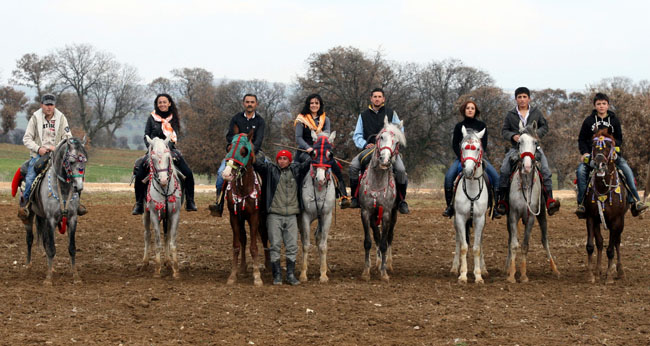
Turkish Female Cirit Players are Seeking for Support

 
The women of the Uşak Women’s Equestrian Sports Club’s cirit team are training regularly for the coming Spring Festival in Uşak’s Ulubey district. As the only women's cirit team in Turkey, they are facing with several challenges, may of which are related to financial issues. Coach Aysun Yilmaz says that her team members have to borrow horses from their friends for the training. She adds that they are hopeful to find another female cirit team to compete against one day, as they can only compete with male cirit teams, since they are the single female group interested in this traditional sport in Turkey. The team consists of women, aged from 20 to 30, who have learned this sport from their families when they were very young. They say that they feel liberated while riding horse. 


Turkish Young Female Wrestlers are Competing in Izmir

124 athletes from 22 different cities of Turkey will be competing in 10 divisions of wrestling. Maximum number of athletes attended the game was from Izmir, partly because of the limited funding for transportation from other cities for the championship. The champions will be announced today, after the final games. 

Muslim Women in SPORTS Launches its Logo

2/17/11

Multiple voices: improving participation of Muslim girls in physical education and school sport

Authors: Symeon Dagkasa; Tansin Benna; Haifaa Jawadb

Abstract

This study reports on data from a larger-scale research project in one city in the West Midlands, England. The study was commissioned by the local education authority because of the rising incidence of parental withdrawal of Muslim girls from physical education. The aim was to provide evidence-based guidance to schools on improving the inclusion of Muslim girls in physical education and school sport. In-depth interviews in eight case study schools provided a thick description of the lived realities for 19 head teachers and teachers, 109 young people and 32 of their parents. Four additional focus group interviews were held with 36 Muslim young people in community/supplementary schools. Questionnaires were sent to 402 city schools and 12 supplementary schools (50 of which were returned). Methods focused on capturing views on experiences and concerns regarding the inclusion of Muslim girls in physical education. Content analysis and inductive and deductive analyses of data procedures were used. Responses indicated a diversity of positive and negative experiences across the community, with the majority of young people enjoying their school-based physical education lessons. Parental influences were strong across the age phases. Body and religious consciousness increased during adolescence. Common concerns centred on the need to improve recognition of religious requirements in schooling processes, policies and practices to provide inclusive learning environments for some Muslim young people. Problems such as poor communication, inflexible dress codes—particularly concerning wearing of the hijab (headscarf)—gender organisation and use of public swimming pools were identified. Patterns of good practice also emerged from across schools. Flexibility of approach, shared decision-making and situation-specific policies were most successful for supporting the inclusion of Muslim girls in physical education and school sport. Findings informed policy-orientated guidance for city schools.
Keywords: Muslim girls; Islam; Physical education; Religiosity; Culture
Affiliations: a School of Education, University of Birmingham, Birminghom, UK
b School of Philosopy, Theology and Religion, University of Birmingham, Birmingham, UK
Published in: Sport, Education and Society, Volume 16, Issue 2 March 2011 , pages 223 - 239
Full Article on: 
http://www.informaworld.com/smpp/content~content=a933523013~db=all~jumptype=rss

2/7/11

El Moutawakel: Middle East female athletes will come to the fore


Nawal El Moutawakel
Olympic 400m hurdle champion Nawal El Moutawakel believes female athletes in the Middle East have a bright future.
Moroccan El Moutawakel became a household name in 1984 when she won gold at the Los Angeles games, the first African-born Muslim woman to do so.
She picked up the Lifetime Achievement Award at the Laureus ceremony 12 months ago, and was convinced to join the Academy when confronted by the list of fellow members that she still considers to be “heroes”.
After watching Saudi Arabia’s Dalma Rushdi H Malhas scoop Equestrian bronze at the Youth Summer Games in Singapore last year, she believes this region will soon produce another Ghada Shouaa, the heptathlete who won gold for Syria at the 1995 World Championships.
“To see a young girl from Saudi Arabia on the podium in Equestrian, was phenomenal to us, to me,” she said.
“I was in there watching it, I started crying and broke into tears because for me it was a very special moment to see a powerful woman coming from the Gulf states to say ‘hey, I can win’.
“The future of this region is feminine. We have seen women reaching all kinds of levels in administration, as a minister, even pilot, lawyer, judges and everything. And we will see women becoming Olympic champions and world champions.
“Success can be achieved. More and more there is a strong participation of women from this region maybe it’s still shy but there is a presence.”
The former athlete was still a student when she shot to fame in Los Angeles, so she knows more than most the life-changing affects sport can have.
“A couple of years ago I was just a tiny, shy little girl from Morocco who wanted to run but I never knew I could perform one day and here I am enjoying the benefits that were given to me by sport,” she added.
“Sport has a great impact on any kind of humankind. It impacts your life for… life, forever.”

2/4/11

Increasing the focus on minority ethnic women and girls' sport - UK

Rimla Akhtar, Chairperson of the Muslim Women's Sport Foundation on the challenges and achievements of her organisation.
Sport is and always has been a powerful means of uniting people and overcoming prejudices, particularly those against minority communities. It can come in many forms and not just the traditional ones. Women's sport has seen a massive development over the years and women and girls across the country are embracing less traditional sports and activities such as dance, basketball and yoga.
The Muslim Women's Sport Foundation (MWSF) was set up in 2001 with the main aim of providing equal opportunities and access to sport for Muslim women who are severely underrepresented across the board when it comes to sport.
Rimla Akhtar with Hugh Robertson receiving the Kick It Out Grassroots award on 14 December 2010
Rimla Akhtar was recently presented with the Kick it Out Grassroots award. 
The organisation also forms the British Muslim Women's Squad for the Women's Islamic Games which are held in Tehran every four years in an Olympics style tournament. I joined the futsal team in 2001, playing in the Games that year and then had the honour of captaining the team in 2005. When we returned from the Games in 2005, my friend and vice captain Ayesha Abdeen and I became Chair and Vice Chair of the MWSF, respectively. Over the past five years we've worked to increase the accessibility of sports facilities and opportunities to play and compete. More recently we've focused on sports education through providing coaching and refereeing courses and reaching out to schools to provide their girls with a positive experience of sport.

Addressing under-representation head on

Through working closely with National Governing Bodies for sports and with other sporting organisations, such as Sporting Equals, we've been able to help increase the focus on minority ethnic women and girls' sport.
The work we do is not just for Muslim women but for all women, girls and men from ethnic minority communities. By realising the unique needs of people from these communities, there are great opportunities to refresh the sporting strategies for participation and to generate success in the long term whilst also bringing energy, creativity and dynamism to the way the strategies are implemented.
You can read the rest of the post from Rimla Akhtar's blog: http://blogs.culture.gov.uk/main/2011/01/post_6.html

1/31/11

Judo Sessions in UK Sponsored by Bolton Wanderers Community Trust


MUSLIM girls in Bolton (UK)  are to feature on Match of the Day — learning the art of judo!
Bolton Wanderers Community Trust (BWCT) has been running the sessions at Bolton Muslim Girls School for the last two months, and the success of the scheme has now caught the attention of one of TV’s longestrunning football programmes.
The girls are set to make their debuts on Match of the Day next week after BBC cameras visited the school.
Wanderers stars Fabrice Muamba and David Wheater, as well as British judo champ Sarah Clark, were also there to support the project.
PE teacher Anika Tariq said: “Sport here has come a long, long way.
“But the Premier League has helped in terms of funding.
“Sport for our girls isn’t always seen as a priority outside of school for parents so for them to get this opportunity in school is great.
“They really enjoy judo.
It was a sport they hadn’t tried before but they have really taken to it.”
Sport England research has shown that Muslim women are “significantly less likely” to take up exercise compared to other groups.
BWCT identified the school as being an ideal place to start the project.
But now, the popularity of the sport with the girls means a local judo club is now in the process of being set up.
After a short time on the sidelines, watching the girls in action, the two Whites players took to the floor to try out a few of the moves themselves.
Wanderers’ latest signing David Wheater said: “It’s nice to come and do stuff like this away from football.
“It’s a decent gym here and it was good fun having a go.
“I maybe wish I’d tried some other sports like this when I was younger, but I was pretty single minded about playing football.”
Muamba added: “It has been good to see the girls getting involved in judo.
“It is a great sport and this project is good for the community and it is good for their health as well.”
But while the girls were thrilled to see the two Wanderers’ stars, it was judo champion Sarah Clark who really bowled them over.
Sarah said: “It has been excellent to meet these girls.
“This is something they have not had the opportunity to do in the past and you can see how much they enjoy it.
“They get involved and they are quite physical, which is great to see.”
Bolton Muslim Girls School can be seen on the repeat version of Match of the Day on Sunday morning.

1/25/11

Sports' Totally Unnecessary Hijab Drama


By Sara Yasin
Recently, Maryland seventh-grader Maheen Haq was forced to sit out during the first half of her basketball game, after league officials cited concerns over her hijab as a safety hazard.
A safe sports scarf designed by Elham Seyed Javad
She was eventually allowed to play in the second half, after her parents explained that she was covered for religious reasons, and that they would take full responsibility for any injuries that she might sustain as a result of wearing it. According to Jim Shannon, former coordinator of the league, the official citing concerns about Haq was worried about the potential for neck injury.
This isn't the first time such a thing has happened. In 2007, an 11 year -old girl was prevented from playing in an indoor soccer tournament in Quebec for similar reasons. The referee told Asmahan Mansour that her hijab was a safety hazard, and thus she wouldn't be allowed to play while wearing it.
Design for tennis by Cindy Van Den Breman (Capsters)
I spent my awkward middle school years at an Islamic school, where my classmates and I preferred to wear loose and large hijabs, fastened with a safety pin at the neck as a part of our school uniforms. Potential hazards of playing sports in hijab were not to be trivialized. I regularly found ways to trap my long hijab in doors and furniture. In the hormonal hellhole that is an all-girls gym class, the hijabs that we wore were regularly used in catty warfare, caused us to overheat in an ever-sweltering North Carolina climate and sometimes prevented us from playing sports properly. Our problem wasn't covering, but rather how we were doing it. And identifying the hijab as a hazard is not the question; it can present safety problems when not worn properly during sports. But the real frustration lies in how it is addressed.
Design for aerobics by Cindy Van Den Breman (Capsters)
Identifying the hijab as a hazard is not an issue, but frustration lies in how it is addressed. At local skating rinks in my hometown, my friends in hijab were regularly kept from skating without a helmet, yet I was still allowed to skate in my obstructive JNCO jeans, showing that safety standards were not only being violated by religion, but also by other changing factors, like fashion. However, in these conversations the hijab as a hazard was the bottom line, rather than a point to initiate discussion. I think this is a large part of the problem.
Most safety-related problems can be easily remedied by finding the appropriate style for a particular activity. There are many different styles of hijab available, especially in recent years, including those that are more suitable for the needs of athletes. A Dutch woman named Cindy van den Bremen developed the "Capster", which fits snugly around the head, allowing a woman to remain covered while staying cool and safe. While ideal for athletic use, many non-sports related companies and organisations have approached Cindy to help create hijabs conforming to their respective health and safety policies. It would be easy to incorporate into any uniform.
Much like the Capster, there are other (cheaper) ways to help ease concerns over safety. After one too many incidents involving aggressively pulling each other's hijabs during games of flag football, our school made a smaller version of the Amira-style hijab a part of our gym uniform. Much like the Capster, it snugly fits around the head, and is not fastened with a safety pin. While not as flattering as the Capster, it would not hurt if ripped off, and it does not interfere with athletic performance. Similarly, there are also ‘tear away' options. This is a problem easily solved, but only with willingness to research and dialogue.
While there are some pretty accessible solutions out there, the point is that none of them can be used unless administrators are open to them. It is important for the league to focus on the best and safest way to keep Haq playing basketball, rather than focus on shying away from controversy. It is important to have conversations about ways that organizations can include young Muslim female athletes AND keep them safe. To focus on a choice between covering and sports may prevent these young women from playing at all. I had many peers that felt excluded from trying out for sports teams because of stringent uniform requirements, including non-Muslims. Surely, both comfort and safety would be central components to maximizing the benefits of team sports. I hope that these solutions are involved in the conversation between league leaders and Haq's parents.
The author of this post can be contacted at tips@jezebel.com
Read more: http://jezebel.com/5740119/sports-totally-unnecessary-hijab-drama#ixzz1C24oer9M
Source: http://jezebel.com/5740119/sports-totally-unnecessary-hijab-drama

1/23/11

‘Muslim women’, Islam and sport : ‘race’, culture and identity in post-colonial

Farooq, Samaya (2010) ‘Muslim women’, Islam and sport : ‘race’, culture and identity in post-colonial Britain. PhD thesis, University of Warwick.
Full text not available from this repository.

Abstract

This thesis offers insight into the lives and lived (sporting) experiences of 20 British born Muslim women of Pakistani and Bangladeshi heritage. They comprise working professionals and students who live in the urban diaspora community of Stratley, UK, and have been playing basketball (since April 2007) in preparation for the 5th Islamic Women’s Games. Adopting a post-colonial philosophical consciousness this qualitative ethnographic study centralises the voices of subjects who are pathologised in media-hyped discourses pertaining to the ‘Islamic peril’ on the one hand, and simultaneously truncated by the demise of fundamentalist Islamism on the other. It does this by addressing four inter-related research questions. The first asks how membership of urban diasporic communities contributes to British Muslim women’s self-identifications and whether living in such spaces shapes the nature and context of women’s (social) lives and their entry to sport. The second question explores the extents to which British Muslim women are able to activate a ‘politics of difference’ to (re)-negotiate their access to sport. The third question centralises the complex identity politics of being ‘British Muslims’ and assesses, in particular, whether my respondents’ sporting ambitions have any impact on their identity work as ‘British born’ Muslim women who are of a migrant heritage. The fourth question also addresses British Muslim women’s sense of self, but investigates, in particular, whether playing basketball has any impact on the ‘self/bodywork’ of single, heterosexual ‘British-born’ Muslim women of a migrant heritage. Drawing upon critical literatures rooted in post-colonial, Asian and Islamic feminism the study contextualises the conditions of post-colonialism for Muslim individuals in Britain, especially Muslim women. It also focuses upon debates pertaining to Muslim women and sport. By privileging marginal epistemologies that have often been silenced or distorted through essentialist, uncritical and simplistic understandings of ‘Muslim women’, findings advance arguments about the lives, lifestyles and identities of subjects whose social, gendered, cultural and religious authenticities beneath the (body) veil evoke both sensitive questions and global concerns (especially in the aftermath of 9/11). The overall discussion brings into sharp focus the collective and subjective struggles of respondents in terms of their identity re/construction. I allude to the agentic capacity which my respondents had to re-constitute and re-negotiate aspects of their day-to-day lives, their engagement with sport, their identities and their bodies. I exemplify the myriad ways and extents to which my participants struggle against multiple material constraints that impose a particular ‘identity’ upon Muslim women and enforce a way of life upon them that restricts their access to sports. The thesis concludes that those frequently depicted as being oppressed and voiceless do indeed have the power to relationally make, unmake and/or remake their selfhoods.
Item Type:Thesis or Dissertation (PhD)
Subjects:H Social Sciences > HQ The family. Marriage. Woman
Library of Congress Subject Headings (LCSH):Muslim women -- Great Britain -- Case studies, Basketball for women -- Great Britain -- Case studies, Sociology, Urban -- Great Britain
Date:July 2010
Institution:University of Warwick
Thesis Type:PhD
Supervisor(s)/Advisor:Hughes, Christina, 1952- ; Parker, Andrew, 1965-
Sponsors:Economic and Social Research Council (Great Britain) (ESRC)
Extent:vi, 274 leaves : ill.
Language:eng

A Kickboxer from Sydney: Mariam Farid

by Trevor Allen
“The greatest pleasure in life is doing what people say you cannot do,” wrote British journalist Walter Bagehot.
There are few who truly go out of their way to realise this, to defy stereotypes and cultural barriers like Mariam Farid.

Arriving at the Bulldog Gym in Parramatta on a chilly, late-September evening, she appears unremarkable. At about 160cm tall, she hardly has the imposing stature of her trainer, Tim Fisher. She wears her regular work clothes and her black hair is tied into a ponytail.
But Mariam Farid leads a double life. By day, the 23 year old is a social worker at Westmead Hospital. By night, she trains as a Muay Thai kickboxer.
Entering the gym, she dons a t-shirt and shorts. Although she does not have the muscle definition of her male counterparts, she has the steely determination evident in all top prize-fighters. “I’ve gotta train hard for my next fight in October,” she says. “It’s not gonna be easy and I’ve gotta lose six kilos to make the weight.”
Farid has won all three of her amateur bouts. She is dedicated to her intense training regime, working out for three hours every weeknight as she builds towards her goal of becoming a national champion.
But there is another side to her story. Farid is a proud Muslim and came to Australia as a refugee in 1996 after fleeing the Taliban. She lived in Herat with her parents, grandmother, two sisters and brother. Her mother was a teacher at the local school and her father was the manager of a construction firm.

As the provincial capital and Afghanistan’s third-largest city, Herat is a hive of activity. After the Soviets left, the city was captured by the Taliban as its grip tightened across the country. With the Taliban’s brutal rule came drastic changes to Farid’s life.
“I remember everything from that time,” she says.
“Girls were banned from going to school, women needed male escorts and there were regular public killings in the soccer stadium. It was terrible.”
One particularly chilling experience has remained with her since she was 10 years old.
“I was with my dad riding a bike on the way to the video store near our house. As we approached the square, all of a sudden we were thrown to the ground, as a bomb had just exploded very close to us. There was blood everywhere and my father was hit with a small piece of shrapnel in his mouth.”
Apart from scratches and bruises, Farid and her father escaped unharmed but others nearby were killed by the blast.
In 1997, her father took the family on vacation to Iran. Whilst there, he received a phone call from relatives living in Australia. He was told it was too dangerous to return to Afghanistan and he should flee. He wanted a better life for his children so the family boarded a plane for Sydney.
“It was quite a shock,” she says.
“I never got to say goodbye to my extended family in Herat. They said, ‘No, don’t go!’ but my father wanted us to have an education, which we couldn’t get in Afghanistan.”
In Sydney, she attended intensive English classes, completed high school and now studies social work at university.
So, how does she transform from social worker to kickboxer?
“I’m not an aggressive person,” she says.
“When I step in the ring, I just concentrate on what I’ve learned from Tim. But it’s just a sport to me. I do it for fun.”
In Australia, less than one per cent of Muay Thai kickboxers are women, and there is a fledgling circuit for female fighters in Sydney. Bouts are mainly held at local RSL Clubs as the undercard to big professional fights.
Farid discovered the sport partly by accident.
“I used to do regular training at another gym where Tim was also a trainer, but I found regular gym work boring,” she says. “So when Tim opened a new gym three years ago, I began kickboxing. It’s been really tough but Tim has been a great teacher. And you have to be very disciplined.”
The ancient martial art is Thailand’s national sport. Practitioners claim it was developed by Siamese soldiers, more than 2000 years ago, as an unarmed combat method in case they lost their weapons in battle. Thai locals nicknamed the sport the “Art of Eight Limbs” because fighters attack with eight points of contact: punches, kicks, elbows and knee strikes. They compete bare-foot and with little protective clothing other than specialised boxing gloves and groin protection.
Preparing for the upcoming fight, Farid’s routine consists of skipping, push-ups, sit-ups, circuit training and kicking and punching technique training.
Her trainer, Tim Fisher, says: “When I first met Mariam, she was very quiet and reserved. Now she has so much confidence, it’s amazing… she’s very tenacious.”
Sparring is also an integral part of Farid’s training and she is unfazed by her male counterparts.
“At first they’re a little hesitant to hit me, but when I hit them, they’re like ‘Oh, OK. She’s pretty good,’ so they start punching a lot harder.”
“I had my nose broken during one session. There was blood streaming down my face and I had to get Tim to crack it back into place,” laughs Farid.
“My parents still don’t know about that one!”
She says although her parents support her, they still have not seen her fight. “My sister comes to my fights and texts them the results. When my parents see the trophies I bring home, they’re very impressed.”
Although Farid is in every other sense, a typical Muslim woman living in Sydney, she displays no signs of being religious.
“Although…I don’t wear a hijab [traditional head scarf for Muslim women], I don’t think it’s just the external that counts,” she says. “I think you have to feel it on the inside. I was born Muslim and I am Muslim.”
And what would her life be like if she had remained in Afghanistan?
“I’d probably be married by now. With kids!” she says.
Farid is a fighter – both in the literal and figurative sense. She is no stranger to community criticism. Muslim women can be frowned upon for doing any activities considered masculine, especially contact sports. In response to a story in a local newspaper, a reader condemned her for kickboxing. But Farid is unconcerned by such reactions and receives Facebook messages of support from the local youth.
“Everyone is entitled to their own opinions. It hasn’t stopped me from doing what I love doing. So I just ignore it – it just flies over my head.”
Source: http://www.reportageonline.com/2010/11/muslim-woman-defies-kickboxing-stereotypes/
Photos: Reportageonline