10/15/12

Female Students Opinion about Women’s Participation in Sports

Mohammad Younis Khan
Government Degree College # 2 Dera Ismail Khan, K.P.K
Email: yunskhan@hotmail.com
Dr Asif Jamil
Institute of Education & Research Gomal University Dera Ismail Khan, KPK
Email: asifjamil72@hotmail.com
Dr Umar Ali Khan
Institute of Education & Research Gomal University Dera Ismail Khan, KPK
Uzma Kareem
MPhil Student IER, Gomal University DIKhan
Ghazanfar Imran
Ph.D Scholar Department of Arabic, Islamic Studies and Research, Gomal University, DIKhan KPK
Email: ghazanfar4958@yahoo.com 
Abstract
A research study was conducted to know about the participation of Muslim girls and women in sports  and philosophy of Islam in this regard. The population of this study was all female students of Government Girls Degree Colleges of District  Dera Ismail Khan.  Total 100 respondents selected from within the population through convenient or available sampling technique. For the purpose of collection of data a structured questionnaire on three point Likert scale, ranging from disagree (DA= 1 point) to agree (3 points), was prepared and handed over to 100 respondents with the help of female lecturers in physical education of concerned colleges. The main objective of the study was to know about the participation of Muslim girls 
and women in sports and philosophy of Islam in this regard. The result of the study indicated that Muslim women like sports and she wants to participate in sports for overall development but their ethnicity, culture, physical and spiritual challenges, parents, family members, and society members discourage them to participate in sports. The result of the study further confirmed that  Islam encourages the women to participate in sports for good health, fitness and healthy life style after observing the Islamic dress code.

10/14/12

Ruqsana Begum: Fighting For Her Sport

Ruqsana Begum has been quite literally fighting for her sport since she was just 18. The now 28-year-old East Londoner has spent a decade battling against her Muslim-Bengali origins to earn herself the title as Britain’s female Muay Thai champion, despite all the religious odds.
Holding her title in the amateur Atomweight division since November 2010 Ruqsana has gone from strength to strength. July 2011 saw her win gold at the European Clubs Cup in Latvia and recently she brought home a bronze from Russia after impressing at the IFMA (International Federation of Muay Thai Amateur) World Championships in September.
The tournament held in St. Petersburg saw the Team GB captain beat Ranini Cundasawmy from Mauritius before going on to bag the bronze after a close fight against the European Champion Chyslova Liudmila from Belarus, who went on to win silver.
Although she may have started out fighting in secret, Ruqsana’s passion for Muay Thai and her success now sees her family and community back her all the way. While she is not completely without her critics, her rising success has seen her fan base expand as she has become somewhat of an East London sporting hero.
The part-time school science technician has also turned her capable hands to coaching at the charity Fight for Peace, which uses boxing and martial arts to help rehabilitate some of London’s disadvantaged youngsters who turn to crime and gang violence.
Her success in the ring as well as her community commitment was recognised by The Muslim Women in Sport Foundation who shortlisted Ruqsana for the Sports Woman of the Year in 2012.
In 2013 Ruqsana is hoping to repeat her success at the Sport Accord World Combat Games and take the European Muay Thai title.
Ruqsana can be found tweeting at @BritishMuayThai. For more information please visit www.ruqsana-begum.com or contact ENS sports PR. 

Muslim sport volunteer from Harrow nominated for Woman of the Year

Rimla Akhtar captained the British Muslim Women's side in Iran in 2005.
A footballer who campaigns for more opportunities in sport for Muslim women has been recognised as a ‘woman of the year’.
Rimla Akhtar, 30, has been chairwoman of the Muslim Women’s Sport Foundation in Station Road, Harrow, for seven years and works to make sport more accessible though providing female-only training sessions and coaching programmes.
The chartered accountant, who captained the British Muslim Women’s football team in 2005 and played cricket for her county as a teenager, has been selected as one of 400 women to be recognised by the Women of the Year scheme.
Ms Akhtar worked with Olympic organisers to advise them on female representation at London 2012, and recently helped to extend the charity’s programmes to the United Arab Emirates, Saudi Arabia and Sri Lanka.
She said it was “lovely” to receive an invitation to the annual Women of the Year lunch, which recognises the achievements of those across the UK who are deemed to have made a special contribution.
She added: “I’m a grass roots girl at heart – I like to go about my work quietly and get on with what I need to do, so receiving this kind of recognition is incredibly pleasing on a personal level.

“Any event which brings women together to recognise our achievements is a fantastic one, and the lunch is such a unique opportunity to meet some remarkable individuals.”

Previous nominees for the scheme, which has been running since 1955, include Annie Lennox, Katie Piper and Lulu, and five of the 400 women will receive a special award for their efforts on October 22.

10/11/12

Women athletes break barriers inside and outside Gaza


The Gaza women’s table tennis team with their coach and administrators.
 (Shadi Alqarra / The Electronic Intifada)
A women’s tennis table team is set to leave Gaza for Jordan to participate in an international Arab table tennis tournament in October. The four-strong team is traveling for the first time since Israel imposed tightened closure measures on Gaza in 2007.
The anticipated departure of the team for the tournament — an annual event hosted by the Arab Table Tennis Federation — comes as a result of a slight easing of the strict conditions at Rafah crossing by Egyptian authorities. Rafah is the only outlet from Gaza besides those between the coastal territory and Israel.
“When I was a little girl, my father used to encourage us to play table tennis to the extent that he bought us a table tennis to play at home,” Ruba al-Zubaidi, a 31-year-old mother of two, told The Electronic Intifada at Gaza City’s al-Jazeera Sports Club, where she was training with her teammates.
“During the 1991 war in Iraq, we were locked down inside our homes along with the whole population of Gaza for weeks by orders of the Israeli occupation,” al-Zubaidi recalled cheerfully. “This was a good chance for me to practice my favorite sport.”
Al-Zubaidi’s international sporting career began in 1996-1997 when she represented Palestinian universities in a championship in Jordan.
Hailing from the central Gaza Strip town of Deir al-Balah, al-Zubaidi insists that despite the increasing conservatism of Gaza, women should still participate in sports.
“Look, the people are the ones who set the social traditions and customs in any given society. As you see, my husband has allowed me to practice my favorite sport, respecting me the way I have respected him,” al-Zubaidi said. “Women here should be no longer marginalized, frankly. It is enough that we live under siege.”
Stop ignoring equal rights
As she took up sports as a child, al-Zubaidi hopes her ten-year-old daughter will do the same. “I do hope she will have the chance like me to practice her favorite activities and that our community will stop ignoring women’s equal rights to men,” al-Zubaidi added.
The youngest team member is Hadeel Saba, aged 13, from Gaza City, who got her start playing at the Christian Youth Association in Gaza.
“I feel that I have freed myself from the occupation and I feel I am defying the occupation by means of my sports and being able to participate in a championship abroad,” Saba said.
Reem al-Zaeem, 23, a graduate in information technology, was just as enthusiastic as her teammates.
“I began my career as a table tennis player during high school, then I went on playing at university. We have been training here at the club for the past five weeks and we are excited to take part in the upcoming contest,” al-Zaeem said.
Her family has been fully supportive of her efforts. “Our social traditions here do not allow us to get involved in such activities but my own family has really encouraged me to play table tennis without impediments,” al-Zaeem added. “I do hope to represent Palestine in more worldwide competitions in the future, God willing.”
The fourth member of the team is Yasmine Eliyan, 28 years old.
Khamis al-Habet, the team’s coach, looks forward to better conditions for women’s sports in Gaza.
“Currently, the team trains three days a week for a couple of hours only,” he explained. “I have made contacts with the Egyptian sports club of al-Ahli to see if it can host the team for four days of intensive training before the championships start.”
“This is first time for the team to participate in an international championship. Our women will possibly play against very skillful Chinese women players,” al-Habet said.
Encouraging women’s athletics in Gaza
Gaza women have a history as sports pioneers. Sanna Abubkheet, a runner, was one of only three athletes, and the first and only woman, to represent Palestine in the Olympics at Athens in 2004.
At the time, her travails, training in difficult conditions, without any sponsors and only a single pair of running shoes, and in a full-length track suit to avoid some local disapproval, made world headlines.
Women athletes still face considerable barriers. The al-Jazeera Sports Club was established in 2007 by a group of local businessmen. The club is licensed by the sports and youth ministry, which is controlled by the Hamas party.
Ali al-Nazli, the club’s director, and himself a well-known former athlete in Gaza, spoke to The Electronic Intifada about the development of women’s sports in territory.
Women’s athletics in the Gaza Strip have been limited and confined to closed areas such as gyms or certain women’s associations or clubs. According to the socially conservative norms in Gaza, women do not do sports or exercise in public.
“We are the first-ever club in Gaza that has taken the initiative. For the past couple of years, we have organized a number of sports activities such as swimming classes for women in closed areas with the help of female trainers; we managed to train more than 150 women of different ages,” al-Nazli said.
According to al-Nazli, the youth and sports ministry has approved the club’s activities relating to women.
“We have broken the barrier that is in the face of women’s sports in Gaza,” he said.
Ruba al-Zubaidi and her team mates are undaunted by the ongoing challenges:
“We are proud to take part in such the championship, coming out of the Israeli blockade of Gaza.”
Rami Almeghari is a journalist and university lecturer based in the Gaza Strip.

10/2/12

Veiled Women Athletes in the 2008 Beijing Olympics: Media Accounts

By Mayfoud Amara
The aim of this paper is to explore and to compare different international media accounts about the presence of veiled athletes in the 2008 Beijing Olympic Games. In other words, to uncover whether the discourse of clash of cultures or that of cross-cultural dialogue has shaped their position about Islam, Muslim identities,
Muslim women and the Muslim world in general. Furthermore, from the perspective of media in the Arab and the Muslim world, the purpose of the analysis is to explore their responses to international media, and to investigate their positions in relation to the host nation (China), Asian culture and the Olympics.
Keywords: 2008 Beijing Olympics; hijab (the veil); veiled Muslim women athletes; identity; body; media; religion
Full Paper Available: The International Journal of the History of Sport, Vol. 29, No. 4, March 2012, 638–651

9/27/12

Pakistani and Indian athletes building bridges through football

BY: SHIREEN AHMED

"Today, young female athletes from India and Pakistan have come together to forge new friendships on and off the soccer field" -Ann Stock, US State Department

The United States State Department has an Sports Exchange  program called "Sports United" under the umbrella of the Bureau of Educational and Cultural Affairs. This program hosts athlete delegations from various countries and sends US athletes to other countries to learn about culture and philanthropy through sport. Sports United encompasses fair play principles to build bridges and empower youth.
From September 11-22, 2012 it hosted 18 young women and two coaches from India and Pakistan.
The ten-day program offered opportunities for the athletes and coaches to speak with sports management and offers conflict-resolution workshops. These young women gained access to young athletes, nutritionists and sports professionals during this exchange. They were provided with a tour of ESPN studios in Washington, DC for a tutorial in Sports Media. 
They met with State Dept Rep James Moore (Deputy Assistant for Public Diplomacy in the Bureau of South and Central Asia)  to discuss their challenges, obstacles and share ideas and provide encouragement for one another. 
(Footballers training onsite)

Most importantly was the opportunity for the women to train with and engage in healthy activity with women from their neighbouring country. It is commonly known that India and Pakistan have many socio-cultural, political and religious divides. The differences between the nuclear-armed countries in opinions of history, geo-politics made it almost impossible to get a visa for many years. Athletes were not able to compete against each other in regional competitions thus greatly reducing the prospects for proper local competition. Only recently have both nations signed an agreement to warm relations and facilitate  border crossing.
To connect these talented women abroad in this manner is critical to continue to bridge building and develop understanding for the future. Each delegate was an ambassador to their country. 
Most importantly to accord these athletes such an experience to empower themselves and provide opportunity for personal growth is outstanding. 
These athletes come from countries where there is not yet support for women's football, either financially or culturally and they can be met with resistance. To engage in an exchange to improve their skill, drive and be enjoyable is a fantastic venture.
As the focus of this trip was football the young women attended a professional women's soccer match with DC United Women's team and worked with JoLi Academy for advanced technical training. They were trained with accomplished players such as Joanna Lohmann (DC United Women and also a Co-founder of the JoLi Academy). Lohmann took to twitter to praise the efforts of the young delegates and respectfully noted their challenges.


This program was a success in connecting women and teaching them how their participation in sport can transcend into high achievement in the classroom and improve life skills.
Passion for football can be used to foster a relationship-building process that is still in its' early stages. 
In an interview with The Hindu, 16 year-old Chinta Anjani Rashmitha from India stated: "Before I came here, I didn't have a connection with any of the people [I have met during this trip]. Now, using communication skills that I never knew I had, I have built a relationship with the people of Pakistan via sports. We get closer with soccer, share our ideas, some in common, some with differences, and become better citizens."  
Despite cultural differences, language barriers and background these women came together, worked hard, trained, observed learned and played a fantastic amount of football.
They have the tools to go back to their communities and teach, inspire and create initiative. 
Sports have the ability to bring people together and produce not just great sportsmanship but wonderfully optimistic people. These young talented footballers are no exception. 

(Delegation from Pakistan)

Pictures from training session:  http://www.flickr.com/photos/50221841@N06/sets/72157631534165851/
c/o US Dept of State: South and Central Asia Photostream

9/18/12

Tasteless jokes about football video games to justify Violence Against Women

BY: SHIREEN AHMED

I'm not a much of a recreational gamer. I have never been interested in video games. I don't like simulating life when one can be OUT there actually living it. Why play NBA or NHL when one can go outside or to a gym and engage in real play? It's logical not to mention much better for one's health. I don't like gratuitous violence and don't appreciate kids "pretending" to kill people in popular games. Learning strategy, planning and hand-eye coordination is important but I find them anti-social and isolating.
That being said, I recognize I am from a different generation (remember board games?!?). 
Furthermore, there is much debate regarding how video games are beneficial for people to relieve tension, many advances in technological industry and how there may be other factors contributing to bad grades and depression in youth.
Any popular activity whether it be dancing, music, sport has the chance to become a video game. Within this industry there are also roles that women have. From what I have seen, the avatars for most video games that female players may choose are not diverse, offer little choice when selecting a "body-type" and are fairly stereotypical (white, large-chested yet thin woman).
In addition, most major sports games such as NBA, NHL, FIFA, do not have female player options. There are few games (aside from tennis and extreme beach volleyball) from amazon  that girls can choose to play and have their gender represented. Even sports gaming blogs have started to comment on this subject .
Furthermore, there is such a tremendous history of misogyny related to men's sport, gaming and in reporting and marketing in general. 
As an avid footballer and fan I was most disgusted to see the sexist tweets from from the official (yes, official) twitter account of EURO 2012 I watched the rather dull match between Portugal and Germany in early June 2012. 
(I immediately responded to the tweet expressing my disgust. My comment is below pic).
The first half was quite disappointing in play and result so the "journalist" decided to add some flavour to their commentary. Both offensive and absurd. Her outfit and appearance had absolutely nothing to do with the match, style of play or field on-goings (other than the Portugal scarf she was waving). That particular twitter account has since been deleted as the event is over. But to have an "official" twitter representative of a huge football event only including women in the coverage as sexualized objects is in such bad taste. The commentary and portrayal of her in the stands is cheap and sexist. I am sure there were many more fans there that day. But that this account chose to show this one as the only female to be seen during this match is telling of how much work the Sports Community must do to recognize and respect women as fans and players. 
Most recently there was tremendous criticism of the way that Women's Beach volleyball was photographed and represented during the London 2012 Olympic games. 
Although these two examples highlight clear examples of obvious biases in sports journalism, they do not go far enough to endorse violence and abuse of women.
Earlier this week, I saw a tweet from an account to which I follow (https://twitter.com/EverydaySexism). EverydaySexism tweets the experiences of women who must endure offensive comments, looks and situations that most of the community takes for granted and considers normal. When we read these pieces we are reminded how sexism is ingrained into the fabric of society.  
The request was to contact the account (https://twitter.com/Footy_Jokes) and ask that they apologize and remove the a tweet and disturbing image immediately. 

The picture was extremely graphic and upsetting. I have worked with abused women and their families and was horrified. This image reduces the effect of violence. It blatantly disregards so many factors regardiung the victim such as socio-economic struggles and emotional trauma. It portrays gamers as male-only, abusive, ranging barbarians who may ignore legal ramifications. It illustrates that a woman can not express her feelings about a relationship if it oversteps interferes with the latest, greatest gaming product. It perpetrates that a female partner in a relationship is not as worthy as the newest video game on the market.
Most horrifically, it shows that if she says something one may not agree with it is fine to bash her teeth out.
The https://twitter.com/Footy_Jokes account has over 195,000 followers on twitter many of whom are young men. It is not only condoning violence in the name of a video game but encouraging it. 
As depicted in the above illustration, there were many retweets of the image. One can assume that a retweeted image is an endorsement of the tweet, unless specifically stating otherwise. That almost 1000 people found this cartoon to be comical is mortifying at best. 
Since this post, the image has been removed from the account. It was not endorsed by the designers/ creators of the video game. They did not acknowledge or speak our against it. It is possible that it was removed before they were notified.  
Understandably there were millions of men and women who waited for the demo release of FIFA 2013 on Sept.11, 2012. To unofficially market the game through joking about violence against women is reckless and irresponsible particularly when this year has been such an exciting time for women's football. The London 2012 Olympics showed some spectacular athletes and level of play as did the more unknown South Asian Football Federation Women's Cup tournament. 
To reduce many accomplishments by relating's women's participation in football and fandom to such a disgusting image is disrespectful to millions of people- and the sport itself. 
It is very dangerous and setting a terrible precedent. Using a such a serious epidemic as Violence Against Women as the butt of jokes is not funny. 
Speaking up and out against Violence against Women is an important step. 
Letting media outlets and social media know that this will not be tolerated and mocked is necessary.
To educate and eradicate we must be sure that people understand that no sport, no match, no virtual reality, no fantasy league will ever justify hitting a woman. 


9/16/12

Iranian Female Athletes Find Their Way

At this summer's London paralympics, Iran's Zahra Nemati won an archery gold, becoming the first Iranian woman to win a gold medal at any Olympic Games. In an interview with the Tehran Times, Nemati said that the lack of facilities did not (and does not) prevent Iranian female athletes from succeeding in sports.
In many respects, her statement is a half-truth. Since 1979, Iranian sportswomen have faced many obstacles in order to participate in international competitions -- especially since both government and international organizations have designed and implemented policies that stand in their way. As an immediate example, recall what happened to Iran's national football team, one of the best squads in the Middle East. In 2011, FIFA disqualified the female soccer team from entering Olympic competition. FIFA pointed to the to thehijab uniform the athletes were obliged to wear, deeming them a breach of the association's dress code and promoting of religious symbols in international competition. Female footballers had no choice in this matter: not only did their government impose the headscarf, but FIFA also prevented them from participating because of this headscarf.
Caught between Iran's state policies and international regulations, Iranian women have lost many opportunities in the field of sports in the past three decades. With the establishment of the Islamic Republic in 1979, unveiled women were banned from entering the public sphere. After this ruling, many women's sports teams were disbanded. Radical ideologies and conservative beliefs put a stop to the athletes' activities in the first years after the Revolution. Traditionalist clerics believed that women's participation in any sort of sport was contrary to Islamic teachings.
In the 1990s, Faezeh Hashemi, President Akbar Hashemi Rafsanjani's youngest daughter, launched a campaign advocating women's sports. After meeting in Qom with Grand Ayatollahs, high-ranking clerics in charge of issuing fatwas for Shi'a Muslims, she endeavored to recreate a community of female athletes for the first time since the revolution in spite of the heavy-handed criticism from conservative government officials. Her opponents went so far as to call her a faheshe, meaning "prostitute" in Persian -- even though she was a believer, a high-ranking cleric's daughter, and a wearer of the chador. Faezeh Hashemi's efforts culminated in holding the first female-only sports competitions for Muslim countries in Tehran for the years 1993, 1997, 2001 and 2005. However, no more events have been held since 2005. President Ahmadinejad's administration dissolved the Islamic Federation of Women's Sports, Iran's governing body in charge of organizing the competition which had Hashemi as its head. However there were the rumors that this decision was made in order to dismiss Hashemi from her position.
As a result of compulsory hijab restrictions and rising international regulations, Iranian women athletes tended to participate in sports which did not subject them to the same legal provisions in international competitions. Archery was one such sport (martial arts, such as judo and wushu, car racing, rowing and chess are among the sports that Iranian women play professionally, mainly in recent years.) Archer Lida Fariman was the first Iranian female athlete to participate in the Olympics since the 1979 revolution. She was also the only female athlete on Iran's Olympic team at the 1996 Atlanta games.
Although many barriers still remain, Iranian female athletes vow to compete with their fellow sportswomen from other countries. Their presence in sport tournaments, however, could be more victorious and joyous if both the Iranian state and international sports governing bodies allow them to pursue their dreams -- free from any political and cultural obligations.
Follow Leila Mouri on Twitter: www.twitter.com/femiran

9/9/12

South Asian Football Federation Women's Tournament a HUGE score!

By: Shireen Ahmed
As the world watches Women's Soccer explode on the International Stage, there is an incredible opportunity  for Women's of less wealthy nations to compete for the first time in the South Asian Football Federation's Women's Cup. 
The SAFF Tournament runs from September 8th with finals being played on September 16th. 
In a sponsored tournament that evolved from its' predecessor South Asian Association of Regional Cooperation (SAARC) Women's Gold Cup, the SAFF Tournament is a fantastic opportunity for eight teams to participate in football and engage in high level play.
India, Afghanistan, Bangladesh, Bhutan, Maldives, Nepal, Pakistan and host country Sri Lanka. 
Columbo is no stranger to International tournaments. It's a terrifically vibrant city with a lot of spirit- particularly for its' sports teams. Although the Ceylonese Rugby & Football Club Ground only hold 500 spectators, the players are committed to excellence and good sportsmanship with full professionalism. 

*Above: Team Bangladesh warms up*
This tournament caters to the different religions and clothing preferences of players.
There are hijab-wearing players with their legs covered to footballers in shorts with pony-tails sprinting down the field. There are no issues with players having to be disqualified due to choice of dress. 
The players are able to focus on winning instead of dreading rejection of various Football Associations as was the case with Iran last year in  Women's World Cup qualifying game. 
Games are exciting and the polls are challenging. 
India is ranked much further up the FIFA rankings  at an impressive #52 (and much higher than the Men's squad who are currently at #169) and have thus far dominated the tournament.  
The other teams are ranked lower with Bangladesh and Maldives at #115 and #116 respectively. The other teams are at the bottom of the rankings with #128. 
Nepal and India have had women's football programs in place for the last 25 years. The other countries' have not have support, structure, facilities as long. Afghanistan and Pakistan being the most disadvantaged with their countries' engulfed in geo-political conflicts. 
Despite the odds, these footballers have fought beyond obstacles and perhaps cultural expectations. They have risen up with far less financial support than their male counterparts. 
The SAFF Women's Tournament was supposed to be held last year but was unable to find a sponsor. This year Holcim Cement has generously agreed to sponsor this great event. 
Hopefully, this year's SAFF tournament will draw great attention and interest from home countries. 
These women do not have the commercial backings, magazine covers, modelling contracts and millions of dollars of infrastructure that Top Women's Team are provided with. 
They run on hard work and humility.
The participants are great representatives of "passion, dedication and belief"; understandably this years motto.
These athletes are excellent examples of how women may achieve anything if they are given a chance to thrive. 
South Asian female footballers are shinning representatives of good sportsmanship and honouring culture. They couple inspiration with intensity and drive. 
Their home countries should laud them and respect them with the highest acclaim- regardless of result. They are creating a precedent in the world of International Sport. 
The world and International Football Federations must pay much attention to these players. They are setting the pitch for tomorrows superstars. 
*Below: Team Maldives and Team Afghanistan walk onto pitch pre-match*

9/5/12

Azerbaijan's Madinat Abdullayeva gives it her all!


Fantastic shot of  Azerbaijan's Madinat Abdullayeva competing in the discus final on September 4th at the 2012 Paralympic Games in London. Abdullayeva did not receive a medal but her effort and dedication to sport is an inspiration. 


9/4/12

Iran’s Zahra Nemati wins archery gold at 2012 Paralympics

LONDON - Recurve archer Zahra Nemati won the gold medal in women's individual W1/W2 class event at 2012 London Paralympics.
She beat Elisabetta Mijno of Italy 7-3 in the final to claim the gold. Li Jinzhi of China defeated Italian Veronica Floreno to get the Bronze.
Nemati is the first Iranian female to win a gold medal at the 2012 London Paralympics. She’s also a world record-holder and world number three.
“My Italian rival was very strong and I really worked hard to beat her. I wanted to prove that we can win a medal despite lack of equipments. I dedicate my gold medal to all of the people who prayed for me to achieve this success. I also want to thank all of my coaches who helped me,” Nemati said 
She competed in taekwondo before her legs were paralyzed. She was a black belt and was in the national team.

9/2/12

Turkey's Nazmiye Muslu breaks records


Turkey's Nazmiye Muslu broke the world and Paralympic records to take gold ahead of silver medallist Zhe Cui of China

Islamic Reflections on Women’s Sporting Bodies in Relation to Sexuality, Modesty and Privacy

By Sertaç SEHLIKOGLU

During 2012 London Olympics, heated debates arose around the question of Muslim women’s participation to Olympics. Some of these discussions problematized the position of countries which have never sent a female Olympian (Brunei, Saudi Arabia and Qatar), while others discussed under which conditions headscarved (hijabi) Olympians should participate in the games. Although they come from very different ideaological, political, and religious perspectives, all these debates and interventions claimed the right to exercise power on the female body. As an activist blogger on Muslim women’s involvement in sports and a young anthropologist, I have been inquiring issues of women’s agency, desire, and privacy in my field research.  As I have been interviewing Muslim women doing sports in women-only gyms in Istanbul, I have asked them about their views on involvement in sports, privacy, modesty, and public sexuality.

In order to have a better understanding of the debates on Muslim sportswomen, one needs to keep two points in mind: The first one is the Islamic point that sports requires body movements that trouble the perceptions on women’s public visibility and public sexuality. The second point however is linked to a broader question on the boundaries between the masculine and the feminine; which are perceived to be physically yet discursively trespassed by professional sportswomen, who are therefore considered as troubling subjects.
The literature on sports and gender also emphasizes that women face higher levels of constraints than men regarding involvement in leisure and sports both in Western and in Muslim contexts (Shaw 1994, 1996; Henderson and Bialeschki 1993). While several scholars bring forward the original teachings of Islam which actually favor and advocate physical development sports for both sexes (Mahfoud 2008, Pfitzer 2008), several others criticize the ways in which Muslim women’s involvement in sports are overshadowed and restricted by hegemonic masculine discourses (Di-Capua 2006). Among those discussions, I am interested in whether and how Muslim women have developed strategies to increase and legitimize their involvement in sports both in the Muslim and non-Muslim and/or secular world.

MUSLIM WOMEN AND SPORTS: A CONTESTED AREA

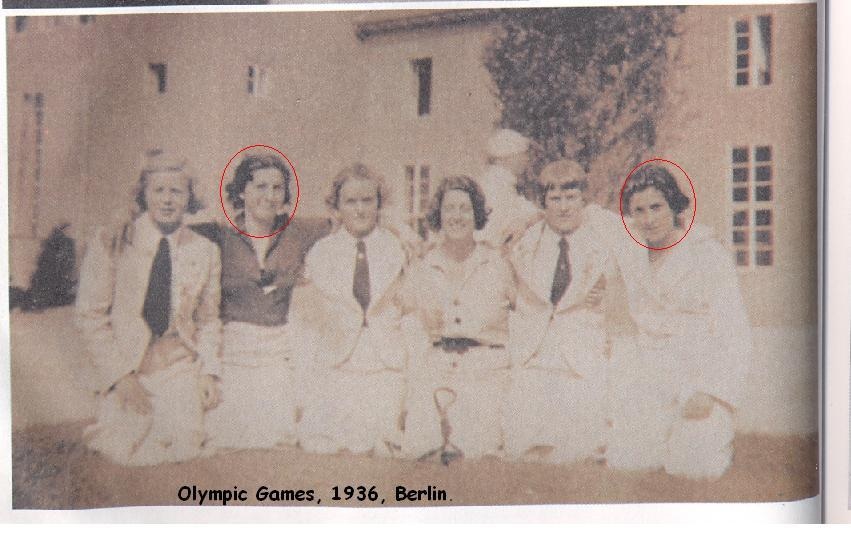
Two female participants of Olympics from Turkey with other fencers, 1936. Image courtesy Sertac Sehlikoglu
We can group Muslim sportswomen into three based on their participation in international games. The first group of women is composed of those who are not following the Islamic dress code, some of whom do not believe that such dress code (ie, headscarf) is Islamic. Historically, this group has been involved in international games for much longer than the other two, since modernists in many Muslim societies viewed sports as a means of breaking women’s segregation and including them in public life in the early 20th century. The first Muslim women attended the 1936 Berlin Olympics: Suat Aşeni and Halet Çambel represented Turkey in fencing, 36 years after first women were allowed to compete in the Olympic Games. Turkey, as a country which accepts international dress regulations for different branches of sports, does not have any problem in sending its successful sportswomen to the Olympic Games, as long as the sportswomen follow the international dress codes in sports.
The second group of Muslim women is composed of those who believe in modesty and prefer observing Islam in terms of the dress code as well. These women often face other rules, such as those in international games, which forbid their headscarf based on safety and security concerns. Muslim sports activists propose “safe hijabs” to negotiate with security concerns and suggest alternative styles for different branches. FIFA, for instance, was in contact with designers for an approvable headgear to be used in international soccer games when this article was being written.
A third group of Muslim women however, are not allowed to participate in sports, not because of their religious choices or international game regulations, but because of the regulations of their own country. Iranian sportswomen are an example to this, since the branches of sports Iranian women are allowed to participate are limited: Lida Fariman, Manije Kazemi (archery), Marjan Kalhor (skiing), and Sara Khoshjamal Fekri (taekwondo) are four examples, who have represented Iran in the Olympic games in earlier years within clothes regulated by their country. In these Iranian cases, the dress codes of the sport are in line with Iran’s national dress code for modesty to be preserved. Similarly, and unfortunately, there are countries, such as the Southeast Asian nation of Brunei, Saudi Arabia and Qatar, which have not sent any single woman to the Olympic games until 2012. Such outfit regulations influence female citizens of these countries whether the sportwomen themselves are Muslims or not, since they are bounded with the codes both at national and at international level.
What all these groups of Muslim women seem to be sharing is that their bodies are at the center of heated ideological, political, or religious debates and contestations at national and international platforms; as these women are subjected to different forms of idealized discourses and pressures (of secularist and Islamist patriarchies) on multiple fronts.
The fatwas regarding sports are very explanatory in understanding the “Islamic” attitudes. Although Islamic rules do not necessarily pose an obstacle to the participation of women in sports, they can shape the sporting experience of women as gendered subjects. All of the fatwas on Islamic web sites concerning physical exercise begin with the importance of sports for health and encourage individuals to be physically active with reference to hadiths, with minor warnings on violence, fanaticism, or hooliganism. When it comes to women’s involvement in sports, the fatwas start using a more regulative language in details. Almost all of the suggested regulations and rules about women’s involvement in sports are related to gender segregation, and, more importantly, bodily exposure. Fatwas specify several rules that must be followed:  First, men and women must be segregated, since mixed environments may open channels for seduction, temptation and corruption. Fatwas reject any physical exercise that stir sexual urge or encourage moral perversion such as women practicing dancing and being watched by the public since each one of the these acts are coded as “sexual(ly appealing).” Indeed, those within Saudi Arabia who oppose the inclusion of women in sports do so because future implications and consequences of women’s involvement in sports might be un-Islamic although there is nothing in Islam that prohibits women from physical activity or even competitive sports.
Most of the time, the most convenient sport for Muslim sportswomen who have concerns about their body movements or Islamic veiling are the branches that do not require too much body movements – the movements which are perceived as ‘sexually appealing’ such as movement of hips (running) and breasts (jumping). The most popular sports for women from predominantly Muslim countries have been athletics, power lifting, fencing, archery, martial arts and table tennis. Such branches are more convenient especially if women are professionals and need to spend hours everyday for training. Women can easily find spaces for training and do not need to seek for special dedicated spaces.

WHAT IS THE BORDER OF VEIL, SEXUALITY AND SPORTS?

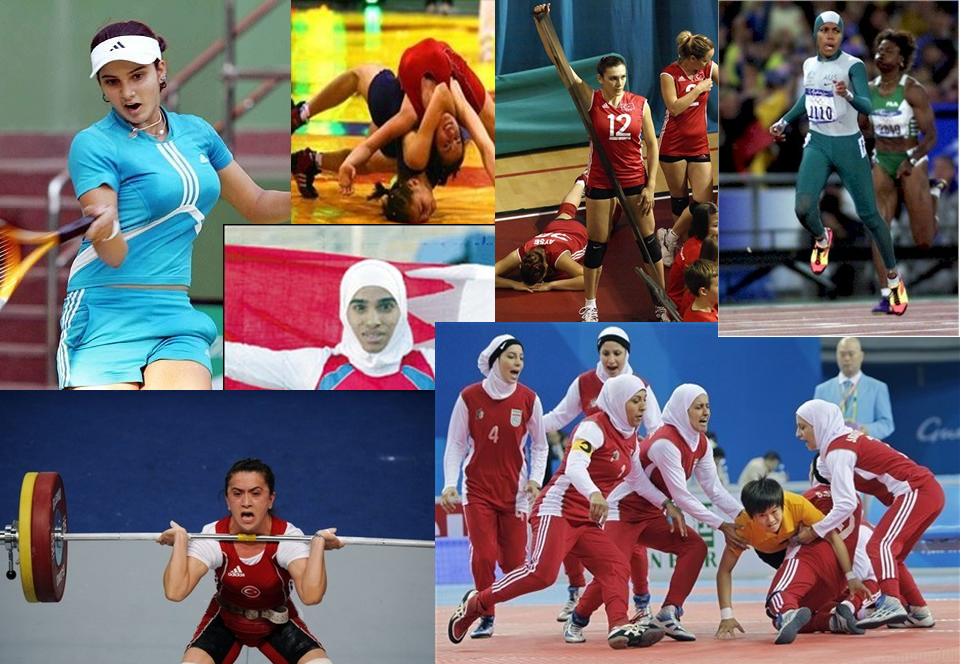
Set of photos shown to informants and asked what they think. Image courtesy Sertac Sehlikoglu
The Islamic veiling, whether in the format of a simple headscarf or in more sophisticated outfits, does have a spiritual value for Muslim women as they cover their bodies during prayer. Such a value is too important to underestimate. Yet, the borders of a veiled body also stay on the edge of the gender binary of modern Islamic heterosexual norms. As apparent in the fatwas, less veiled body of a Muslim woman arouses hyper-femininity yet reflects homoerotic boundaries of women in Islamic cultures. However, the body of a Muslim sportswoman is troubling not only because it is sexually arousing as a female body, but also because it trespasses into the masculine zone.
During my field research on women-only gyms in Istanbul, I interviewed 40 women on their involvement in physical exercise and how their involvement is shaped or constrained by people closest to them at home or at work. These women prefer such homosocial spaces simply because they do not feel “comfortable”, as they put it, when they can be seen by men. I showed my informants, who were sporty but not involved in any professional sports, photos of various Muslim sportswomen taken during international games. They were all familiar with physical exercise and accepted Islamic gender norms at one level, therefore preferred homosocial spaces to exercise. The photos women were shown included Sania Mirza (Indian tennis player, non-veiled), Roqaya Al-Gassra (Bahraini Athlete, veiled), female wrestlers, volleyball players, and weightlifters. Amongst all, Al-Gassra aroused the most mixed feelings amongst women. Women did not feel comfortable about Al-Gassra’s look since she “looked like a guy” and she was revealing her body although she was covering her head. On the other hand, most of my veiled informants were proud to see a ‘veiled’ (not a Muslim but veiled) woman in international games but they still found it unnecessary. The Olympics and international games therefore, raise the debate on the ways in which a woman’s body is exposed to international audiences which is linked to complex feelings on national pride (and how this sense of pride and nation is perceived), women’s public sexuality, modesty and Islamic pride (which also takes gendered forms).  Indeed, Al-Gassra, as a professional veiled athlete, was becoming part of such Islamic pride and become target of criticisms for two reasons: for her low-veiling and tomboy look. Thus, Islamic pride of a woman is expected to be both normative and modest; both of which are violated in the case of Al-Gassra.

8/30/12

Is Islam Compatible With Women's Sports, Fitness and Health?

By Shahnaz Taplin-Chinoy
As the Olympian winners savor their gold, silver and bronze medals and the London party winds down, I think much of the world is still perplexed by the intersection between Islam, women and sports.
The global Muslim mosaic is multi-lingual, multi-cultural and multi-ethnic -- as are the women. In Bishkek, I met a vodka-drinking Krgyz woman with a doctoral degree. She defies the traditional stereotype of Muslim women -- and yet she views herself as a solid, observant, liberal Muslim who said to me: "I am every bit as Muslim as any other Muslim." She is a stark contrast to Saudi, Yemeni and Nigerian women controlled by the strict tenets of sharia.
Nine Muslim women contestants won medals in the London Olympics. They represented the world's Islamic spectrum. Their faith dictated their norms of dress, including the hijab which the Olympic committee compromised on for Wojdan Ali Seraj Abdulrahim Shahrkhani from Saudi Arabia who competed in Judo.
Modesty, no doubt, is a vital tenet for conservative Muslim women -- many of whom do not want to negotiate the hijab, moderating their modesty, even as they participate in the Olympic Games. On the other hand, for Americans, modesty is of no import in the sports arena, where performance trumps all.
For me, the bottom line issue about sports for Muslim girls and women is how it impacts their fitness, health and well being. In strict sharia-driven societies, Muslim women are often deprived of exercise. A Human Rights Watch report, "Steps of the Devil: Denial of Women and Girls Rights to Sport in Saudi Arabia," highlights, "Gender discrimination in Saudi Arabia is institutional and entrenched. Millions of girls are banned from playing sports in schools and women are prohibited from playing team sports and denied access to sports facilities, including gyms and swimming pools."
The big question is where does this conservatism come from? Are these views propagated by the Islamic faith or culture? The words and actions of Prophet Mohammed would suggest that these restrictive views on women's sports are inconsistent with the faith.
But not all countries we think of as being religiously dominated are in the anti-girls sports camp. In an article entitled, "Islam and Women's Sports," Gertrud Pfister explains Iran, where Muslim feminists claim that neither the Quran nor Muhammad's sayings prescribe women's exclusion from public life. Iranians support physical activity and good health for both sexes.
In fact, Iran has the distinction of being an enlightened forerunner in supporting women's sports as championed by Fa'ezeh Hashemi, daughter of President Rafsanjani. Almost 20 years ago, Hashemi initiated the first Women's Games in Iran (in 1993); and once again in 2005 when 1,700 athletes from 40 countries competed and 10,000 people attended -- while Saudi Arabia brings up the rear -- permitting women to participate this year in the 2012 Olympics.
When local culture wins, women mostly lose: Muslim women athletes are caught in the cross fire between faith and culture. If the latter is dominated by patriarchy, misogyny and tribal customs, the religious support for sports and good health is simply ignored. Muslim sociologists fight back by referencing Islamic sources in concluding sports for health should be mandated for women. The struggle is increasingly more between progressive sports loving Muslim women like Lina al-Maeena, founder of the Jeddah United basketball league, being pitted against regressive female sexuality/chastity advocates. These concerns are also tied closely to family honor which could be challenging as Muslim women forge new frontiers for themselves.
But what is the genuine Islamic tradition? What did the Prophet say about women and sports?
Ahmed Shihab Eldin, in "Saudi Arabia's Olympic Paradox: Insulting Women, Islam and "Prostitutes"on HuffPost, quotes a Saudi female friend questioning Saudi Arabia's interpretation of the faith: "To me it is a contradiction to Islam itself. The prophet said teach your children 3 things, archery, swimming and riding horse. ... Archery for being self-sufficient and getting food, riding horses for mobility and swimming for sport." The friend goes one step further and she says, "today's modern world equivalent -- getting a job, driving cars and sports in general -- are still restricted for millions of women."
This violation of religious tradition has serious consequences. It impacts women's ability to exercise, to compete in sports and most egregious of all is its detrimental impact on their health. Obesity of >25kg among 20+ years, is very high in Saudi Arabia: for men it is 70.2 percent and for women it is 73.2 percent -- but before we get too high handed, here is the comparative data set for American men 72.5 percent and for American women 66.3 percent (according to the WHO Global Status 2010 report). Better now than later for both nations to address this health hazard for both sexes.
Just to remind ourselves of Islam's origins and positions, I would like to revisit a story about Prophet Muhammad and his wife Aisha, a significant religious scholar. Aisha who loved games and sports says: "I raced with the Prophet and I beat him. Later when I had put on some weight, we raced again and he won. Then he said this cancels that (referring to the previous race)."
And finally, when in doubt, Muslims can again revert to the Prophet who is reported to have said: "And your body also has a right over you." This is the Islam of my youth. It is the Islam of sense, sensibility and spirituality -- a faith of moderation, a way of life which also believes in the oneness of humanity.
This blog is inspired by Khadijah, Prophet Muhammad's first wife. Khadijah is the quintessential role model for Muslim women. She was the first convert to Islam, the first Muslim woman entrepreneur, a globalist and a feminist